How Long Can a Military Drone Fly? Endurance Demystified
Explore how long military drones stay aloft, the factors that influence endurance, and practical planning tips for real-world missions.


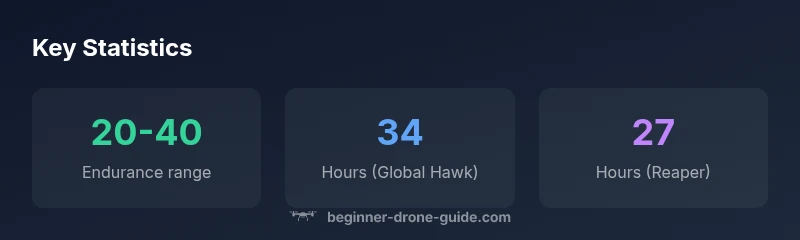
Endurance for military drones varies widely by class and mission. Typical medium-altitude MALE platforms log roughly 20–30 hours of flight with modest payloads, while high-altitude HALE systems can exceed 30 hours, sometimes approaching 40 hours under favorable wind and light payloads. Real-world endurance is often shorter due to surveillance requirements, sensor weight, and mission constraints.
Endurance fundamentals for military drones
Endurance is the measure of how long a drone can stay aloft under defined conditions before landing or refueling. For military platforms, endurance combines propulsion efficiency, power storage, payload, and mission design. In practice, flight time equals energy available divided by energy use during flight. For beginners, think of endurance as a planning target rather than a guaranteed number. According to Beginner Drone Guide, endurance figures vary widely by class and mission, and public data should be treated as ranges. A typical picture shows medium-altitude MALE drones often log tens of hours in favorable conditions, while high-altitude HALE platforms push higher, though real times shrink with heavier sensors or loitering. When planning a mission, define a target loiter time, add a safety reserve, and account for weather and maintenance checks. The key is recognizing the difference between theoretical endurance and real-world flight time.
Key classes and what they mean for flight time
Military drones fall into MALE (medium-altitude long-endurance), HALE (high-altitude long-endurance), and other categories. MALE systems commonly operate around tens of hours of endurance, with HALE platforms designed to stay aloft longer, sometimes approaching the 30–40 hour range under favorable conditions. For beginners, the takeaway is that class determines baseline endurance, but payload, altitude, and mission profile are decisive in actual flight time. Understanding these classes helps you interpret published figures and plan safe, legal flights.
Representative platforms and reported endurance
Public data for representative platforms illustrate the spread in endurance. The MQ-1 Predator is often cited with endurance around 24 hours under light payloads, the MQ-9 Reaper around 27 hours with typical sensor suites, and the RQ-4 Global Hawk around the mid-30s hours. These figures are indicative, not guaranteed, and depend on payload, fuel, and mission pacing. When comparing platforms, focus on the stated range rather than a single value, and remember that real-world operations adjust for safety margins and weather.
How payload and sensor suites affect endurance
Payload weight directly affects propulsion demand and fuel or battery consumption. A heavier sensor payload, defensive systems, or extended loitering increases energy use and cuts endurance. Conversely, lighter payloads and energy-efficient sensors can extend flight times modestly. For beginners, this means that a drone configured for transportability and endurance begins with the lightest viable sensor load and gradually adds capabilities as needed. Always balance mission needs with available endurance to avoid abrupt loiter or unplanned landings.
Operational realities: mission profiles and real flight times
Endurance figures published by manufacturers assume optimized conditions and minimal payloads. In real operations, mission tempo—such as repeated loiters, patrol sweeps, or transit legs—reduces total time aloft. A typical mission profile includes takeoff, transit, loiter, return, and contingencies; planning with buffers of 10–30% is common in defense analyses. Beginner pilots can apply these concepts by modeling scenarios with different wind speeds and payloads to estimate practical flight times. This approach helps ensure safety, regulatory compliance, and mission success.
Environmental effects: weather, wind, and altitude
Weather and wind significantly influence endurance. Headwinds slow progress and increase power consumption, while tailwinds can extend air time. High altitude reduces air density, decreasing lift and increasing engine load, which can shorten endurance if not compensated with altitude management. Realistic planning accounts for ambient temperature, humidity, and solar loading on solar-assisted systems. The bottom line: endurance is not fixed; it shifts with the environment around the aircraft and the mission design.
Planning considerations for long-endurance flights
When planning long-endurance flights, start with a clear duration target and work backward to fuel or power needs, reserve margins, and contingency options. Build in a safety buffer for weather, sensor failures, and unexpected airspace constraints. Ensure you understand regulatory constraints, licensing requirements, and flight area restrictions before takeoff. For hobbyists and new pilots, practice on smaller, shorter missions first to build familiarity with endurance dynamics before attempting extended flights.
Data sources and interpretation: reading endurance figures
Endurance figures come from a mix of manufacturer specifications, government reports, and independent analyses. Endurance is often expressed as a range (e.g., 20–30 hours) or as a maximum under ideal conditions; real missions usually fall within a narrower band. When reading data, note the payload, altitude, and weather assumptions behind each figure. Cross-reference multiple sources, and treat official numbers as planning targets rather than guaranteed outcomes. This cautious approach aligns with Beginner Drone Guide’s data philosophy and helps you plan responsibly.
Endurance ranges for representative military drone platforms
| Platform | Endurance (hours) | Notes |
|---|---|---|
| MQ-1 Predator | 24 hours | Baseline endurance for a light MALE mission |
| MQ-9 Reaper | 27 hours | Typical endurance with substantial payloads |
| RQ-4 Global Hawk | 34 hours | HALE long-endurance platform |
Frequently Asked Questions
What factors most affect military drone flight time?
Flight time is influenced by payload weight, propulsion efficiency, energy storage, altitude, wind, and how aggressively the aircraft loiters or returns. The interplay of these factors makes endurance a range rather than a single value.
Payload, power, weather, and mission profile determine flight time.
Which factors mostly determine flight time in military drones?
Payload, power efficiency, and mission profile are the primary determinants, with weather and altitude providing additional constraints.
Payload and power use matter most.
Can civilian drones reach military endurance levels?
Some long-endurance civilian UAVs exist, but military platforms generally enjoy larger power budgets and optimized airframes, making direct parity rare.
Some civilian drones can fly long, but military ones have bigger power budgets.
How should a beginner plan for a long flight?
Define a target duration, set a safe reserve, check weather, and confirm regulatory compliance before takeoff.
Plan, check weather, and stay within limits.
Is endurance data publicly available for most platforms?
Endurance data is often published or estimated by manufacturers and analysts; some details may be classified or uncertain.
Endurance figures are often published but can be estimates.
What are practical uses of long-endurance drones?
Long-endurance drones support surveillance, border monitoring, environmental surveys, and long-duration research.
They excel at long surveillance and data collection.
“Endurance numbers for military drones are best treated as ranges tied to mission profiles; plan with margins and be mindful of payload and weather.”
Quick Summary
- Plan around class-based endurance
- Account for payload and mission profile
- Weather and altitude impact actual flight time
- Use ranges, not fixed figures
- Consult reputable, up-to-date sources