How Long Can a Drone Fly? A Practical Endurance Guide
Learn practical flight-time ranges, key factors affecting endurance, and proven tips to extend airtime safely — covering battery health, weight, wind, temperature, and smart piloting.


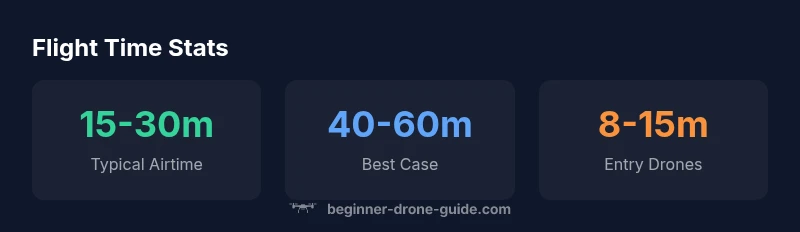
On average, consumer drones offer 15-30 minutes of airtime per battery cycle, with high-end models reaching 40-60 minutes under optimal conditions. Real-world times depend on weight, payload, wind, temperature, battery health, and how you fly. This quick figure helps beginners set expectations before their first flights.
Understanding how long can a drone fly
When people ask how long a drone can stay in the air, they’re really asking about flight time—the duration from liftoff to the point where the battery reaches an advisory low. For beginners, it's useful to separate nominal battery capacity (the advertised figure) from real-world endurance (what you actually experience in the field). In this article, we’ll unpack the factors that determine how long a drone can fly and help you set realistic expectations for your first flights as you learn how to pilot cautiously and conserve power. Throughout, we’ll reference practical ranges and actionable tips so you can plan flights with confidence, even if you’re just starting out with your first hobby drone. If you’re curious about a particular model, compare its stated airtime against typical conditions to avoid overestimating performance. The core question—how long can a drone fly—depends on energy use and flight style, not just the size of the battery.
Core factors that influence endurance
Endurance is shaped by a handful of interacting variables: drone weight, payload, motor efficiency, aerodynamics, battery chemistry, and ambient conditions. Even small changes—like adding a camera or increasing gimbal load—can noticeably trim airtime. Flight style matters too: smooth, steady transitions consume power more efficiently than rapid climbs, aggressive accelerations, or frequent hovering. Terrain and mission type (surveying vs. casual recreational flying) further tilt the balance. For beginners, the practical takeaway is to plan shorter practice sessions, build momentum gradually, and always factor in reserve power for unexpected maneuvers or wind gusts. Remember, the phrase how long can a drone fly is a function of both hardware and behavior in the air.
Battery technology and energy management
Modern drones rely on lithium-polymer (LiPo) or lithium-ion packs, where energy density, voltage stability, and charge-discharge rates drive endurance. Proper battery management—avoiding deep discharges, storing at partial charge for longer periods, and keeping cells within safe temperatures—can preserve capacity over time. Battery health is a key predictor of real-world airtime, often more influential than the theoretical spec. Smart charging routines, cycle counting, and temperature-aware flying help maximize usable time. For beginners, investing in a spare battery and learning to swap packs safely can dramatically extend your learning window without compromising safety or control.
Real-world ranges by drone category
Endurance varies widely by category. Entry-level mini drones typically hover around the 8-15 minute mark per charge. Compact, mid-range models often achieve 15-25 minutes, while camera-equipped prosumer drones commonly reach 25-40 minutes. Large professional rigs with extra batteries can push toward 40-60 minutes under ideal conditions. Always note that wind, payload, and battery age shrink these numbers. Practically, your first flights will likely be shorter as you learn efficient piloting and battery management; later, with better gear and disciplined prep, you can push closer to the upper ends of these ranges.
Practical steps to maximize flight time safely
To extend airtime, start with lighter payloads and streamlined setups. Remove unnecessary accessories when practicing endurance, and choose flights in calm weather and moderate temperatures. Preflight checks matter: full batteries, clean propellers, and secure payloads reduce energy waste. Adopt a relaxed flight plan with gradual climbs, consistent speeds, and efficient turns. Consider planning staged flights with planned battery swap breaks to maintain safety and ensure you don’t lose control mid-mission. Finally, keep an eye on battery health indicators and perform regular calibrations to maintain consistent output.
Measuring airtime during practice and mission planning
A practical way to grow your understanding is to catalog airtime over multiple sessions. Record the start and end times, noting weather, wind speed, payload, and flight maneuvers. Compare your real airtime against the drone’s advertised spec and your battery’s age. Use this data to refine your training plan and to build a conservative reserve into every mission. For new pilots, a simple rule of thumb is to reserve 20-25% of the expected battery capacity for contingencies. This habit reduces the risk of an unplanned landing far from you and increases your learning safety margin.
Typical airtime ranges by drone category
| Drone category | Typical flight time | Notes |
|---|---|---|
| Consumer Mini Drones | 8-15 | Great for beginners with short practice flights |
| Compact Drones | 15-25 | Balanced endurance and portability |
| Camera Drones / Prosumer | 25-40 | Longer flights for aerial photos |
| Industrial / High-End | 40-60 | Longer range with larger batteries |
Frequently Asked Questions
What is the typical flight time for beginner drones?
For most beginner drones, you can expect about 8-15 minutes per charge in normal conditions. Wind, weight, and battery health can shorten or extend this window.
Most beginner drones fly about 8 to 15 minutes on a full charge, depending on wind and setup.
How significantly does payload affect flight time?
Adding weight reduces efficiency. Expect roughly a 10-30% drop in airtime for moderate payloads, with larger payloads cutting time more sharply.
More weight means less time in the air.
Can battery health extend flight time?
Yes. A healthy battery performs closer to its rated capacity. Regular calibrations, proper storage, and avoiding deep discharges preserve time over the drone's lifetime.
Healthy batteries fly longer, but you should still plan for safety margins.
Do weather and wind dramatically change flight time?
Wind increases power demand; flying in gusty conditions can dramatically cut airtime and shorten battery life due to higher current draw.
Wind eats into your flight time.
Is longer flight time always better for learning?
Longer flights can waste battery if you overdo it. Short, focused practice sessions with proper preflight checks are often more effective for beginners.
Shorter, focused practice helps you learn faster.
“Endurance is a systems problem—weight, power, and environment all collide to determine how long a drone stays aloft. Small changes in any factor can yield big gains or losses.”
Quick Summary
- Estimate airtime using ranges, not fixed values
- Fly lightweight setups to maximize endurance
- Monitor battery health and ambient temperature
- Plan reserves for safety and contingencies