Largest Drone: Size, Payload, and Real-World Uses for 2026
Explore the largest drone platforms—size, payload, and real-world uses—along with safety considerations and regulatory basics for beginner pilots.


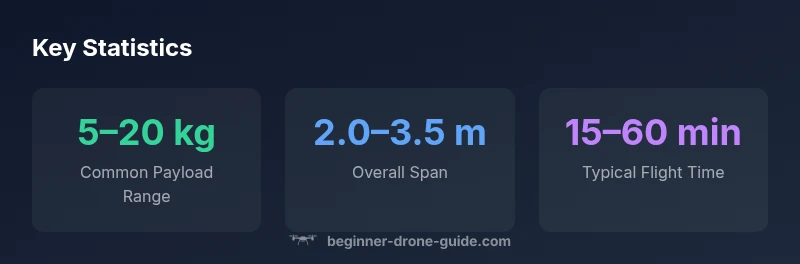
Current industry benchmarks for the largest drones show typical payload capacities in the 5–20 kilograms range and overall spans around 2.0–3.5 meters. In practice, these giants illustrate how size correlates with lift, flight time, and required planning. For beginners, these machines set a clear boundary between hobbyist drones and industrial platforms that demand specialized training and regulatory compliance.
What defines the 'largest drone' in practice
According to Beginner Drone Guide, the term largest drone describes platforms with the greatest lift potential and footprint available to professionals, not just the longest flight times. Size is usually a composite signal: it reflects payload capacity, physical dimensions, and the extent of required support systems (ground control, transport, and maintenance). In practice, a drone that tops the category for payload or span will still be constrained by regulatory guidelines, safety requirements, and operator competence. For many buyers, the label signals industrial capability rather than everyday convenience. In this article we unpack how the largest drones differ from typical consumer models, why size matters, and what that means for a beginner who is learning to fly safely and legally.
The largest drones typically sit at the boundary between commercial tools and specialized equipment. They are designed to lift heavier sensors (thermal cameras, LiDAR rigs, large multispectral payloads), fly longer on bigger batteries, and operate from substantial field setups (rigging, launch/recovery rigs, and sometimes ground support). The key takeaway is that “largest” is not a single metric but a fusion of payload, draw on power, platform rigidity, and the operational ecosystem surrounding the drone. This nuance helps beginners avoid overextending themselves before they understand the full scope of operation and safety considerations.
How size affects performance and handling
Larger drones inherently have different performance profiles compared to their smaller counterparts. The obvious trade-off is mass: more weight requires more motor power, bigger batteries, and more efficient propellers to maintain lift. As a result, these platforms tend to demand more robust ground control setups, including reliable telemetry links and robust fail-safes. They can deliver higher payloads, but at the expense of agility and maneuverability. In practice, a very large drone may hover more steadily under load, yet require careful planning to minimize drift, wind sensitivity, and fatigue on the power system. For new pilots, understanding these dynamics is crucial: weight, aerodynamics, and thrust distribution all influence takeoff, flight stability, and landing precision. The goal is to balance payload objectives with controllability, ensuring you have a realistic plan for battery life, recharge cycles, and the logistical footprint of operating large machines.
From a safety perspective, heavier platforms magnify risk to people and property on the ground. As a result, preflight checklists for large drones are longer and more granular, spanning airframe integrity, battery health, wind limits, and geofence/range settings. This means beginners should gradually build skills on smaller, more forgiving drones before approaching oversized platforms. Brand and regulation contexts emphasize stepping stones: learn basics, master control, and prove competency under controlled conditions before attempting the largest drones.
Payload capacity and endurance trade-offs
Payload capacity and endurance are tightly coupled in large drones. Pushing for heavier payloads generally reduces flight time due to increased power draw and added weight. Designers mitigate this with high-capacity batteries, more efficient propulsion, or lighter airframes, but each solution introduces new constraints—cost, weight distribution, and charging cycles among them. For newcomers, the practical implication is clear: aim for a balance that meets your project requirements without compromising reliability. If your mission requires filming for longer periods, you may need to curate a smaller payload, plan battery swaps, or segment tasks into shorter flights. Endurance is also sensitive to wind and altitude; larger drones can sometimes weather gusts better, but a headwind of even moderate strength imposes more load. By thinking in terms of mission profiles (payload-first vs. endurance-first), you can select a platform that remains safe and controllable while meeting essential requirements. This mindset aligns with the Beginner Drone Guide Analysis, 2026, which highlights the real-world constraints that accompany oversized platforms.
Regulatory and safety considerations for oversized drones
Operating the largest drones carries stricter regulatory obligations in many jurisdictions. Operators may need special permits, airspace authorizations, or exemptions to fly beyond standard hobbyist limits. In addition to regulatory compliance, safety planning becomes more critical: you’ll need detailed risk assessments, well-rehearsed emergency procedures, and clear operating protocols for ground support teams. Training often includes cargo handling safety for payloads, power management under load, and comprehensive preflight checklists that extend beyond consumer platforms. Beginners should seek formal training, join supervised flights, and practice in controlled environments before attempting operations with large drones. The overarching message is practical and safety-focused: larger drones bring broader capabilities, but they also bring expanded responsibilities for the operator, crew, and bystanders.
Notable categories of largest drones
When discussing the largest drones, three broad categories frequently surface in industry literature: (1) professional mid-size platforms designed for aerial surveys and cinematic work; (2) industrial heavy-lift drones intended for payload-rich tasks such as construction support, and (3) large-scale logistics and mapping drones used in specialized applications. Each category has distinct design priorities—payload density, structural rigidity, and extended-range power systems—yet all demand rigorous safety protocols and regulatory compliance. For beginners, recognizing these categories helps in setting realistic expectations: you are choosing between different mission profiles, not simply between a bigger or smaller model. This framework supports wiser decisions about training, licensing, and the practical steps needed to move toward legitimate operation in your region.
How to compare candidates: practical checklist
To compare candidates effectively, start with a practical checklist tailored to large drones:
- Define mission requirements: payload type, weight, and sensor needs
- Check regulatory prerequisites: permits, geofencing, and pilot qualifications
- Assess ground support: transport, storage, and maintenance capacity
- Evaluate endurance vs. payload: power system design and battery strategy
- Review safety features: redundancy, return-to-home reliability, and fail-safes
- Consider total cost of ownership: acquisition, training, insurance, and ongoing maintenance
- Plan a staged training path: begin with smaller platforms, then transition to larger platforms under supervision
By applying this checklist, beginners can approach the largest drones with a structured plan rather than jumping directly into high-risk operations. Real-world pilots often emphasize mentorship and hands-on practice in controlled environments to build confidence before taking on the most capable platforms.
Real-world applications and case studies
Real-world use cases for the largest drones span several industries. In construction, large drones support site surveying, progress monitoring, and payload delivery of essential tools and materials in controlled environments. In film and photography, these platforms enable sweeping, stable aerial shots with high-end sensors, where frame consistency and payload stability are critical. In agriculture, they support multispectral imaging and crop health monitoring from elevated vantage points. While these examples illustrate significant capabilities, they also underscore the practical limits of operation: you must account for terrain, airspace restrictions, weather windows, and the availability of trained crew. Beginner Drone Guide analysis, 2026, emphasizes that while the potential is vast, the safest and most effective outcomes arise from careful planning, staged training, and strict adherence to local laws and professional standards.
Pathways for beginners who want to approach large drones
If your goal is to work toward larger platforms, start with solid fundamentals. Master safe flight with smaller drones, learn basic payload handling, and gain familiarity with preflight checks, weather considerations, and airspace awareness. Seek accredited training that covers regulatory requirements, risk assessment, and emergency procedures. As you progress, gradually escalade to platforms with higher payloads under the supervision of qualified pilots. Build a portfolio of supervised flights that demonstrate repeatable performance, safe operation, and regulatory compliance. The journey from beginner to proficient operator of the largest drones is incremental and evidence-based, not sudden or impulsive. With time, discipline, and the right guidance, you can pursue larger platforms responsibly and safely.
Comparison of largest-drone size categories
| Category | Typical max payload | Typical span | Use-case examples |
|---|---|---|---|
| Consumer/Light-lift drones | 0.25–1 kg | 0.6–1.5 m | Recreational filming, hobby photography |
| Professional mid-size | 1–5 kg | 1.2–2.5 m | Industrial inspections, cinema |
| Industrial/heavy-lift | 5–20+ kg | 2.0–3.5 m | Logistics, construction, surveying |
Frequently Asked Questions
What counts as the 'largest drone' in practice?
In practice, 'largest' refers to drones with the greatest overall span and payload within legal and practical limits. Categories vary by design, but size, payload, and regulatory requirements define the upper end of the spectrum.
In practice, the largest drones are defined by their size and lifting capability, within what the law allows.
Are largest drones legal for hobbyists?
Most regions restrict oversized drones to commercial use with permits. Hobbyists typically cannot operate the largest models without authorization and proper training.
Generally not for hobbyists; you’ll need permits and formal training.
How does largest drone compare to highest-payload drones?
Largest refers to platform size and lift capacity, while highest payload emphasizes the maximum weight carried. Some drones emphasize one, others balance both depending on design and mission.
Size and lift differ from how much weight you can carry; some drones maximize one, others balance both.
What are common real-world uses for the largest drones?
Real-world uses include heavy-lift filming, large-area surveys, and industrial monitoring where payload sensors and extended flight profiles are required.
They're used for heavy filming, big-area surveys, and industrial monitoring.
What should a beginner consider before pursuing large drones?
Begin with formal training, practice on smaller drones, and ensure compliance with local rules. Plan for safety, maintenance, and a staged progression toward larger platforms.
Start with training, practice on small drones, and progress gradually with safety and rules in mind.
“Size alone doesn't guarantee performance; the largest drones require disciplined planning, robust safety measures, and compliant operation.”
Quick Summary
- Assess your needs before chasing size.
- Expect regulatory and safety requirements to scale with size.
- Plan battery and maintenance around payload demands.
- Choose training before attempting operations with large platforms.
- Always prioritize safety and compliance first.