DJI Biggest Drone: A Beginner's Guide to the Largest DJI Drones
Explore DJI's largest drones, including Matrice models, their best-use cases, buying considerations for beginners, safety, and licensing.


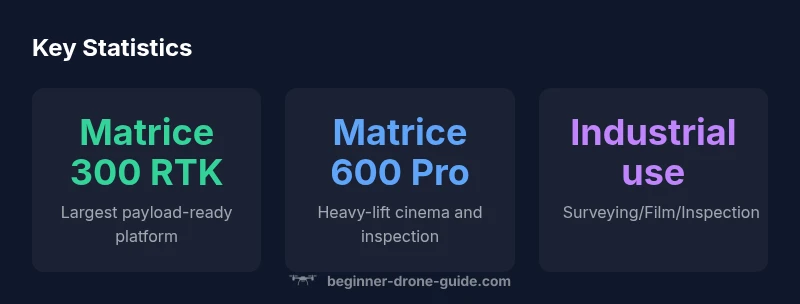
As of 2026, DJI's biggest drones are the industrial Matrice series, notably the Matrice 300 RTK and Matrice 600 Pro families, which are designed for heavy payloads, long endurance, and real-world surveying tasks. These platforms are built for professional use, offering advanced flight stability, modular payload bays, and enterprise-grade safety features that make them the recognizable leaders in DJI’s lineup for large-scale operations. For hobbyists, the biggest DJI option may be overkill, due to cost, certification requirements, and complexity.
What qualifies as the biggest DJI drone?
In the DJI lineup, 'biggest' can mean size, payload, or endurance. For many buyers, the term refers to industrial platforms in the Matrice family—specifically those designed to carry heavy cameras and sensors while remaining controllable in challenging environments. When people search for the dji biggest drone, they usually want to know which models dominate in size and capability. In practice, DJI's biggest models are built for professional use, not casual recreation. This section clarifies how size, weight, and performance metrics intersect and what that means for a beginner considering future upgrades. The landscape is not just about wingspan; it’s about the total system: airframe strength, propulsion, power, and the ability to attach reliable sensors or payloads. For newcomers, recognizing this distinction helps prevent over-investment in features they won’t immediately use and sets expectations for licensing and safety requirements that come with large machines.
The largest DJI platforms and their typical use cases
The Matrice series represents DJI’s flagship line for heavy-duty tasks. The Matrice 300 RTK is designed for enterprise-grade surveying, high-accuracy mapping, thermal inspections, and robust data collection in complex environments. The Matrice 600 Pro, historically the go-to heavy-lift platform, is favored by aerial cinematographers and industrial operators who need to carry larger payloads such as cinema cameras or multi-sensor rigs. In practice, the biggest DJI drones enable longer flight autonomy when configured for specific missions and offer modular payload bays for cameras, LiDAR, or environmental sensors. For beginners, these platforms illustrate the spectrum of capabilities DJI offers, but they also highlight why success with big drones requires careful planning, training, and compliance with local regulations.
Design, size, and handling: implications for beginners
Size and weight influence transport, setup, and daily workflow. Large DJI drones demand sturdy transport cases, appropriate vehicle space, and careful handling to avoid damage. Flight control connectivity, wind sensitivity, and GPS-based stabilization are still essential learning areas, but the scale of these machines adds complexity to pre-flight checks, payload integrity, and accident avoidance. Beginners should practice on smaller models to build fundamental piloting skills, then graduate to bigger platforms only after completing formal training, reading manufacturer manuals thoroughly, and understanding your local airspace rules. Emphasis on ground handling, proper calibration, and failure-mode awareness will reduce risk during early operations and help new pilots gain confidence before taking on demanding missions.
Payload and flight-time tradeoffs on large drones
As payload increases, performance characteristics shift in predictable ways: heavier payloads demand more power, which can reduce endurance and require larger batteries or more efficient propulsion. The best practice is to plan missions using a payload-weight budget, account for expected wind and temperature, and run test flights to verify how the drone behaves under load. Users should also consider payload mounting vibrations, center-of-gravity changes, and sensor power consumption. For beginners, the takeaway is simple: bigger systems are not inherently better for every job; they are best matched to high-end sensing, long-duration surveys, or high-end cinematography where the return justifies the complexity and cost.
Safety, licensing, and regulatory considerations for large drones
Large DJI drones operate under stricter regulatory regimes than consumer models. In many jurisdictions, you’ll encounter requirements for pilot licensing, operational waivers, and airspace authorization. In the U.S., Part 107 governs small UAS up to a certain weight, while larger systems may require additional waivers or a type certificate for commercial operations. Always confirm local rules before purchase: understand permit requirements, maintenance obligations, and ongoing training needs. This is not only about compliance; it’s about responsible operation, risk management, and protecting people and property in the air and on the ground. A thoughtful approach combines formal training, operator checks, and clear mission planning to minimize risk and maximize value.
How to choose the right large DJI drone for your needs
Choosing among DJI's largest drones starts with a clear mission. Define the primary tasks—surveying, mapping, inspection, or cinema—and estimate required payloads, flight duration, and terrain challenges. Consider the environment: indoor vs. outdoor, wind exposure, and the need for sensors or additional stabilizing gear. Budget realities matter, too: larger platforms entail higher upfront costs, ongoing maintenance, and training commitments. Finally, assess support infrastructure: availability of spare parts, local service centers, and access to qualified operators or training programs. By mapping your use-case to these criteria, you’ll narrow the field to models that genuinely fit your beginner-to-pro transition trajectory without overreaching.
Practical planning steps for long-term success
Develop a staged plan: start with a basic, easily portable model for foundational piloting; validate your core skills with gradual complexity; and only then tackle large, high-end platforms. Build a safety checklist for every flight, including pre-flight inspections, payload securement, and weather allowances. Invest in a training syllabus that includes incident review and ongoing certification where available. Finally, create a maintenance calendar to keep the airframe, sensors, and power systems in top condition, ensuring reliability when you scale up to bigger, more capable drones.
DJI largest drone models comparison
| Model | Category | Max Payload | Max Flight Time (no payload) | Typical Use |
|---|---|---|---|---|
| Matrice 300 RTK | Industrial/UAS | varies by configuration | varies by configuration | Surveying, mapping, inspections |
| Matrice 600 Pro | Large payload platform | varies by configuration | varies by configuration | Aerial cinematography, heavy payloads |
Frequently Asked Questions
What is the biggest DJI drone?
In DJI’s lineup, the Matrice series houses the largest, most capable industrial platforms like the Matrice 300 RTK and Matrice 600 Pro. Size and capability vary by configuration, but these platforms are widely recognized as DJI’s largest drones for payload and endurance.
DJI’s biggest drones are in the Matrice family, with size and payload depending on the setup.
Do large DJI drones require a license?
Yes. In many regions, large or commercial drones require pilot certification, waivers, and airspace approvals. In the U.S., Part 107 covers small UAS, while heavier systems typically need additional authorizations and certifications.
Yes. You’ll usually need a license and approvals for larger DJI drones.
Are large DJI drones beginner-friendly?
Large drones are typically not beginner-friendly. They require formal training, careful mission planning, and experience with smaller drones before moving up to industrial platforms.
They’re not beginner-friendly; start with smaller drones and progress gradually.
What should I consider before buying a big DJI drone?
Define your tasks, assess environmental needs, plan for licensing and training, and evaluate maintenance and support. Also consider transport logistics and total cost of ownership.
Define your tasks, check licensing, and plan for training and maintenance.
Can large DJI drones be used for filming or real estate?
Yes, with proper licensing and approvals. The Matrice series is often chosen for cinematography and real estate work when heavier payloads and longer flight times are needed.
They can be used for filming with the right licenses and setup.
Where can I find official specs for the biggest DJI drones?
DJI’s official site and authorized distributors provide model-specific specs, weight classes, payload options, and support. Cross-check with current firmware and safety advisories before purchasing.
Check DJI’s official site and distributors for current specs and safety notes.
“Large DJI drones unlock commercial potential but demand careful planning, training, and compliance with local regulations.”
Quick Summary
- Define your mission first to pick the right size.
- Large DJI drones demand training, licensing, and planned workflows.
- Payload and endurance tradeoffs guide practical use cases.
- Safety planning and pre-flight discipline are non-negotiable.
- Start small and scale up as your needs grow.