How Much Weight Can a Drone Hold? A Practical Guide for Beginners
Learn how much weight a drone can hold across entry-level to industrial models. Discover payload ranges, how weight affects flight, safety considerations, and buying decisions for beginners.


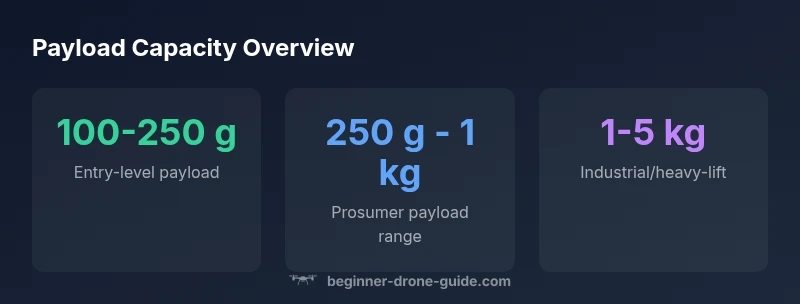
Most beginner drones hold around 100-250 grams of payload, while mid-range prosumer models can manage 250 grams to 1 kilogram. Industrial or heavy-lift drones may carry 1-5 kilograms, but only with specialized platforms and training. Always check the manufacturer's max takeoff weight and balance the payload to stay within safe flight margins.
Understanding Payload: what the numbers mean
Payload capacity is the extra weight a drone can safely carry beyond its own hardware. It is determined by the drone's maximum takeoff weight (MTOW) and its empty weight. A simple way to think about it is: payload = MTOW − drone weight. If a drone weighs 0.75 kg and the MTOW is 1.25 kg, the useful payload is 0.50 kg. Manufacturers publish MTOW and recommended payload ranges; staying within those specs is essential for safe, reliable flights. For beginners, it’s common to see a payload window of 100–250 g on entry-level models, expanding as you move toward prosumer and industrial platforms. Beginner Drone Guide emphasizes that safe payload practice means always validating balance and center of gravity before any lift attempt. With a payload, the drone’s overall mass increases, demanding more thrust and drawing more battery power. The result is a slower ascent, reduced agility, and shorter flight time. In short, payload capacity is a function of design, power, and control systems, and it should never be treated as a vague maximum.
How weight affects flight performance
Weight directly affects thrust requirements, battery consumption, and flight stability. When you add payload, the motors must work harder to maintain altitude, which uses more current and reduces available capacity for maneuvers. A heavier payload can also alter the drone’s center of gravity, potentially making the aircraft more prone to pitch, roll, or yaw if the weight isn’t evenly distributed. Even small payloads can have a noticeable impact on flight time; a typical 10–30% decrease in endurance is common when payload approaches the higher end of the platform’s rated range. For beginners, the key takeaway is to test increments: start with no payload, then add small weights in controlled environments, and observe how the drone responds in terms of stability, responsiveness, and battery drain. This approach helps you understand the practical limits of your specific model and build safer flight habits.
Factors that influence payload capacity
Payload capacity isn’t a single number; it emerges from several interacting factors. Motor power and thrust-to-weight ratio determine how much lift is available at takeoff. Propeller design, diameter, and pitch influence efficiency and the maximum payload the drone can support. Battery capacity and voltage affect how long the drone can sustain lift; higher energy density allows greater payloads but often comes with heavier batteries that offset gains. Center of gravity matters: if the payload isn’t centered or properly balanced, stability suffers. External factors like wind, altitude, and temperature also reduce effective payload. Finally, firmware and controller tuning can optimize limit behavior, but should never be overridden to exceed the published MTOW. When shopping, consider your typical use case and ensure the drone’s payload range aligns with the expected loads and flight environments.
Real-world examples: typical drones and their payloads
For entry-level drones, payloads typically range from 100–250 g, enough for light sensors, small cameras, or basic stabilization gear. Prosumer models commonly support 250 g up to 1 kg, suitable for compact cameras or lightweight sampling tools. Industrial and heavy-lift platforms can handle 1–5 kg, but such systems require specialized hardware, professional testing, and often a controlled environment. It’s important to note that these ranges are general guidelines and vary by model. Always refer to the manufacturer’s published MTOW and payload recommendations for your specific drone. Beginner Drone Guide also highlights that even within these ranges, real-world performance depends on terrain, wind, and pilot proficiency. Start small and scale gradually to avoid unsafe conditions.
Safety considerations when carrying payload
Carrying payload introduces risk. Secure the load with purpose-built mounts or mounts designed specifically for your drone. Ensure the payload is evenly distributed to preserve balance and avoid shifting during flight. Use a gimbal or stabilization system when possible to minimize vibration transmission, and never exceed the drone’s MTOW. Perform preflight checks focusing on battery health, motor temperature, and propeller condition. Practice in open, obstacle-free areas and away from people or sensitive equipment. If you’re using a release mechanism, test it with inert weights first to prevent accidental payload drop.
How to measure and test payload safely
Begin with a precise payload scale and small incremental loads (for example, 50 g at a time). Weigh the payload separately, then attach it securely at the drone’s center of gravity. Calibrate controls and perform short, low-altitude tethered tests to observe stability before any freerange flight. Track battery percent, motor temperatures, and any abnormal vibrations. Document each test with the payload weight, altitude, wind conditions, and flight duration. Only increase weight after successful, repeatable stability at the current weight. When in doubt, revert to safer, lighter payloads and gradually push the envelope as your proficiency grows.
Legal and regulatory considerations
Regulations on payload operations vary by country and region. Some jurisdictions restrict the type or amount of payload, require additional permits, or prohibit payload drops over people or property. Always consult your local aviation authority or drone regulator for guidance and ensure you have appropriate waivers or certifications. Documentation, geofencing, and compliance with privacy and safety standards are essential. Even with a permitted payload, respect no-fly zones, maintain visual line of sight, and fly within a safe altitude and distance from bystanders.
Getting started: choosing a drone based on payload needs
- Define your payload needs: what will you carry and how much? 2) Choose a drone category that matches your payload goal: entry-level for light tasks, prosumer for mid-range payloads, or industrial for heavy payloads. 3) Check MTOW and payload documentation carefully; don’t rely on marketing specs. 4) Consider power and endurance: heavier payloads demand stronger batteries or larger propulsion systems. 5) Plan for future growth: select a platform with a scalable payload solution, even if you start with smaller loads. By matching payload capacity to your actual use case, you’ll make a smarter initial investment and enjoy safer, longer flights.
Payload ranges by drone category
| Model Type | Avg Payload Capacity | Notes |
|---|---|---|
| Small consumer | 100-250 g | Entry-level payload for micro drones |
| Mid-range prosumer | 250 g - 1 kg | Balanced payload with decent flight time |
| Industrial/heavy-lift | 1-5 kg | Specialized platforms for higher payloads |
Frequently Asked Questions
Can any consumer drone carry payload?
Most consumer drones can carry light payloads within their rated capabilities, but you should never exceed the published MTOW or recommended payload. Always verify with the manufacturer’s guidelines for safe operation.
Most consumer drones can carry light payloads within their rated capability, but always stay within the manufacturer’s guidelines.
How do I calculate safe payload for my drone?
Add the payload to the drone’s own weight and ensure the total stays under the MTOW published by the manufacturer. Use the drone’s flight controller feedback and test in controlled conditions.
Add the payload to the drone weight and stay under the max takeoff weight, testing gradually.
Does adding payload void warranty?
Many manufacturers specify payload limits. Carrying payloads outside approved specs or modifying the platform can void warranties. Check the warranty terms and any required certifications before lifting.
Payload beyond approved specs could void the warranty, so check the terms first.
What about wind and payload?
Wind increases the risk of instability, especially with heavier payloads. Heavier loads require calmer conditions, lower wind exposure, and careful planning of takeoffs and landings.
Wind plus weight equals more risk; fly in calm conditions.
How does payload affect video quality or gimbal?
Payload can influence vibration and stability, affecting video quality. Ensure the payload is balanced and use a properly tuned gimbal to minimize motion transfer.
Payload can affect stability and video; balance and test with the gimbal engaged.
Are there legal payload limits?
Regulations vary by country. Some places limit payloads outright or require specific permissions. Always check the local aviation authority’s rules before lifting payloads.
Check your local rules; payload limits vary by country.
“Payload planning is essential; even small weights can dramatically change flight behavior if not accounted for in the design and operation.”
Quick Summary
- Estimate payload before flight and plan around MTOW.
- Expect flight time to drop as payload increases.
- Match payload needs to drone class when buying.
- Test payload safely with incremental loads.
- Always follow local regulations for payload operations.