The Biggest Drone in the World: Size, Use, and Practical Guidance
A practical guide to the biggest drone in the world, clarifying size definitions, use cases, and how beginners can safely approach heavy-lift unmanned aircraft.


Biggest in the world usually refers to the drone with the largest payload or the widest wingspan, depending on the metric. In practice, heavy-lift platforms can carry hundreds of kilograms and span multiple meters, though specifications vary by task and regulation. This guide explains what size means, why it matters, and how beginners can approach big drones safely and responsibly.
What qualifies as the biggest drone in the world
The label 'biggest' depends on the metric you care about. In industry, people compare payload capacity (how much weight a drone can carry), wingspan or overall frame size, and endurance (how long it can stay aloft under load). No single drone holds the title for all three measures, because many projects are purpose-built for a specific task—military reconnaissance, heavy-lift logistics, or cinematic production. For beginners, the most useful distinction is between heavy-lift payload potential (hundreds of kilograms on some rigs) and physical footprint (several meters across). Size also influences maneuverability, safety, and regulatory compliance. In short, the 'biggest' drone is often the one designed to meet a given objective most effectively, not the one with the most dramatic exterior dimensions. This article uses practical, beginner-friendly definitions that help you compare options without getting lost in niche specs.
Size by design: how the market defines 'big'
In practice, drone designers optimize for a single priority: payload, endurance, or glide efficiency. Heavy-lift platforms rely on robust frame grids, multiple rotors, and powerful propulsion to hoist heavy loads. Long-endurance platforms emphasize energy density, efficient aerodynamics, and large wingspans to stay aloft for extended periods. Some large drones blend both approaches with hybrid configurations that combine rotary and fixed-wing elements. The result is a spectrum where appearance can be deceiving: a drone with many rotors might look bulky but carry modest payload, while a slender fixed-wing model can haul substantial weight over long distances. For beginners, understanding this trade-off helps when comparing models: a big drone in one category may be smaller in another, and the best choice depends on your intended task, budget, and local regulations.
Common use cases for massive drones
Massive drones serve a range of demanding tasks where traditional hobbyist platforms fall short. Common use cases include industrial construction inspection, cargo delivery to remote locations, disaster response, cinematic production, and military or security applications. Each scenario highlights why size matters: heavy payloads, longer reach, or extended operation in challenging environments. From a beginner perspective, focus on the prerequisites for responsible use—appropriate training, a clear purpose, and access to legitimate operation channels. Work with licensed operators or certified vendors when your project demands heavy-lift capability, and always plan for additional safety margins, insurance, and regulatory compliance.
How size is measured: payload, wingspan, endurance
Three core metrics define large drones: payload (how much weight they can carry), wingspan or footprint (how much airspace they occupy), and endurance (how long they can stay aloft under expected load). Payload is often the most consequential for real-world work, while wingspan affects takeoff/landing space and maneuverability. Endurance depends on propulsion efficiency, battery or fuel capacity, and payload. When comparing systems, map each metric to your task: a drone with high payload but limited range may be ideal for near-site heavy lifting, whereas a long-endurance platform could be preferred for corridor surveys or remote delivery. Understanding these trade-offs helps beginners evaluate options without chasing a single, oversized spec.
Notable contenders and design approaches
Large drones come in several core design families. Heavy-lift platforms typically maximize frame strength and rotor count to support significant payloads. Long-endurance units prioritize aerodynamics and energy efficiency to extend flight time, sometimes using hybrid propulsion. Some designs blend rotary and fixed-wing elements to gain both vertical takeoff capability and efficient forward flight. Real-world examples are often bespoke for enterprise or defense, reflecting the complexity of scaling up power systems, control algorithms, and ground-handling procedures. For beginners, the takeaway is that there isn’t a one-size-fits-all giant drone; the right choice depends on the mission profile, regulatory constraints, and safety considerations.
Regulatory and safety considerations for huge drones
Operating huge drones brings heightened responsibility. Regulatory frameworks typically require pilot certification, airspace approvals, and compliance with remote ID and vehicle tracking. Insurance, maintenance discipline, and robust safety protocols become critical as the scale increases. Start by reviewing local and national rules—many jurisdictions treat large unmanned aircraft as advanced aircraft requiring formal training and operating permissions. Practice in controlled environments, establish preflight checklists, and coordinate with air traffic services when operating in shared airspace. Collaborate with reputable manufacturers and training providers to ensure your operations align with best practices.
Practical path for beginners: from small drones to big platforms
If your goal is to work toward large drones, begin with solid fundamentals on smaller platforms. Learn core piloting skills, GPS-based stabilization, and safe flight planning. Join local clubs or online communities to learn from experienced operators, and pursue formal training through certified vendors. As you gain confidence, request supervised access to bigger platforms through legitimate programs or internship opportunities. Always prioritize risk assessment, regulatory compliance, and clear mission planning before scaling up.
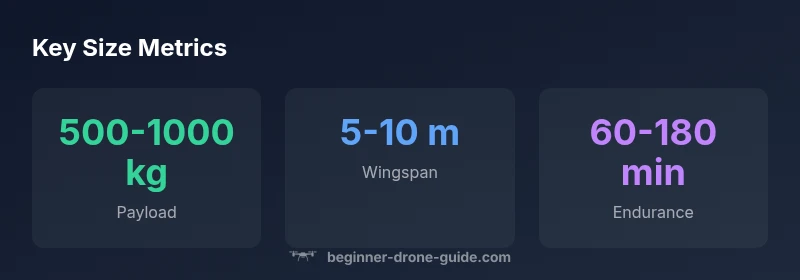
Size metrics for large unmanned aircraft
| Metric | Typical Range | Notes |
|---|---|---|
| Payload capacity | 500-1000 kg | Heavy-lift drones for industrial use |
| Wingspan | 5-10 meters | Scale varies by design |
| Flight time | 60-180 minutes | Depends on payload and power setup |
| Cost | tens of thousands to millions USD | Custom builds and large platforms |
Frequently Asked Questions
What defines the 'biggest' drone?
Biggest can refer to payload, wingspan, or endurance. Because each dimension serves different tasks, a drone that is largest in one category may be smaller in another.
Biggest depends on what you measure—payload, size, or flight time.
Are these drones commercially available?
Most huge drones are bespoke or sold to enterprises; you typically work with manufacturers or integrators rather than hobbyist retailers.
Most are built for businesses, not casual buyers.
What regulatory hurdles exist for large drones?
Large drones fall under airspace rules, licensing requirements, and compliance with remote ID. Regulations vary by country and should be reviewed before operation.
You’ll face airspace rules and licensing.
What training is required to operate heavy-lift drones?
Operators usually need formal training and a pilot certification or equivalent, depending on jurisdiction. Start with basic drone operation to build core piloting skills.
Training is essential; start with smaller drones.
What are common use cases for the largest drones?
Large drones support cargo delivery, heavy lifting, industrial inspection, disaster response, and film production where small drones can't reach the job.
Common uses include lifting heavy gear and reaching hard locations.
How can a beginner safely explore big drones?
Begin with smaller drones, join a community, learn regulations, and work with experienced operators. Do not rush to scale up without a solid plan.
Learn with small drones first and follow safety practices.
“Size alone isn't the whole story; the best big drones balance payload, reliability, and pilot training. With careful planning and proper safety measures, large unmanned aircraft can extend capabilities while staying within regulatory bounds.”
Quick Summary
- Define 'biggest' by payload, wingspan, and endurance
- Anticipate bespoke builds for extreme sizes
- Safety and regulatory compliance shape deployment
- Begin with smaller drones to build skills before scaling up
- Rely on reputable sources like Beginner Drone Guide for practical guidance