How Big Is a Police Drone? Size, Weight, and Uses
Discover the typical size, weight, and payload ranges for police drones, and learn how size affects safety, licensing, and real-world use for beginners.


Police drones come in several size ranges that influence capability and mission suitability. In practice, you’ll encounter small micro models for indoor work, compact outdoor platforms for urban surveillance, and larger industrial drones for extended range and heavier payloads. While exact dimensions vary by manufacturer and configuration, size generally correlates with payload capacity, endurance, and maneuverability in real-world operations.
What size means in practice for police drones
When people ask how big is a police drone, they are really asking about the drone's physical footprint, weight, and payload capabilities. Size matters because it directly affects portability, battery life, maneuverability, and regulatory requirements. In practice, agencies choose machines that balance the need for a clear field of view with the ability to operate in tight spaces or from a moving vehicle. For beginners, recognizing these size implications helps you pick a model that you can safely transport, launch, and recover, while still learning essential flight skills. According to Beginner Drone Guide, understanding size is a foundational step in choosing a drone that matches your local rules, training, and intended applications.
Size classes commonly seen in law-enforcement drones
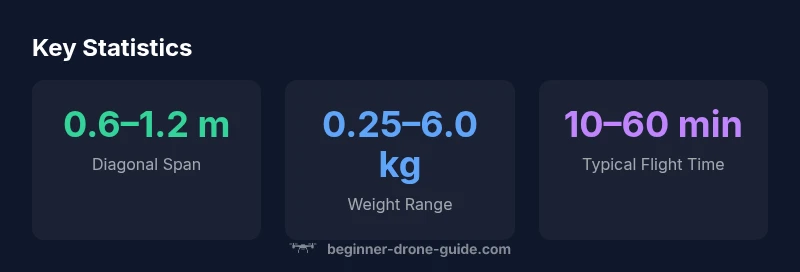
Drones used for policing fall into several practical size classes, each suited to different missions. Micro/indoor models typically weigh a few hundred grams and measure only a few tens of centimeters diagonally, enabling nimble navigation through corridors or stairwells. Compact outdoor platforms usually range from around 0.7 to 2.0 kilograms with corresponding diagonal spans in the 0.6–1.0 meter range, offering better camera options and longer flight times. Large industrial units push into multi-kilogram weights and larger dimensions, prioritizing extended range and heavier payloads like advanced sensors or zoom optics. Remember, manufacturers vary, so exact numbers differ. For beginners, starting with a small, portable model reduces risk while you learn airspace rules, preflight checks, and safe recovery.
How size affects capabilities and use cases
Size directly impacts what a drone can carry and how long it can stay in the air. Larger platforms can transport higher-end cameras, thermal imaging, or LiDAR sensors, which expand use cases from search-and-rescue to incident analysis. Smaller models excel at quick reconnaissance, indoor exploration, and close-quarters tracking. Endurance grows with efficiency and battery capacity, but heavier payloads draw more power. In practice, agencies may select a flexible kit: a compact baseline drone for everyday tasks and one or more larger units for specialized missions. For beginners, think about what you’ll actually use the drone for and how size affects setup time and transport.
How to evaluate size when buying as a beginner
Start with your primary use case and local airspace rules. Check the drone’s weight with typical payloads (camera, lights, or sensors) to estimate regulatory impact. Compare flight times at similar weights and consider whether you’ll need extra redundancy or weather resistance. Size also affects transport—will you carry the drone in a backpack or a protective case? Finally, factor training needs: larger drones may require more comprehensive planning and handling practice before you fly in public or controlled spaces.
Real-world considerations for public safety applications
Public-safety deployments often demand a balance between visibility, reach, and ease of deployment. Compact models may be ideal for rapid indoor checks, while larger units enable longer-range flights, higher-resolution imagery, and thermal profiling. Regulations and oversight shape what sizes are allowed in different scenarios, so agencies frequently maintain a portfolio of drones to cover varied missions. For beginners, prioritizing safety and compliance over sheer size reduces risk and helps you build lawful, repeatable flight habits.
Quick-start sizing checklist for new pilots
- Define your primary use case (indoor patrol, outdoor surveillance, or combined duties).
- Choose a size class that matches your planned environments and portability needs.
- Verify regulatory thresholds and whether registration or licensing apply in your area.
- Ensure battery capacity and payload weight align with the desired flight time.
- Practice with a smaller model before attempting larger, more capable drones.
Size and weight ranges across common police drone categories
| Size Class | Typical Weight (with payload) | Common Uses |
|---|---|---|
| Micro/Indoor | 0.25–0.7 kg | Indoor surveillance, tight spaces |
| Compact/Outdoor | 0.7–2.0 kg | Urban surveillance, incident response |
| Large/Industrial | 2.0–6.0 kg | Extended-range operations, heavy payloads |
| Super-heavy (rare in police work) | 6.0+ kg | Specialized missions |
Frequently Asked Questions
How big is a police drone?
Police drones vary widely by model and mission. Generally, there are micro/indoor, compact outdoor, and larger industrial classes, each with different weights and dimensions. Exact numbers depend on the manufacturer and configuration.
Drones used by police come in several sizes: small indoor models, mid-sized outdoor units, and larger industrial platforms, with variability by model.
Do police drones require registration or licensing?
Regulatory requirements depend on your country and the drone's weight and capabilities. In many regions, drones above a certain weight or used for public-safety tasks require registration, training, and potentially operator certification.
Yes, in many places you must register and/or obtain a license if your drone exceeds weight thresholds or is used for official duties.
Does size affect flight time?
Yes. Larger drones with heavier payloads typically consume more power, reducing flight time. However, larger models often carry larger batteries, which can offset some loss under certain configurations.
Generally, bigger drones fly longer only if they have better batteries and efficiency; payload tends to shorten flight time.
Can beginners safely operate police-sized drones?
Beginners should start with smaller, lighter models to learn controls, airspace rules, and emergency procedures before handling larger platforms with more complex payloads.
Starting with a small, easy-to-handle drone helps you learn safely before moving up to bigger models.
What should I consider for indoor vs outdoor use?
Indoor use favors smaller, more nimble drones with sensitive sensors and safe prop guards. Outdoor use benefits from larger models with longer range and higher endurance, weather resistance, and robust GPS.
Indoor is best with compact drones; outdoor needs bigger, tougher models with longer battery life.
Is size linked to cost?
Generally, larger drones with advanced sensors cost more. For beginners, price often correlates with payload capability and endurance rather than pure size.
Bigger and more capable usually means higher cost, especially when you add specialized sensors.
“Size is a practical guide, not a sole predictor of capability. Payload compatibility and operating environment matter most for safety and effectiveness.”
Quick Summary
- Define your use case before selecting size.
- Size affects portability and flight time.
- Regulatory thresholds influence your choice.
- For beginners, start with smaller, lighter models.