How to Stop Drones: Safe, Legal Steps for Beginners
Learn how to stop drones safely and legally with practical steps, privacy tips, and guidance on reporting incidents to authorities for beginners


To answer how to stop drones, you must act legally and safely. You cannot seize or jam a drone yourself; instead, document the intrusion, contact authorities, and use privacy protections. This guide walks you through legal steps, reporting channels, and preventing future drone intrusions—designed for beginners that are practical for everyday home environments.
Why stopping drones safely matters
According to Beginner Drone Guide, increasing aerial activity means more opportunities for privacy intrusions, noise, and safety risks. Knowing how to stop drones safely helps protect your family, pets, and property without violating laws or escalating conflict. The right approach emphasizes prevention, documentation, and lawful reporting rather than confrontation. By understanding your rights and limitations, you can respond calmly and effectively when a drone enters your airspace. This section lays the groundwork for practical, beginner-friendly action that keeps everyone safe while respecting the rules.
Legal boundaries and safety basics
Stopping drones is not a DIY battle. Interfering with an aircraft or attempting to bring down a drone can be illegal and dangerous. In many jurisdictions, only authorized authorities or licensed entities may take active enforcement actions. The focus for individuals is on safety, privacy, and lawful remedies. Familiarize yourself with local aviation rules and privacy laws before taking any action. If you’re unsure, err on the side of caution and contact authorities rather than attempting to engage the drone directly. This approach aligns with best practices highlighted by institutions like the FAA and university-level safety programs.
The difference between privacy, safety, and nuisance
Privacy concerns relate to unwanted visual capture or data collection, while safety concerns involve threats to people or property. Nuisance describes unintentional disturbances like noise or repeated overflights. Distinguishing these helps you choose the right response: privacy protections (like signage and landscaping), safety measures (keeping a safe distance and documenting), or formal reporting for persistent nuisance. Clear distinctions also guide conversations with authorities and potential operators, reducing emotional risk during an incident.
What you can do legally to reduce risk
There are several non-confrontational and legal options you can apply right away. Start with clear privacy boundaries: install curtains or blinds, use privacy screens on outdoor living areas, and place signage indicating no-fly zones near your property. Improve visibility and lighting at dusk or evening hours to deter opportunistic observers. Finally, set up a simple incident-report process so you can document and relay information accurately if a drone enters your space. None of these steps involve interfering with the aircraft itself.
Step-by-step overview: a safe, legal response to a drone over your property
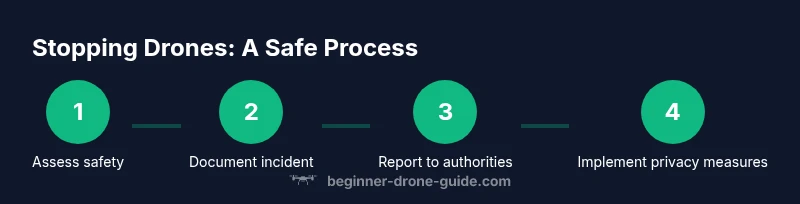
When a drone appears, begin with safety first: avoid approaching the device or its operator, stay aware of your surroundings, and keep others away from the flight path. Next, document the encounter with photos or notes, noting time, location, drone type, altitude, and flight pattern. If the drone persists, contact the appropriate authorities and provide clear, concise information. If possible, attempt to observe and record the operator’s contact details without violating anyone’s privacy. This overview prepares you for the detailed steps in the following sections.
How to document the incident effectively
Effective documentation is the backbone of any formal report. Record the date and time, your location, weather conditions, and the drone’s approximate altitude and markings. Take photos or short videos from a safe distance, focusing on distinctive features like color, size, and logos. Note the drone’s flight path relative to people and property. Preserve any audio cues or disturbances. A well-organized notebook or a digital template will help you present consistent information to authorities or your HOA.
How to report to authorities and what to provide
Start with the appropriate local authority—police, municipal code enforcement, or aviation authority—depending on your location. Provide a factual account: when the drone appeared, how long it stayed, its flight path, and any potential risks observed. Attach your documentation: photos, videos, and a concise timeline. If you have reason to believe data collection violated privacy laws, mention it clearly. Follow up as needed with any additional evidence you gather.
How to communicate with the operator (if possible) and de-escalation tips
If communication with the operator is safe and feasible, keep the exchange calm and non-confrontational. State your privacy expectations plainly and request that they abide by local laws and any airport or airspace restrictions. Do not threaten or attempt to physically restrain the drone. If the situation becomes tense, disengage and contact authorities. The goal is to resolve the incident without escalation while ensuring safety for everyone involved.
Privacy-first design: environmental and architectural strategies
Proactive privacy measures reduce the impact of drone overflight. Use outdoor living areas with visual barriers like strategic landscaping or privacy screens. Consider rearranging seating to avoid direct lines of sight from typical drone angles. Install motion-activated lighting to deter casual intrusions and record activity for potential evidence. These strategies safeguard privacy without provoking confrontations or legal risk.
Real-world scenarios and lessons learned
In real-life cases, prompt documentation and timely reporting led to swift resolutions and clearer outcomes. Observers who maintained objectivity and complied with laws were more likely to see authorities intervene effectively. The key lessons are to stay calm, avoid confrontation, and rely on official channels for enforcement. Beginners can apply these lessons to create a predictable response plan for future incidents.
Common misconceptions and myths
A common myth is that you can quickly disable or shoot down a drone to stop it. In reality, such actions are often illegal and dangerous. Another misconception is that privacy laws only apply to criminals; privacy is a broad protection that covers ordinary residents too. Finally, some people think posting a threat on social media will stop a drone; public shaming does not replace formal reporting and may create unnecessary complications.
Tools & Materials
- Notepad and pen(To record time, location, drone color, markings)
- Smartphone with camera(To capture photos/videos of the drone and surroundings)
- Incident documentation template( digitales or printable form to standardize notes)
- Privacy signage or outdoor screen(Optional to deter casual overflight and indicate no-fly boundaries)
Steps
Estimated time: Estimated total time: 25-60 minutes
- 1
Assess safety and legality
Immediately ensure you and others are safe. Maintain distance from the drone and avoid approaching or attempting to touch it. Familiarize yourself with local laws to confirm what actions are permitted and what actions are not.
Tip: If anyone feels unsafe, move to a secure area and call local authorities. - 2
Document the encounter
Use your phone or a notebook to log the time, location, altitude, and observed behavior. Capture photos or videos that highlight distinctive drone features and flight patterns without compromising safety.
Tip: Keep your records organized with a simple timestamped log. - 3
Identify the risk and decide on escalation
Determine whether the drone overflight poses a privacy concern, nuisance, or safety risk. If there is an immediate danger, contact authorities without delay.
Tip: Avoid speculating about the operator or intent; stick to observable facts. - 4
Notify the authorities
Call the appropriate local authority or aviation authority and provide your documentation, including times, locations, and media. Follow their guidance and submit any additional evidence they request.
Tip: Ask for a case or incident number for follow-up. - 5
Try safe, non-confrontational communication (if safe)
If you can safely ask the operator to respect privacy and airspace rules, do so in a calm tone. If the situation feels unsafe, disengage and exit the area.
Tip: Never attempt to contact the operator if it requires entering a hazardous area. - 6
Implement non-intrusive privacy measures
While awaiting resolution, enhance privacy using blinds, screens, lighting, or landscaping. These measures reduce visibility without engaging the drone or operator.
Tip: Document any privacy improvements for your records. - 7
Review and adjust planning for future incidents
After the incident, review what occurred and update your response plan. Consider additional privacy protections or community steps with neighbors or your HOA.
Tip: Create a lightweight, repeatable incident checklist.
Frequently Asked Questions
Is it legal to stop a drone that overflies my property?
In most places, you should not attempt to stop or jam a drone yourself. Legal remedies include documenting the incident and reporting it to authorities. Privacy protections on your property can also reduce intrusions. Always follow local aviation and privacy laws.
Generally, you cannot stop or jam a drone. Document it and contact authorities; use privacy measures to reduce intrusion.
Can I shoot down a drone to stop it?
No. Shooting at a drone is illegal in many jurisdictions and can create serious safety risks. Rely on documentation and official reporting to address the issue.
Shooting at a drone is typically illegal and dangerous. Use legal channels instead.
What privacy rights do I have when a drone flies over my home?
You have privacy protections that may apply to visual or data capture over your property. Laws vary by location, so consult local regulations and document any potential violations for reporting to authorities.
Privacy protections can apply to drones over your property; check local laws and document any concerns.
What should I include when reporting an incident?
Provide a clear timeline, location, and observed behavior, plus copies of photos or videos. Include any potential privacy concerns and the impact on safety or nuisance.
Give a concise timeline, location, what happened, and attach any photos or videos.
What if the same drone keeps returning?
Document each occurrence and escalate to authorities. A pattern may require an investigation or formal action through aviation or law enforcement channels.
If it keeps returning, report each incident and escalate to the appropriate authorities.
Watch Video
Quick Summary
- Know legal boundaries before acting
- Document incidents accurately and promptly
- Report to authorities and follow up
- Use privacy protections to reduce intrusion
- Plan long-term privacy and safety measures