How to Handle a Noisy Drone: Safe, Legal Steps for Beginners
Learn safe, legal ways to address a nuisance drone. This guide covers documentation, reporting, privacy, and practical non-destructive steps for beginners.


There’s no legitimate way to bring down a drone. Instead, document nuisance, respect privacy, and report the incident to local authorities or the operator. Get the full, safe, step-by-step guidance in this article.
Understanding the legal landscape for drones
When people discuss how to bring down an annoying drone, they are often thinking of immediate, forceful actions. The reality is that such approaches are illegal in most jurisdictions and create serious safety risks for bystanders. The Beginner Drone Guide team emphasizes that the safer path is to work within the law, document the incident, and pursue official channels. In many places, drones are regulated like aircraft, and interfering with their operation can lead to criminal charges, fines, and civil liability. Begin by learning the specific rules that apply where you live—airspace restrictions, privacy protections, and rules for landowners. According to Beginner Drone Guide, understanding both aviation rules and privacy rights helps you choose the right, lawful response. This means avoiding any action that could escalate the situation and focusing on documented, non-destructive options.
Why attempting to physically stop a drone is dangerous and often illegal
Physical intervention—attempting to bring down, disable, or shoot at a drone—puts bystanders at risk and can cause collateral damage. Most jurisdictions treat interference with aircraft as a serious offense, with penalties that include fines and potential jail time. Not only could you harm someone or property, but you may also become legally liable for damages. The risks extend to the drone operator, who may react unpredictably. As a result, the best course of action is to refrain from any direct confrontation and instead pursue lawful remedies. The emphasis should be on safety, legality, and effective reporting, not on retaliation. The Beginner Drone Guide team highlights that non-destructive options are both safer and more likely to yield a timely resolution.
Safer, legal alternatives to address drone nuisance
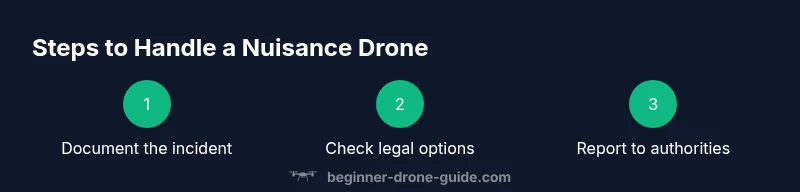
If a drone is causing a nuisance, there are several constructive steps you can take that stay within the law. Start with documentation: note the date, time, location, observed flight path, and any known identifiers. Then, review local regulations to confirm what actions are permissible for property owners and nearby residents. Contact the drone operator if possible and polite, requesting compliance with privacy and safety norms. If the issue persists, file a formal report with the appropriate authority and provide your records. Privacy-focused measures—such as closing blinds or using signs—can reduce the impact while remaining non-confrontational. These approaches align with best practices and avoid escalating the situation. Based on Beginner Drone Guide research, a calm, documented, and lawful approach is far more effective than reactive measures.
Documenting the incident: what to record
Accurate documentation is essential for any subsequent reporting. Record the date, start and end times of the flight, approximate altitude, weather conditions, and the drone’s observed behavior (hovering, circling, over your property, etc.). If safe to do so without violating privacy, capture video or photographs that show the nuisance pattern. Note any identifying features you can observe, such as color, size, or markings, while respecting others’ privacy. A well-organized log makes it easier for authorities to evaluate the situation and determine appropriate enforcement actions. The goal is to create a clear, factual record that supports a formal complaint.
Reporting channels: who to contact
Different regions have different channels for reporting drone nuisances. In many places, you should contact local law enforcement, a regional aviation authority, or a municipal code enforcement office. If the drone is operated by a business or media entity, you may also file a complaint with a consumer protection agency. When you report, attach your documentation and be precise about the nuisance, avoiding speculation. If you know the operator, you can share pertinent details with them through a courteous complaint, but prioritize official reporting if the issue continues. Timely reporting increases the likelihood of a swift, appropriate investigation.
Privacy and protective measures you can take
Protecting your privacy is a legitimate concern. Use practical, legal measures such as tightening window coverings, using privacy screens, and posting signs that indicate surveillance-free zones. Consider coordinating with neighbors to create a shared privacy buffer around areas most affected by drone activity. Avoid using electronic jamming or other interference techniques, as these actions are illegal and potentially dangerous. Instead, focus on documenting incidents, enhancing personal privacy, and engaging with authorities for enforcement. These steps uphold your rights while keeping everyone safe.
Interacting with the operator (if possible) and community guidelines
If you are able to contact the operator safely and respectfully, express your concerns clearly and request adherence to local rules, privacy expectations, and safe flying practices. Sharing your boundaries can sometimes resolve the issue without escalation. Keep lines of communication professional; avoid threats or accusations. Establishing a constructive dialogue can lead to improved behavior, while still relying on official processes if the nuisance continues. Community guidelines and cooperative behavior often yield quicker, mutually agreeable outcomes.
What to do if there is immediate danger
If there is a direct safety risk—for example an aggressive drone, loss of control, or the drone flying near people or vehicles—evacuate the area and call emergency services immediately. Do not attempt to intervene physically or use improvised weapons. Your priority is personal safety and the safety of others nearby. After the danger has passed, document the incident and report it as described above. Quick reporting helps authorities assess risk and take appropriate action.
What to expect after reporting and how to follow up
Once you’ve filed a report, authorities typically review the information and may contact you for additional details. The response time varies by jurisdiction and case load. Stay available and provide any requested materials, such as extra video clips or logs. If the nuisance continues, follow up with periodic updates and additional documentation. Consistent and calm engagement with the process increases the likelihood of a formal resolution and helps prevent future incidents. The process can take time, but persistence along with proper documentation often yields results.
Tools & Materials
- null(No special tools required beyond a notebook and camera (optional))
Steps
Estimated time: 60-120 minutes
- 1
Observe and document the incident
Carefully watch the drone’s behavior and record basics like time, location, altitude, and flight pattern. Note any privacy concerns and whether the drone enters restricted airspace. This creates a solid foundation for later action.
Tip: Keep notes in a dedicated log without embellishment; factual records are more persuasive to authorities. - 2
Review local laws and rights
Identify which rules apply in your area, including privacy laws and aviation regulations. Understanding allowable responses prevents risky or illegal actions.
Tip: Check official government sites or contact a local aviation authority for guidance. - 3
Attempt non-confrontational communication
If it’s safe, contact the operator politely to request compliance with privacy and safety norms. Document any response for your records.
Tip: Use a calm, non-threatening tone; misunderstandings are common and often resolvable through dialogue. - 4
Report to the appropriate authority
Submit your documented evidence to law enforcement, aviation authorities, or municipal regulators as applicable.
Tip: Attach your logs and any video or photo evidence to support your report. - 5
Enhance privacy while the issue is ongoing
Implement non-intrusive privacy measures on your property, such as blinds, curtains, or privacy screens in affected areas.
Tip: Avoid any actions that could escalate the situation or violate others’ rights. - 6
If danger arises, leave the area
If the drone behaves aggressively or you feel unsafe, prioritize personal safety and call emergency services.
Tip: Do not attempt to physically restrain or contact the drone operator in a risky moment. - 7
Follow up with authorities and keep records
After the incident, maintain your documentation and monitor for subsequent nuisance reports or enforcement actions.
Tip: Regularly update your log if new events occur to demonstrate ongoing issues.
Frequently Asked Questions
Is it legal to shoot down or jam a drone?
No. Shooting, jamming, or otherwise disabling a drone is illegal in most places and can endanger people and property. Use documented reports and official enforcement channels instead.
Shooting or jamming a drone is generally illegal; rely on official reporting and non-destructive steps.
What should I do immediately if a drone is over my property?
Move to a safe area, document the incident, and avoid any confrontation. Note the time and behavior, then report to the appropriate authority if the nuisance continues.
Move to safety, document what’s happening, and contact authorities if the drone persists.
Who should I contact to report the incident?
Contact your local law enforcement or aviation authority as directed by your jurisdiction. Provide your incident log and any evidence you’ve gathered.
Reach out to local authorities with your notes and evidence.
How should I document the nuisance for authorities?
Keep a log with dates, times, locations, altitudes, and behaviors. Include any video or photo evidence you’ve safely captured.
Make a clear log and attach any safe evidence you have.
Can privacy laws protect me from drone footage?
Privacy laws vary, but many regions protect people from intrusive recording. Use non-invasive privacy measures and report persistent issues to authorities.
Privacy laws can help, but rely on official reporting for ongoing problems.
Watch Video
Quick Summary
- Do not attempt to bring down a drone; it is illegal and dangerous
- Document, report, and pursue official channels for nuisance incidents
- Protect privacy with non-destructive measures and safe communication
- Stay informed about local drone laws to guide your actions