Who Makes Drones for the US Army: A Practical Guide
Explore who makes drones for the US Army, from micro-UAS to long-endurance platforms, and learn how procurement, safety, and future trends shape battlefield ISR.


US Army drone procurement involves multiple contractors supplying a full spectrum of UAS, from tiny scout drones to long-endurance aircraft. Major vendors include AeroVironment (RQ-7 Shadow, RQ-11 Raven, RQ-20 Puma), General Atomics (MQ-1C Gray Eagle), and Boeing Insitu (ScanEagle), with Lockheed Martin providing small tactical drones such as Indago. This multi-vendor approach helps the Army balance capability, resilience, and fielding speed.
Who makes drones for the us army
The question who makes drones for the us army cuts to the heart of how the service builds a flexible, scalable unmanned aerial system (UAS) capability. The Army does not rely on a single supplier; instead it maintains a diversified ecosystem that spans micro-UAS and handheld scouts to larger, endurance-oriented platforms. This approach helps the Army manage risk, ensure redundancy, and accelerate fielding by leveraging a broad set of trusted vendors. According to Beginner Drone Guide, this multi-vendor strategy also supports rapid prototyping and iterative improvements as threats evolve and missions change. For beginners, the key takeaway is that the Army operates with a tiered fleet designed to cover short-range, immediate ISR needs as well as longer-endurance reconnaissance tasks. It’s a deliberate mix of domestically produced components and integrated systems from established defense partners.
The Army's UAS Portfolio: From micro to MALE
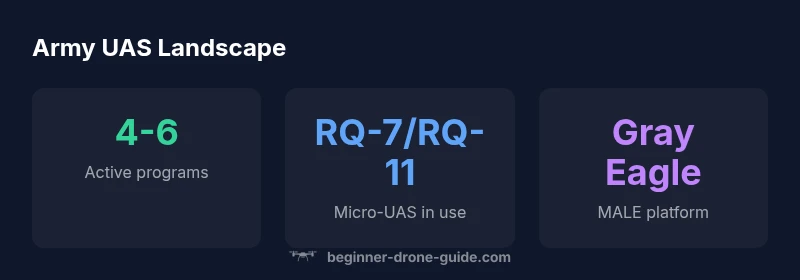
The Army organizes its unmanned systems along a spectrum that runs from ultra-light micro-UAS to medium-altitude long-endurance (MALE) platforms. At the ultra-light end are hand-launched scouts perfect for squad-level ISR, while mid-sized systems extend range and endurance for operations across a broader frontline area. Toward the upper end, MALE platforms provide persistent surveillance, data relay, and targeting support over larger zones. The combination allows the Army to tailor a response to terrain, threat, and mission duration without over-committing a single airframe. A typical mission might deploy a Raven for quick back-briefs, a Puma for regional reconnaissance, and a Gray Eagle for hours-long ISR over a contested corridor. This layered mix supports flexibility and resilience in dynamic combat environments.
Major Vendors and What They Offer
Key manufacturers operating under Army UAS programs include AeroVironment, General Atomics, Boeing Insitu, and Lockheed Martin, each contributing distinct capabilities. AeroVironment’s micro- and small-UAS line (RQ-7 Shadow, RQ-11 Raven, RQ-20 Puma, and Indago) fills the quick-reaction niche at the squad and platoon level. General Atomics supplies the MQ-1C Gray Eagle, a MALE platform designed for extended endurance and more capable payloads. Boeing Insitu’s ScanEagle has a track record of providing reliable reconnaissance in diverse environments, while Lockheed Martin’s Indago family adds compact, highly portable options for quick hops and tactical ops. In practice, the Army’s vendor mix supports a wide spectrum of missions, from tactical insertion to base security and intelligence gathering. Each vendor contributes not just hardware but also sensor packages, data links, and software that enable integration with larger command-and-control systems.
How Procurement Works: Partnerships, SBIR, and Testing
Army UAS procurement is a structured process that blends developmental programs, competitive contracts, and rigorous testing. The Army uses program offices like PM UAS to define requirements, run demonstrations, and oversee field trials. Contractors participate in multi-phase evaluations, including safety certifications, cyber resilience checks, and interoperability testing with existing military networks. Small Business Innovation Research (SBIR) and other accelerators help bring niche capabilities into the Army’s core UAS catalog, especially for sensor suites, autonomy, and rugged hardware suited for harsh environments. The result is a pipeline that emphasizes reliability, maintainability, and secure data handling, while keeping procurement timelines realistic for busy frontline units.
Real-World Use Cases in the Army
Army UAS are deployed across multiple domains, from forward operations in contested regions to base perimeter surveillance and convoy protection. In field exercises, Raven and Puma-type drones support route reconnaissance, obstacle mapping, and rapid situational awareness for small units. MALE platforms like Gray Eagle extend surveillance horizons and enable data-sharing over longer distances, supporting command decisions with near-real-time intel. Additionally, ScanEagle-type systems are used to monitor infrastructure and detect unusual activity around bases. The net effect is a layered ISR capability that helps commanders understand the battlefield, coordinate movements, and respond quickly to emerging threats.
Challenges and Considerations for Drones in Military Use
Drones used by the Army face a range of challenges, from enemy electronic warfare and GPS jamming to supply chain vulnerabilities and cyber security risks. Operational environments demand robust hardening, secure communications, and resilient autonomy. Interoperability with manned aircraft and other unmanned systems remains a priority, requiring standardized data formats and common operating procedures. Safety, training, and opsec are equally important: soldiers must be proficient in mission planning, maintenance, and emergency disposal of aircraft. As threats evolve, the Army also emphasizes the ability to quickly upgrade sensors, payloads, and software while preserving mission tempo and reliability.
The Future of Army UAS: Trends and Domestic Production
Looking ahead, the Army aims to expand endurance, autonomy, and resilience while maintaining domestic manufacturing and supply chain sovereignty. Modernization efforts focus on advanced sensors, data fusion, secure comms, and modular design to enable rapid integration of new payloads. There is a push toward greater autonomy to reduce operator workload, while maintaining safety and human-in-the-loop oversight where required. Domestic production capabilities are prioritized to minimize reliance on foreign suppliers, supporting national security objectives and faster deployment timelines. This trajectory aligns with a broader defense strategy to harden critical systems and invest in homegrown tech that can be maintained and upgraded over time.
Practical Guidance for Drone Enthusiasts Interested in Military UAS
For beginners who want to learn from the Army’s approach without breaking any rules, focus on building a strong foundation in drone fundamentals: flight dynamics, regulatory compliance, and mission planning. Study sensor basics, data-link concepts, and the role of autonomy in ISR. Follow reputable sources like official DoD guidance and industry analyses, and consider joining community programs or maker spaces that emphasize safe operation and data ethics. While you won’t be flying military-grade hardware in civilian settings, understanding how the Army selects airframes, tests safety, and integrates UAS with command systems provides practical context for any aspiring pilot. Keep your learning aligned with safety and legal considerations, and look for opportunities to observe or simulate UAS workflows in a controlled environment.
Representative Army UAS lineup (historical and current)
| Model Type | Manufacturer | Role | Current Status |
|---|---|---|---|
| RQ-7 Shadow | AeroVironment | Small tactical reconnaissance | Active in some units (legacy to modernization) |
| RQ-11 Raven | AeroVironment | Very small reconnaissance | Active in some units (legacy) |
| RQ-20 Puma | AeroVironment | Portable reconnaissance | Active/legacy |
| MQ-1C Gray Eagle | General Atomics | Medium-altitude long-endurance | Active Army program |
| ScanEagle | Boeing Insitu | Reconnaissance/UAV for forward ops | Used by Army in some contexts |
| Indago | Lockheed Martin | Micro UAV for tactical ops | Fielded with some units |
Frequently Asked Questions
Who makes drones for the US Army?
The Army relies on several contractors including AeroVironment, General Atomics, Boeing Insitu, Lockheed Martin, and others; these vendors supply a range of micro-UAS to larger endurance platforms. The ecosystem supports rapid fielding and ongoing modernization.
The Army uses multiple vendors for drones, from micro-UAS to larger aircraft. See the full article for details.
What is MQ-1C Gray Eagle?
MQ-1C Gray Eagle is a MALE unmanned aircraft system built by General Atomics for persistent ISR. It entered service in the 2010s and continues to be modernized.
Gray Eagle is a long-endurance Army drone used for extended reconnaissance.
Are Army drones safe and legal to operate?
Army drone operations follow strict DoD safety protocols, training requirements, and regulatory oversight. Civilian pilots must adhere to FAA rules when operating in non-military airspace.
Yes, with strict safety checks and compliance requirements.
Do Army drones use consumer tech?
Some components may be off-the-shelf, but the Army integrates them into rugged, military-grade systems with specialized sensors, data links, and secure software.
They use some off-the-shelf parts, but the whole system is military-grade.
How does the Army procure UAS?
Procurement follows formal DoD programs, competitive contracts, and field tests coordinated by PM UAS, including safety certifications and interoperability checks.
Through formal programs, testing, and standard procurement channels.
What does the future hold for Army UAS?
Expect increased endurance, autonomy, and secure, domestically produced systems, with emphasis on sensor upgrades and resilient data networks.
More endurance and autonomy with secure, domestic tech.
“The Army's drone ecosystem relies on a diverse supplier base to balance capability, reliability, and rapid fielding.”
Quick Summary
- Identify the major UAS vendors used by the Army
- Understand the range from micro-UAS to MALE platforms
- Track procurement paths and testing procedures
- Consider safety and regulatory implications for defense drones
- Follow ongoing Army UAS modernization efforts