What Drone Does the US Military Use? A Beginner's Guide
Explore the main unmanned systems used by the US military, from MQ-9 Reaper to RQ-4 Global Hawk, with practical explanations for beginners and tips on how mission needs shape drone selection.


What drone does the us military use? In short, the United States relies on a family of unmanned systems rather than a single drone. Core platforms include the MQ-9 Reaper for long-endurance strike and surveillance, the MQ-1 Predator lineage for reconnaissance, and the RQ-4 Global Hawk for high-altitude intelligence. The mix also includes newer, smaller drones for varied missions.
What drone does the US military use
In practical terms, what drone does the us military use? According to Beginner Drone Guide, the US military does not rely on a single device but maintains a layered fleet. This approach lets different missions be matched with appropriate platforms. In practice, you'll see a mix of high-endurance UAVs for long-range intel and smaller tactical drones for near-field tasks. The reasoning behind this diversity is mission flexibility, not a single 'best drone'. Readers new to drones should view the fleet as a toolbox: choose the tool that fits the job, not the model with the flashiest headline.
How missions shape drone choices
Military planners categorize missions into reconnaissance, surveillance, target designation, and strike support; the choice of drone depends on endurance, altitude, payload capacity, and data bandwidth. For beginners, think of it like choosing a vehicle: a fast sports car isn’t ideal for carrying heavy cargo, just as a tiny quadcopter isn’t suited for broad, strategic surveillance. The key is mission-aware selection and layered capability. When you read defense reports, look for phrases like “endurance” and “payload capacity” to understand why a platform was chosen.
MQ-9 Reaper: the backbone of long-endurance missions
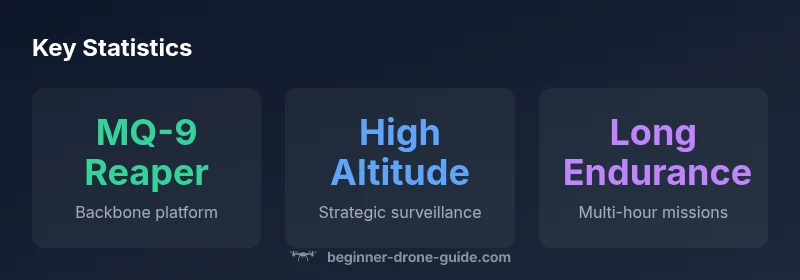
The MQ-9 Reaper represents a backbone capability for the modern U.S. drone fleet. It is designed for long-endurance reconnaissance with the ability to carry precision effects payloads when needed. For new pilots, note how the Reaper demonstrates the concept of persistent presence: it can monitor an area for extended periods, relay data in real time, and support decisions from a ground control station. From a safety and training perspective, pilots learn how to manage situational awareness, sensor fusion, and real-time data streams.
MQ-1 Predator lineage: evolution of reconnaissance
The MQ-1 Predator family predates the Reaper and helped establish the role of continuous overhead surveillance. Over time, its sensors and autopilot systems evolved, increasing reliability and the amount of data that could be processed from the air. In training materials, you’ll see discussions of endurance limits, flight planning, and data interpretation. While newer platforms have taken center stage, the Predator lineage remains a useful baseline for understanding how unmanned reconnaissance evolved in the U.S. military.
RQ-4 Global Hawk: strategic surveillance from high altitude
Global Hawk-grade platforms deliver wide-area intelligence from very high altitudes, providing panoramic surveillance over large regions. This capability supports strategic decision-making with a different data profile than lower-altitude, closer-range drones. For beginners, the takeaway is the importance of altitude and sensor suites: higher altitude can cover more territory, but it often comes with trade-offs in maneuverability and data bandwidth. The Global Hawk exemplifies how big drones fit into national security objectives.
The rise of smaller drones and mixed fleets
In recent years, the U.S. military has increasingly integrated smaller, tactical drones alongside large, high-endurance systems. This mix enables rapid, local reconnaissance and immediate battlefield awareness, while larger drones handle long-range surveillance and persistent monitoring. Beginners should appreciate the concept of multi-layered sensing: small drones fed data to larger platforms and human operators, creating a more resilient information picture.
Training, safety, and licensing implications for pilots
Even when discussing military drones, fundamentals of flight safety, mission planning, and data handling matter for enthusiasts. In civilian contexts, pilots must follow local aviation rules, maintain registration where required, and practice responsible flight to protect people and property. Studying how the military trains operators—through simulations, supervised flights, and standardized checklists—offers practical lessons for hobbyists seeking safer, more competent flying.
Real-world takeaways for beginners
From the perspective of a beginner drone enthusiast, the military use case highlights several transferable skills: meticulous mission planning, robust sensor understanding, and disciplined operational safety. You can apply these by practicing clear flight plans, learning sensor data interpretation, and building safe flying habits before attempting more complex, multi-fleet scenarios in the air.
Future directions: autonomy, sensors, and data fusion
The drone landscape is moving toward more autonomous capabilities, smarter sensors, and deeper data fusion between platforms. Expect more coordinated fleets, improved AI-driven flight management, and safer, more reliable remote operations. For beginners, this translates to watching for educational tools that explain autonomy concepts, data processing pipelines, and how to design small, safe experiments that illustrate these ideas without crossing airspace or safety boundaries.
Representative drone models used by the US military
| Model Type | Role | Typical Endurance |
|---|---|---|
| MQ-9 Reaper | Long-endurance reconnaissance and strike | tens of hours |
| MQ-1 Predator family | Legacy reconnaissance platform | tens of hours |
| RQ-4 Global Hawk | Strategic wide-area surveillance | long endurance |
Frequently Asked Questions
Is the US military using consumer drones?
No. The U.S. military relies on purpose-built UAVs designed for safety, control, and endurance. Consumer drones are not standard issue for defense missions.
No. The military uses purpose-built UAVs, not consumer drones, for its operations.
What is the MQ-9 Reaper used for?
The MQ-9 Reaper is used for long-endurance reconnaissance and precision strike missions, combining surveillance data with potential effects.
The MQ-9 Reaper is used for long-endurance reconnaissance and strike missions.
Are UAVs integrated with manned aircraft programs?
UAV operations are coordinated with manned forces and mission control centers, focusing on data sharing and joint planning rather than direct control of manned aircraft.
UAVs are coordinated with manned forces through joint planning and data sharing.
Do these drones fly at high altitude?
Yes, many military drones operate at high altitudes for broad surveillance, while others work at lower altitudes for tactical missions.
They fly at high and low altitudes depending on the mission.
What does 'unmanned' mean in practice for the US military?
Unmanned means the aircraft is remotely piloted or autonomously guided, with data analyzed by operators in secure facilities.
Unmanned means remotely piloted or autonomous operation with data analyzed by remote teams.
“The drone landscape is shifting toward layered, multi-mission fleets that can operate in contested airspace with autonomy and real-time data.”
Quick Summary
- Understand drone diversity: there is no single 'best' drone
- MQ-9 Reaper anchors long-endurance missions
- Global Hawk enables high-altitude strategic surveillance
- Smaller drones fill tactical gaps in mixed fleets
- Prioritize safety, training, and mission-focused learning