Bringing a Drone from Singapore to India: A Practical Guide
Learn how to legally transport a drone from Singapore to India, including DGCA guidelines, required documents, battery handling, and customs procedures for a smooth cross-border experience.


According to Beginner Drone Guide, you can bring a drone from Singapore to India by following official import rules. Begin with DGCA guidelines for drone imports, determine licensing or registration needs, and collect receipts and model details. At the airport, declare the drone and batteries, pack safely, and be prepared for customs inspections or questions.
Understanding cross-border drone travel rules
Cross-border drone travel involves navigating both Singaporean and Indian regulatory landscapes. As a first step, identify whether your drone falls under consumer use or commercial operations, which largely drives the required permissions. In Singapore, the Civil Aviation Authority sets general safety standards, while India’s Directorate General of Civil Aviation (DGCA) governs import rules, licensing, and registration. Awareness of these regimes helps you budget time, avoid fines, and keep your drone ready for lawful use on arrival. This section will map out the typical checkpoints, common points of confusion, and practical actions you can take well before your trip. Remember, regulations can evolve, so always verify the latest versions from official sources. According to the Beginner Drone Guide team, proactive research reduces travel friction and keeps your drone in safe, legal service.
Assessing your drone: classification, weight, and permissions
Drones are often categorized by their weight, payload, and intended use. Heavier models and those designed for commercial purposes may require additional import permissions, while lighter, consumer-grade drones are commonly treated as non-commercial personal property with fewer hurdles. In practice, you should determine your drone’s exact weight with batteries installed, identify the energy rating of its batteries, and check whether any import permit is necessary. Even if you believe your drone qualifies as a consumer device, confirming the precise requirements through DGCA and Singapore’s CAAS helps prevent last-minute surprises at the border. Begin by listing the drone’s model, serial number, and total weight.
Documentation you may need: licenses, receipts, and declarations
Documentation often makes or breaks international drone transport. Prepare the original purchase receipt or invoice, a detailed model/serial number list, and any existing registration or export/import permits granted by Singapore authorities. At Indian customs, you’ll likely need to declare the drone’s value and purpose, so have the price shown on the invoice and any supporting paperwork handy. Digital copies stored on your phone can save time if originals are not immediately available. If a permit is required, ensure it is obtained before departure or arranged through the appropriate agencies.
Battery safety and transport considerations
Batteries are a frequent source of compliance questions. Carry spare batteries in the mobile luggage when allowed, ensuring terminals are protected and batteries are within the permitted watt-hour (Wh) range. If your batteries exceed typical limits, you may face heightened scrutiny or need special approvals. Airlines and customs are particularly mindful of lithium-based cells, so check both airline policies and DGCA/CAAS guidelines. Pack batteries securely in protective sleeves and separate them from the drone when possible to minimize the risk of short circuits during transit.
Packing and labeling: how to prepare for the flight
A well-packed drone reduces damage risk and supports smoother checks. Use a rigid case with foam inserts tailored to your drone’s dimensions, spare batteries, charger, and cables. Label the case clearly with the owner’s contact information and the drone’s model, serial number, and country of origin. Keep cords neatly coiled and avoid sharp bends in cables present inside the case. If possible, carry a simple inventory inside the case so inspectors can quickly verify what is inside.
At the airport: check-in, security, and customs procedures
When you reach the airport, follow the airline’s guidance for checked versus carry-on items. Present receipts, permit documents, and clear declarations if requested. At security checkpoints and baggage drop-off, be ready to present the drone, batteries, and related paperwork. Some airports require additional screening for batteries; comply with these procedures to prevent delays. Keep in mind that Indian customs may require you to declare the drone upon arrival, so have your forms ready and answer questions honestly.
Arrival in India: registration, usage limits, and compliance
Upon landing, complete any required customs declarations and verify whether your drone must be registered with DGCA or another authority. Indian regulations may impose restrictions on flight locations, altitude, and privacy considerations, even for personal use. Plan to stay within permitted corridors, avoid sensitive zones, and maintain visibility of the drone during operation. If registration is mandatory, complete it promptly to avoid penalties and ensure continued lawful use. Remember to keep your purchase documentation accessible for any future inspections.
Authoritative sources and quick-start checklist
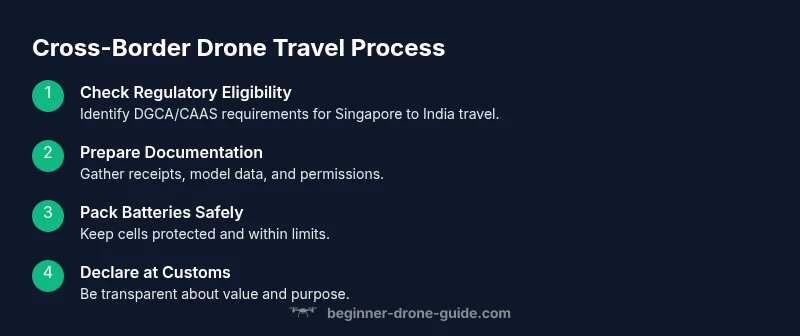
Use official sources to stay current on requirements. Useful authorities include India’s DGCA and Central Board of Indirect Taxes and Customs, as well as Singapore’s CAAS for export considerations. Quick-start checklist: verify import requirements; prepare receipts and model data; pack safely; declare at customs; check battery limits; arrange registration if needed; and confirm airline policies ahead of travel. For ongoing updates, consult these sources and bookmark the pages before planning your trip.
Tools & Materials
- Drone(Include model, serial number, and original packaging.)
- Original purchase receipt/invoice(Needed for customs valuation and verification.)
- Batteries with chargers (within allowed Wh)(Carry in carry-on with terminals protected; comply with IATA guidelines.)
- Protective carrying case(Rigid case with foam inserts to protect drone during transit.)
- Documentation folder (digital/print)(Invoices, permits, registration certificates if applicable.)
- Charger and cables(Original chargers; include travel adapters if needed.)
Steps
Estimated time: Estimated total time: 1-3 weeks, depending on permit processing, flight plans, and customs clearance.
- 1
Check regulatory eligibility and drone category
Review DGCA rules for importing drones into India and CAAS guidelines in Singapore. Determine whether your drone falls under consumer-use or commercial-use categories, as this affects permits and declarations. Compile a preliminary list of required documents based on category.
Tip: Start with official portals to confirm current rules before buying or shipping. - 2
Verify weight and battery class
Measure the drone’s total weight with batteries installed and identify each battery’s watt-hour rating. Many countries differentiate requirements by weight or energy; ensure your setup stays within common passenger-handled limits.
Tip: If possible, choose batteries that comply with standard passenger-carriage rules to minimize friction. - 3
Apply for required permissions or licenses
If your drone requires an import license or special permit, apply through the appropriate Indian authority or embassy channels before travel. Document processing times can vary, so plan well in advance.
Tip: Document everything in advance and keep confirmations handy for inspection. - 4
Assemble and organize customs documentation
Gather the purchase receipt, model/serial numbers, and any existing registrations or export permits. Prepare a clear declaration of value and purpose for customs in both Singapore and India.
Tip: Keep both digital and printed copies accessible during travel. - 5
Pack batteries and drone securely for transit
Place batteries in protective packaging with terminals insulated; keep them separate from the drone if your airline requires. Use a rigid case and ensure inside padding protects sensitive components.
Tip: Label batteries with Watt-hour and chemistry to speed inspections. - 6
Coordinate airline and airport procedures
Consult the airline’s rules for transporting drones and batteries, and arrive early to accommodate extra screening. Bring all paperwork to the check-in desk for smooth processing.
Tip: Ask for a pre-check or special handling if flying with fragile electronics. - 7
Declare the drone at Indian customs upon arrival
At entry, declare the drone and batteries per customs rules. Present all receipts, permit confirmations, and model information to minimize delays and ensure transparent processing.
Tip: Honesty speeds clearance and reduces risk of penalties. - 8
Register and comply with Indian drone rules after arrival
If required, complete any registration with DGCA and follow local flight restrictions and privacy guidelines. Maintain records and renew permits as needed to stay compliant.
Tip: Keep a dedicated log of flights and location restrictions for easy reference.
Frequently Asked Questions
Do I need an import license to bring a drone into India?
Yes, some drones require an import license or permit depending on the category and intended use. Check DGCA guidelines and the CBIC requirements for accurate guidance.
Yes. Some drones require an import license depending on their category and use; verify with DGCA and customs.
Can I carry spare batteries in my carry-on luggage when flying from Singapore to India?
Batteries are regulated; carry on with protective caps and within weight limits set by the airline and safety guidelines. Always check airline-specific rules.
Yes, but you must follow airline rules and protect the batteries in carry-on luggage.
Is it legal to use a drone for personal purposes in India?
Personal use is allowed under certain restrictions, including registration and compliance with no-fly zones and privacy laws. Verify current rules before operating.
You can fly for personal use within restrictions, but registration and compliance are important.
What documents should I prepare for customs when importing a drone?
Prepare the purchase receipt, drone model/serial numbers, proof of ownership, and any applicable permits. Ready digital copies can speed up the process.
Bring receipts, model details, and permits to customs.
How long does the import process typically take?
Processing times vary based on permit approvals, declarations, and inspections. Start early and check with DGCA and CBIC for current timelines.
Processing times vary; plan for possible delays and check official sources.
Watch Video
Quick Summary
- Research DGCA and CAAS rules before travel
- Keep receipts and model details handy
- Pack batteries safely and declare at customs
- Expect variable processing times and plan ahead