What Drones Come with Goggles: A Beginner's Guide
A practical, beginner-friendly guide explaining which drones include FPV goggles, how to choose, setup, and real-world use cases for immersive flight.


If you’re exploring what drones come with goggles, the most common scenario is a beginner FPV bundle that includes entry-level goggles paired with a basic drone. Many all-in-one kits bundle a set of lightweight, user-friendly goggles with a small FPV drone for learners, while higher-end kits separate components for customization. Beginner Drone Guide analyses show that bundles are designed to reduce setup friction and help new pilots practice basic flight safely.
What Drones Come with Goggles
If you’re wondering what drones come with goggles, you’re not alone. In practice, most beginner FPV (first-person view) kits bundle a small, user-friendly drone with a pair of goggles designed for straightforward setup and safety. According to Beginner Drone Guide Analysis, 2026, this pairing minimizes compatibility headaches and helps newcomers ease into FPV flight without juggling components from multiple vendors. The goggles typically support the common 5.8 GHz video link, have a modest field of view, and include basic controls that match entry-level drones. While higher-end FPV gnats/“race” kits exist, they’re often marketed as upgrades for those who have already mastered basic flying. For learners, a bundled setup means you can focus on fundamentals like orientation, throttle control, and smooth movement rather than hunting for compatible gear. The goal is to reinforce safe habits while building confidence in real-world conditions.
How Goggles Are Paired with Drones
Modern FPV systems revolve around a video link between the drone’s camera and the goggles. In most beginner setups, the goggles and drone communicate over a standard 5.8 GHz frequency with a compatible transmitter module on the drone. The pairing process is typically automatic in newer models, requiring only a simple bind procedure from the goggles to the drone’s receiver. This simplicity is deliberate: it lowers the barrier for first-time pilots and reduces the chance of misconfiguration. It’s important to verify the frequency bands supported by both components and ensure there’s no local interference from other devices. Beginner Drone Guide’s research highlights that a stable link is essential for smooth flight and reduces the risk of tail-enders losing video feed mid-air.
Types of Goggles: Box-Style vs Headset-Style
Goggles come in a few form factors, with box-style and headset-style being the most common for beginners. Box-style goggles tend to be lighter and more affordable, offering a compact screen that sits in front of the eyes. Headset-style goggles provide a wider field of view through individual screens or a single large panel and are preferred by pilots who want immersive visuals. For newcomers, box-style sets are often enough to learn basic maneuvers, while headset-style models can significantly enhance spatial awareness as you gain confidence. When shopping, consider comfort, weight, and the adjustability of the head strap to minimize fatigue during longer practice sessions.
What to Look for When Buying FPV Goggles
When selecting goggles to pair with your drone, prioritize comfort, durability, and ease of use. Look for a good balance between field of view (FOV) and pixel clarity; a very wide FOV without adequate resolution can cause eye strain. Ensure the goggles support at least one of the widely used receivers (e.g., diversity receivers) and check if they come with a built-in DVR for recording flights. Latency should be as low as reasonably possible for beginners; many entry-level goggles offer latencies in the 50-120 ms range, which is manageable for learning. Another practical consideration is the fit around glasses, head size, and whether the goggles can be comfortably worn with a helmet. As always, verify that the goggles’ weight won’t cause neck strain during longer sessions.
Safety, Setup, and Practice Routines
Getting the most from goggles requires a deliberate practice plan. Start with a calm, obstacle-free space and use a quad with stable handling to learn basic yaw, ascent, and braking. Schedule practice sessions in short intervals to prevent fatigue, and always perform a quick pre-flight check of the drone, battery, and video link. For safety, maintain line-of-sight with the drone at all times (if required by local regulations) and pilot with a buddy when possible. The Beginner Drone Guide team emphasizes that building a routine—calm breathing, checking trim settings, and simulating emergencies—helps new pilots respond quickly to video lag or control issues. If you experience video dropout, switch to a backup band and rebind cautiously to avoid crashes.
Latency, Interference, and Real-World Performance
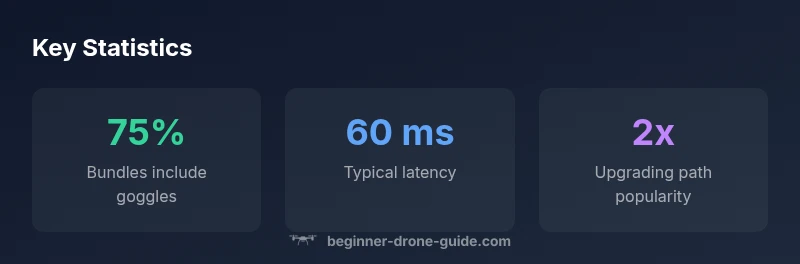
Latency in FPV goggles affects how quickly your input translates to the drone’s movement. In practice, entry-level bundles exhibit higher end latency (often around 60-120 ms), which is noticeable but workable for learning. External interference from nearby wireless devices can increase jitter; reduce this by choosing a quieter frequency band, relocating to a clearer space, or using antennas with better gain. The real-world takeaway is that latency is a key learning signal: as you progress, upgrade to lower-latency goggles for a more responsive feel, but don’t rush the upgrade before you’re confident with basic controls.
Upgrading or Mixing Goggles with Existing Drones
Many beginners start with a bundled kit and later upgrade goggles as they improve. When mixing goggles with an existing drone, ensure compatibility between the video transmitter and the goggles’ receiver, particularly the frequency band (most commonly 5.8 GHz). Some ecosystems favor a single brand for both drone and goggles to minimize compatibility headaches; others allow cross-brand compatibility but may require adapters. A prudent approach is to pair goggles with a drone that shares the same control protocol and to test in a controlled environment before venturing to open spaces. This staged approach aligns with the Beginner Drone Guide Analysis, 2026 guidance on smart upgrades that balance cost, safety, and performance.
Real-World Use Cases: Learning, Aerial Filming, and Racing
Goggles dramatically improve situational awareness, making it easier to learn precise positioning and smooth maneuvers. For new pilots, goggles help with alignment, depth perception, and the sense of speed, which translates into safer flights and quicker skill acquisition. In filming scenarios, goggles help you frame shots through the drone’s camera with greater confidence, enabling more stable cinematic movements. Racing enthusiasts use goggles to gauge speed and proximity to obstacles, but beginners should start in slow lanes and gradually increase complexity as competence grows. Across these scenarios, the common thread is patience, practice, and adherence to safety guidelines.
Maintenance, Troubleshooting, and Common Issues
Regular maintenance keeps goggles and drones performing reliably. Clean the lenses, inspect cable connections, and update firmware from reputable sources. If the video link cuts out, verify the power supply to the transmitter, rebind the drone, and try a different frequency band if available. Battery management is essential; avoid deep discharges and store batteries inappropriate temperatures. If fogging occurs in goggles, ensure proper ventilation and consider anti-fog solutions designed for eyewear. The key is to create a simple, repeatable pre-flight routine to catch issues before they become problems.
Comparison of drone types and goggles inclusion
| Drone Type | Goggles Included | Latency (typical) | Notes |
|---|---|---|---|
| Entry-level Ready-to-fly Drone | Included in some bundles | 50-120 ms | Great for beginners; straightforward setup |
| FPV Racing/Performance Drone | Often sold separately | 20-40 ms | Requires more experience; high-speed handling |
| Drones with Built-in Goggles | Yes (all-in-one) | 120-200 ms | Convenient; limited upgrade paths |
| Kit with Box-style Goggles | Yes (kit) | 60-100 ms | Budget-friendly; easy to learn |
Frequently Asked Questions
What drones come with goggles in a package?
Many beginner FPV kits include goggles as part of the bundle, designed to reduce setup complexity for first-time pilots. Always verify box contents before purchase to ensure goggles are included.
Many beginner FPV kits include goggles in the box, but always check the package contents before buying.
Can I use any goggles with any drone?
Goggles and drones must share a compatible video transmitter and receiver, usually on the 5.8 GHz band. Cross-brand compatibility is possible, but may require adapters or additional configuration.
Goggles and drones need to use the same video-band and receiver; cross-brand setups are possible but may require extra steps.
What latency should I expect with goggles?
Entry-level goggles typically offer latency in the 50-120 ms range. Lower latency improves responsiveness, but beginners can still learn with higher-latency setups.
Expect about 50 to 120 milliseconds of latency in beginner goggles, which is workable for learning.
Are goggles safe for beginners?
Yes, when used with proper training, safe equipment, and a controlled practice area. Always fly within your line of sight and follow local regulations.
Goggles are safe for beginners if you practice in a controlled area and follow safety guidelines.
Do goggles significantly add to the cost?
Goggles can add a meaningful amount to the initial setup, especially if you choose higher-end models. Budget-friendly bundles often provide a cost-effective learning path.
Goggles can raise initial costs, but bundled beginner kits offer good value for learning.
What about licensing or regulation when flying FPV with goggles?
Regulations vary by country. In many places, FPV flying requires a spotter or a pilot with a license, along with registration for certain drones. Check your local rules before flying.
Regulations vary; many regions require a spotter or licensing and drone registration for FPV flights.
“Goggles are a learning tool, and the best rigs for beginners balance comfort, latency, and safety. Proper fit and supervised practice matter most.”
Quick Summary
- Start with a bundled FPV kit to learn basics.
- Ensure goggles are compatible with the drone’s transmitter.
- Prioritize comfort, latency, and field of view when buying goggles.
- Practice safety routines before exploring advanced maneuvers.
- Upgrade gradually; plan a path from learning to performance.