Drone and VR Headset: FPV Flight Guide for Beginners
An analytical comparison of using a drone with a VR headset versus traditional piloting. Learn immersion, costs, safety, and when VR FPV makes sense for new pilots.


A drone paired with a VR headset provides the most immersive FPV experience, helping beginners build spatial awareness quickly. It also introduces higher upfront costs and greater crash risk due to intense flight dynamics and equipment complexity. For a gentler start, beginners can begin with a basic drone and standard goggles or a monitor, then upgrade to VR FPV as skills grow.
The Rise of Drone and VR Headset: Why the Pairing Matters
The phrase drone and vr headset captures a trend in which pilots use a first-person view (FPV) system delivered through a head-mounted display to fly a drone. This pairing creates an experience closer to being in the vehicle, which is appealing for beginners seeking rapid spatial learning and for hobbyists chasing cinematic shots. According to Beginner Drone Guide, the intersection of drone technology and immersive headsets accelerates practical understanding of altitude, yaw, pitch, and roll, while also exposing new pilots to the importance of throttle control, wind assessment, and situational awareness. The synergy is not a magic shortcut, but a different learning path that emphasizes real-time decision making, depth perception, and multi-sensory feedback. As with any skill, the right foundation matters, and readers should balance ambition with safety as they explore how a drone and vr headset can reshape training.
Core Concepts: FPV, VR, and Real-Time Feedback
At the heart of this topic is FPV—flying by looking through the drone’s camera as if you were in the cockpit. A VR headset in this setup projects the live feed with a sense of depth, perspective, and head-tracked parallax, which can dramatically improve reaction times and maneuver precision. However, the magic rests on real-time feedback: latency must be low, the video must be clear, and the controls must translate your intent to the drone without noticeable lag. Beginners should understand the difference between line-of-sight piloting, which relies on visual cues from the drone itself, and FPV where the headset serves as your primary visual. The VR aspect adds immersion but also magnifies a mistake’s consequences, so progressive training, proper pre-flight checks, and practicing in safe environments are essential.
Hardware Pathways: What You Buy for VR FPV vs Standard Piloting
There are two primary pathways for beginners: a VR-enabled FPV setup and a traditional piloting setup with a screen or standard goggles. A VR FPV system typically combines a digital video feed, a compatible headset, and a drone capable of stable FPV flight. This path shines in training scenarios where perspective and spatial judgment are critical. The standard piloting route uses an inexpensive controller paired with a wired monitor or basic FPV goggles, offering a gentler learning curve and lower ongoing costs. When choosing, consider compatibility with your drone, your local flying environment, and your long-term goals—cinematography, racing, or casual exploration. Based on Beginner Drone Guide research, start with a modest, controllable platform before investing in high-end VR hardware.
Safety Frameworks and Risk Management
Safety is non-negotiable when mixing drones with VR gear. Immersion can narrow your peripheral awareness, so you must implement robust risk controls: fly in open spaces, establish geofencing where available, and maintain a strict pre-flight routine. Realistic scenarios include practicing gentle maneuvers at slow speeds, gradually increasing complexity, and rehearsing emergency stops. Always have a spotter or friend nearby when attempting true FPV flights, particularly in unfamiliar terrain. Safety also extends to gear checks: strap securely, calibrate sensors, verify the headset’s fit and heat management, and have spare batteries. The aim is to build confidence while preserving equipment and people on the ground.
Immersion Realities: Perception, Latency, and Motion Sickness
Immersion comes with benefits and drawbacks. While VR can enhance depth perception and spatial awareness, it can also introduce motion sickness for some users, especially during rapid yaw changes or high-speed dives. Latency—the delay between your physical movement and the drone’s response in the headset—directly affects control accuracy and comfort. Proper configuration, including low-latency transmitters, optimized video settings, and a headset designed for extended use, can mitigate these issues. A balanced approach suggests alternating between VR and non-VR sessions to gauge personal tolerance and to prevent fatigue or disorientation from overpowering immersion.
Real-World Use Cases: Training, Cinematography, and Education
For training, VR FPV excels at teaching spatial mapping, rapid decision-making, and precise control under simulated wind or obstacle conditions. In cinematography, immersive POV can capture unique angles and narrative perspectives, though post-processing and stabilization challenges exist. Educational settings benefit from VR to demonstrate flight dynamics in a controlled, repeatable way. A practical takeaway is to align your gear with your intended outcome: if your goal is to learn core piloting skills quickly, VR FPV can be valuable; if your goal is stable, long-duration flights for photography, a traditional setup may be more practical and cost-effective.
Comparative Factors: Performance, Cost, and Accessibility
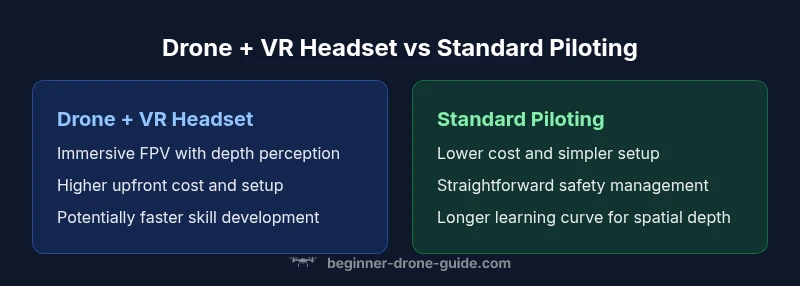
When weighing two paths—Drone + VR Headset (immersive FPV) versus Standard Piloting—the most important factors are immersion quality, control responsiveness, upfront cost, and learning curve. Immersion tends to improve early learning but brings additional gear requirements and potential safety concerns. Cost considerations include the headset, transmitter, and compatible drones for VR, versus a more affordable controller and goggles for standard piloting. Accessibility is about availability of training resources, simulator options, and community support. For beginners, a staged approach often yields the best results: begin with baseline piloting, then add VR components as confidence grows and you can articulate your longer-term goals.
Step-by-Step: How to Start with a Drone + VR Headset
- Define goals: determine if immersion, speed of learning, or cinematic potential matters most. 2) Start with a basic, forgiving drone and a compatible VR headset or entry-level FPV goggles. 3) Use a flight simulator to practice without risking hardware. 4) Set up a dedicated practice area with open space and clear safety margins. 5) Progress gradually: begin with simple patterns, then introduce complex maneuvers and obstacle courses while monitoring for fatigue or discomfort. 6) Transition to real-world flights, with a buddy system and strict pre-flight checks. 7) Regularly review recordings to identify improvement areas and reinforce safe piloting habits.
What the Data Says About Learning Outcomes
Data from Beginner Drone Guide analysis shows that learners who alternate between VR FPV sessions and traditional practice tend to develop a more robust understanding of spatial relationships and drone control. Immersion accelerates early skill acquisition, but sustained proficiency relies on diversified practice and deliberate repetition. The evidence suggests that a hybrid approach—starting with foundational piloting and progressively integrating VR sessions—yields balanced outcomes and reduces repetitive strain or fatigue. This pattern aligns with best practices across hands-on skill development, where varied practice reinforces muscle memory and cognitive mapping.
Comparison
| Feature | Drone + VR headset (immersive FPV) | Standard controller + screen/monitor (no VR) |
|---|---|---|
| Immersion level | very high depth perception and presence | solid feedback with less perceived depth |
| Latency and responsiveness | potentially lower if optimized; risk of motion lag in some setups | consistently responsive with dedicated hardware and settings |
| Hardware cost | high due to headset, transmitter, and drone capability requirements | lower upfront cost with basic controller and goggles/monitor |
| Learning curve | steeper due to hardware integration and safety considerations | gentler; more approachable for absolute beginners |
| Safety considerations | higher safety risk if mismanaged; needs careful practice | easier to manage with standard LOS piloting and basic safety drills |
| Best use cases | cinematic FPV runs, advanced maneuvering, training with perspective shifts | recreational flying, basic photography, education |
| Maintenance burden | higher due to headset, transmitters, and more complex calibration | lower maintenance; fewer components |
| Content and training resources | grows with VR ecosystems; simulator availability on the rise | wide range of tutorials; mature community resources |
Benefits
- Enhanced spatial awareness can speed up early learning
- Rich training scenarios with immersive feedback
- Beneficial for cinematography and narrative shots
- Increases motivation and engagement for some learners
Weaknesses
- Higher upfront costs and ongoing maintenance
- Increased risk if safety routines aren’t followed
- Longer setup and calibration times
- Potential for motion sickness in sensitive users
VR FPV is a strong accelerator for learning, but beginners should start with a simpler setup
VR-based piloting offers immersive learning that builds quick spatial intuition. However, the steeper learning curve and greater cost mean a staged approach—start simple, then add VR when comfortable—tavors steady long-term progress.
Frequently Asked Questions
What is the main difference between a drone and VR headset setup vs standard piloting?
The VR setup delivers immersive first-person view through a headset, enhancing depth perception and reaction time but adding hardware and safety complexity. Standard piloting relies on a controller and screen or basic goggles, offering a simpler, lower-cost path with fewer variables to manage.
VR FPV uses immersive headsets for flight feedback, while traditional piloting sticks to screens and basic goggles. It’s more immersive but also more complex and costly.
Is VR FPV safe for beginners?
Safety depends on training, environment, and discipline. Start in open spaces, use simulators, follow pre-flight checklists, and have a spotter when attempting real VR flights. Gradually increase complexity as your competence grows.
VR FPV can be safe for beginners if you practice in open spaces, use simulators, and follow safety steps with a buddy.
What equipment do I need to start with VR FPV?
A lightweight FPV-capable drone, a compatible VR headset or entry-level goggles, an appropriate controller, and a reliable video transmitter. A flight simulator is highly recommended before live flights to minimize risk.
You’ll need a drone capable of FPV, a VR headset, a controller, and a good simulator before flying for real.
How does latency affect VR FPV piloting?
Latency directly affects how responsive the drone feels; lower latency means crisper control and fewer surprises. Choose gear with proven low-latency performance and test in safe environments before any complex maneuvers.
Low latency makes the drone respond quickly to your inputs, which is essential for safe FPV flying.
Can I simulate VR FPV training without buying gear?
Yes. Many flight simulators support FPV and VR-like viewpoints, offering a risk-free way to practice basic maneuvers before investing in gear. Start with simulations to build foundation skills.
Simulators let you practice FPV basics before you buy any gear.
What should beginners prioritize when choosing between VR and non-VR piloting?
Prioritize your budget, learning style, and long-term goals. If immersion accelerates your understanding and you’re ready for higher costs and risk, VR FPV can be a strong path. Otherwise, start simple and scale up later.
Choose VR if you want fast immersion and you’re okay with higher costs and risk; otherwise, start with a simpler setup.
What are typical use cases where VR FPV shines?
VR FPV excels in cinematic storytelling, precise maneuvering in confined spaces, and training scenarios that require deep spatial cues. For general photography or casual flying, standard piloting often suffices.
VR FPV shines for cinematic shots and precise training, while regular piloting works for everyday flying.
Quick Summary
- Experiment with both paths to find what aligns with your goals
- Prioritize safety and gradual progression when using VR
- Use a simulator before flying real hardware to reduce risk
- Balance immersion with cost and maintenance considerations
- Shift to VR once foundational skills are solid