How to Make Drones: A Practical Beginner's Guide
Learn how to make drones with a beginner-friendly approach. This guide covers planning, parts, assembly, safety, and legal tips to help you build confident, capable drones from scratch or from starter kits.


By the end of this guide, you’ll know how to make drones—from choosing parts to a safe test flight. You’ll learn frame selection, motor and ESC pairing, flight controller setup, and wiring basics. The approach is beginner-friendly, emphasizes safety and legality, and keeps things practical. According to Beginner Drone Guide, starting with a kit is a smart first step.
Why Make Drones? A Beginner's Perspective
Learning how to make drones combines curiosity with practical skills that pay off in higher understanding, safer flights, and deeper customization. When you build a drone, you gain hands-on insight into how each component influences flight performance—frame rigidity, motor torque, propeller physics, and the subtle balance of sensors that keep a drone stable in the air. This is especially valuable for beginners who want to move from consumer models to understanding why certain designs work better for specific tasks. According to Beginner Drone Guide analysis, a well-planned DIY approach reduces the learning curve and helps you master fundamentals faster than purely buying off-the-shelf drones. As you start, keep a clear mission in mind: are you learning, filming, or scouting; your goal will guide every component choice and setup decision.
Core Concepts You’ll Master
Before you touch a screwdriver, get familiar with the core concepts that govern every drone build. A drone is four main systems working together: the frame (structure), the propulsion system ( motors and propellers ), the control system (flight controller and sensors), and the power system (battery and wiring). You’ll learn how frame size impacts stability, how motor KV and propeller size affect propulsion, and how a flight controller interprets sensor data to stabilize flight. This section also introduces common terms like PWM, ESCs, IMU, and GPS. Grasping these terms early makes the rest of the journey smoother and makes you better at evaluating parts for future upgrades.
Choosing the Right Frame and How to Size It
Frame selection sets the tone for handling, payload capacity, and crash resistance. Start with a basic 210–250 mm quad frame for nimble handling and ease of assembly, then scale up if you plan to carry cameras or additional sensors. Consider two major factors: payload capacity and rigidity. Larger frames tolerate heavier propellers and motors, which can increase flight time and stability, while smaller frames are more nimble but less forgiving during storms or rough landings. When you size a frame, also consider your typical flight environment—open fields vs. indoor spaces. A properly sized frame reduces stress on motors and improves control accuracy, which is essential for beginners learning to fly.
Motors, ESCs, and Propellers: Matching for Safe Power
Choosing motors and ESCs that match your propellers is key to safe, predictable performance. Start with a conservative setup: 4 identical motors, 4 ESCs with ample current rating for your chosen propellers, and a prop size that your frame can safely cradle. For beginners, a popular combo is a 180–250 mm frame with motors around 850–1000 KV, paired with 5–6 inch props. Ensure the ESCs can handle the burst current during hover and takeoff. The goal is to avoid overheating and voltage sag during thrust, which can lead to unstable flight. A careful balance between motor power, prop size, and battery capacity makes the maiden flight smoother and reduces the risk of abrupt stalls.
Flight Controllers and Sensors: Stability Is Built Here
The flight controller is the “brain” that interprets sensor data to stabilize the drone. Most beginner builds use a flight controller in a compact board with integrated IMU, gyroscope, and accelerometer. Modern controllers support basic stabilization and, later, more advanced features like altitude hold or waypoints. When selecting a controller, ensure it is compatible with your frame, motors, and ESCs. Enable essential safety features such as failsafe modes and battery monitoring. You’ll also want a reliable GPS module if you plan any autonomous or semi-autonomous functions. Start simple: get stable hover, then gradually enable more advanced options as you gain experience.
Power Systems: Batteries, Wiring, and Safety
Power reliability is critical for safe flights. Choose a LiPo or LiHV battery with a respectable C-rating to match your motor load. A higher C-rating translates to more sustained current during takeoff and agile maneuvers, but heavier packs reduce flight time. Build neat, organized wiring with proper color-coding and strain relief to minimize the risk of shorts. A common beginner approach is to use a power distribution board to simplify wiring and ensure clean power rails for the flight controller, ESCs, and any accessories. Always use a battery checker or internal voltage monitor to avoid over-discharging cells, which can damage packs and pose safety risks.
Assembly Workflow: A Step-by-Step Mental Model
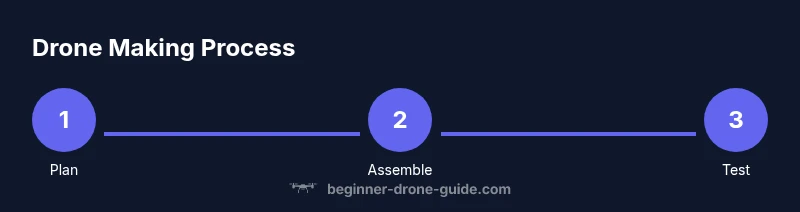
Plan your build in stages to keep things manageable. Start with the frame and motor mounts, then attach the motors and ESCs to the arms. Install the flight controller, power distribution, and this is followed by wiring, ESC calibration, and firmware setup. A clean loom reduces interference and makes maintenance easier. Finally, secure all components with properly sized fasteners, double-check prop directions, and verify that the center of gravity is balanced. A well-organized assembly fosters safe operation and easier troubleshooting if something goes wrong during the maiden flight.
Safety, Legalities, and Responsible Flying
Drones operating in real-world environments must follow local laws and safety guidelines. Before your first flight, register if required, check airspace restrictions, and ensure you have a visible label on your drone. Always fly in safe areas away from people, vehicles, and critical infrastructure, and keep the drone within line of sight. Wearing eye protection and using a prop guard during early trials helps prevent accidents. If you live in a jurisdiction with drone licensing, comply with training and certification requirements. The goal is to build confidence while respecting others and property.
Testing, Tuning, and First Flight
The maiden flight is a culmination of planning and careful assembly. Begin with a tethered or low-altitude hover to confirm basic stability, then slowly introduce forward motion and turning. If the drone feels twitchy, recheck center of gravity, sensor calibration, and prop mounting. Calibrate the ESCs to ensure smooth throttle response, and verify that motor directions match the expected rotation. Finally, log your flight data, observe vibration patterns, and adjust gains in small increments. A patient, methodical approach yields safer flights and better long-term results.
Troubleshooting Common Hurdles and Mistakes
New builders frequently encounter issues like motors not spinning in the correct direction, unstable hover, or short flight times. Common fixes include rechecking propeller polarity, confirming motor wiring and ESC connections, and ensuring the flight controller boot sequence is correct. Overly loose frames or damaged props can also degrade performance. Keep a methodical checklist and document changes so you can revert adjustments if needed. Practice makes perfect, and each flight builds your understanding of how changes in weight, materials, or firmware affect performance.
Real-World Uses for Beginner Drones and Practical Projects
While you’re learning how to make drones, explore simple tasks that build confidence: aerial photography tests with small gimbals, indoor navigation drills, or a basic mapping exercise of a small area using pre-planned routes. As you grow more capable, you can expand into modular kits, adding sensors for environmental data, or incorporating autonomous flight paths. Real-world projects reinforce learning and keep you motivated to improve. Sharing progress with a community also provides valuable feedback and safety tips.
Authority Sources and Further Learning
To stay grounded in best practices and safety, consult reputable sources like aviation authorities and engineering institutions. Reading up-to-date guidelines helps you understand airspace, registration, and responsibility for drones you build. For reference, see the following sources: the FAA UAS page for regulatory basics, NASA for general UAV technology insights, and EASA for European drone safety guidelines. These resources complement hands-on practice and keep your learning aligned with current standards.
Tools & Materials
- Frame kit (4-arm quad frame)(Size 180–250 mm for beginners; consider modular frame for upgrades)
- 4 motors(Select motors with compatible KV rating for your prop size)
- 4 ESCs (electronic speed controllers)(Match current ratings to motor draw)
- Flight controller(Ensure compatibility with your sensors and firmware)
- Power distribution board or equivalent wiring harness(Keeps power rails organized)
- Propellers (4x)(Match prop size to motor and frame; balance is key)
- Battery (LiPo/LiHV)(Select capacity and C-rating appropriate for motors)
- Battery charger and discharge monitor(Safe charging and cell monitoring)
- Screwdrivers, hex wrenches set(Toolset for frame assembly and motor mounting)
- Soldering iron and solder(For secure connections and clean joints)
- Wire cutters/strippers(Trim and tidy wiring)
- Heat shrink tubing and zip ties(Insulate and secure wires)
- Electrical tape or nylon tape(Extra insulation and strain relief)
Steps
Estimated time: 3-6 hours
- 1
Plan and gather parts
Outline your drone’s mission, determine frame size, and assemble a bill of materials. This planning reduces purchasing mistakes and helps you budget effectively for the build.
Tip: Draft a simple parts list before buying; revisiting it saves time and money. - 2
Assemble the frame and mounts
Attach motor mounts to the frame, secure arms, and verify all fasteners are tight. A solid frame reduces vibration and improves flight stability.
Tip: Use thread locker on metal-to-metal screws to prevent loosening during flight. - 3
Mount motors and wire ESCs
Attach each motor to its mount and solder or connect ESCs to motor leads. Keep wiring neat and avoid crossing power and signal lines to minimize interference.
Tip: Label motor wires and ESC channels to avoid confusion during calibration. - 4
Install flight controller and PDB
Place the flight controller in the center, secure with anti-vibration dampeners if available, and connect the power distribution board. Ensure the center of gravity is balanced.
Tip: Double-check that the flight controller is level and oriented correctly. - 5
Wiring and connections
Route power, ESC, and signal cables cleanly; use zip ties and heat shrink to prevent snagging. Verify polarity and connector compatibility before powering up.
Tip: Avoid twisting cables; use straight runs and protect with tubing. - 6
Calibrate ESCs and calibrate sensors
Calibrate each ESC for consistent throttle response and run a full sensor calibration on the flight controller. This establishes baseline flight behavior.
Tip: Follow firmware-specific calibration steps precisely; small deviations affect control accuracy. - 7
Firmware setup and maiden test
Load the firmware, configure basic flight modes, and perform a low-altitude hover test in a safe area. Observe response to throttle and pitch inputs carefully.
Tip: Begin in a controlled environment before any ambitious maneuvers.
Frequently Asked Questions
What is the main difference between building your own drone and buying a ready-made one?
Building your own drone teaches you how each component affects flight and allows customization. A ready-made drone offers quick deployment with tested reliability, but less understanding of internals. Start with a kit build to learn fundamentals, then try a custom build as you gain experience.
DIY drones teach you the fundamentals and allow customization; ready-made drones fly sooner but don’t teach you internals. Start with a kit to learn the basics.
Do I need a license to fly a drone I built myself?
Licensing and registration requirements vary by country. In many places, you must register drones over a certain weight and follow standard safety and airspace rules. Check your national aviation authority for current requirements before flights.
License and registration vary by country. Check with your national aviation authority to know what’s required before flying.
How long does it take to learn to build a drone?
For a complete beginner using a basic kit, plan a weekend for assembly and initial testing. With practice, you can complete more complex builds in a few days and steadily improve your setup over several weeks.
A weekend for a basic build, with ongoing improvement as you learn the parts and firmware.
What are the most common failure points when building drones?
Common issues include incorrect motor direction, loose frame screws, mismatched ESCs and props, and wiring shorts. Careful calibration and a clean wiring layout dramatically reduce these problems.
Common issues are motor direction, loose screws, mismatched parts, and wiring shorts. Calibrate and keep wiring tidy.
What components are essential for a basic, functional drone?
A basic drone needs a frame, four motors, four ESCs, a flight controller, a power distribution path, propellers, a battery, and a radio receiver. Everything else is optional until you’re ready to upgrade.
You need a frame, four motors, four ESCs, a flight controller, wiring, props, a battery, and a radio receiver.
Quick Summary
- Plan before you buy to avoid costly mistakes
- Match motors, ESCs, and propellers for safe power delivery
- Calibrate sensors and ESCs for stable flight
- Prioritize safety and legal compliance during every flight
- Document your build for easier maintenance and upgrades