How Drones Are Made: A Beginner's Manufacturing Guide
Explore the full journey of drone creation—from concept and design to assembly, testing, and safe operation. A practical, beginner-friendly walkthrough that explains frames, motors, controllers, batteries, and quality checks for confident building.


How drones are made: this guide outlines the full manufacturing journey from concept to flight-ready prototype. Learn about frame design, propulsion, control systems, power, and safety testing. According to Beginner Drone Guide, the process balances performance, reliability, and cost. By the end, you’ll understand common build paths for hobbyists and how professional production differs.
What goes into a drone
Drones are composed of several interlocking systems that work together to achieve stable flight and useful sensing capabilities. At the core is a lightweight frame that supports four key subsystems: propulsion, power, control, and payload options. Propulsion comes from brushless motors paired with propellers; power is supplied by a battery that determines flight time and weight; the flight controller, sensors, and radio link manage stability, navigation, and control inputs. Other components like GPS, obstacle sensing, and cameras determine what your drone can do in practice. As Beginner Drone Guide notes, beginners should focus on safe, modular designs to reduce risk and make upgrades easier. A well-chosen starting point helps you learn concepts like center of gravity, motor count, and how different frames impact flight.
Design considerations for beginners
When designing or choosing a starter drone, consider frame material (carbon fiber vs. reinforced plastic), weight, stiffness, and cost. Carbon fiber frames are strong and light but can be pricier; plastics are affordable and forgiving for beginners. For most hobbyists, a quadcopter layout (four motors) offers a good balance between handling and simplicity. Frame size matters: smaller frames are nimble but carry less payload and power; larger frames handle heavier loads and resist wind better. Planning for modular upgrades—such as swapping motors or adding a camera—helps you learn progressively without rebuilding from scratch.
Core components explained
- Frame: the skeleton that ties everything together. Look for mounts that match motor positions and allow for easy access.
- Motors: brushless DC motors provide efficient, reliable thrust. Quantity usually equals the number of axes (4 for a quadcopter).
- ESCs: electronic speed controllers regulate motor power. Keep ESCs matched to motor current ranges to avoid overheating.
- Flight controller: the “brain” that maintains stability and executes flight modes. Common beginner-friendly boards offer auto-leveling and easy calibration.
- Battery: LiPo packs are common for drones, balancing energy density with weight. Always observe proper voltage, charging, and storage practices.
- Propellers: pick sizes and pitches that suit your frame and motors; balanced props reduce vibration.
- Radio link and receiver: a reliable controller connection is essential for responsive control.
- Sensors and payload: GPS, obstacle sensors, and cameras expand capabilities but add cost and complexity.
From concept to prototype: manufacturing workflow
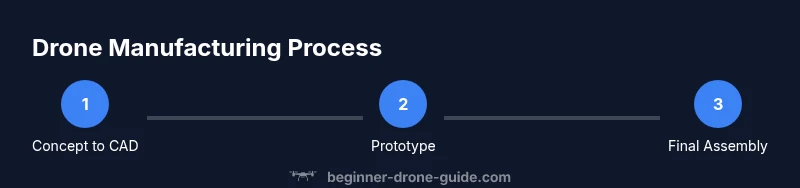
A drone starts as a concept, then moves through CAD (computer-aided design) to define parts and tolerances. Engineers perform simulations for strength, vibration, and aerodynamics before committing materials. Prototyping often involves 3D-printed or CNC-cut frames and iterative testing. Once a design proves viable, assemblies shift from single models to repeatable processes, with standardized wiring harnesses and modular components to save time. This workflow mirrors professional production while staying approachable for learners.
Safety, testing, and quality control
Quality control is as important as clever design. Before any flight, inspect frame integrity, secure fasteners, and proper wiring. Bench tests of the ESCs, flight controller, and sensors help detect issues without propellers turning. Progressive flight tests—start with a hover in a calm area, then small, controlled movements—reduce risk of crashes. Begin with safety gear and keep others clear of the test area. Beginner Drone Guide analysis shows that systematic testing reduces surprises during real flights and builds confidence in your build.
A practical build example: a beginner quadcopter
Imagine a small quadcopter in the 180–250 mm class built from a simple, off-the-shelf frame with four identical brushless motors. Use four lightweight ESCs, a compact flight controller, a basic GPS for position hold, and a 2S–4S LiPo battery suitable for the frame size. Attach propellers carefully, route wiring cleanly, and secure power distribution. This kind of modular, entry-level build makes it easier to swap components as you learn, while giving you a tangible, flyable platform to practice on.
Common mistakes and how to avoid them
- Skipping a proper calibration routine can result in unstable flights. Always complete accelerometer, compass, and radio calibrations before your first hover.
- Overloading the frame with heavy payloads defeats stability and reduces battery life. Start light and upgrade in increments.
- Ignoring safe LiPo handling leads to fire risk. Use a fireproof bag, never puncture a battery, and follow charging guidelines.
- Poor cable management can cause shorts or interference. Keep wiring tidy and separate power and data lines where possible.
Scaling up: when you move from hobby to production
As you gain experience, you may scale your project from a single prototype to small-batch production. This involves refining bill of materials, standard operating procedures, and quality checks. You’ll also consider certifications, licensing, and compliance depending on your region. For many enthusiasts, the journey remains about learning and safety, with opportunities to collaborate, document repurposed parts, and share improvements with the community.
Tools & Materials
- Frame kit (quad frame, 180–250 mm class)(Aim for modular mounts and accessible wiring paths)
- 4 brushless motors(Choose motors with compatible kv rating for your frame and battery)
- 4 ESCs (electronic speed controllers)(Match current rating to motor draw; consider programming headers)
- Flight controller(Look for beginner-friendly firmware with auto-leveling)
- Propellers(Balance before use; ensure correct orientation for each motor)
- LiPo battery (2S–4S)(Use a battery with appropriate C-rating and capacity for your setup)
- Power distribution board or wiring harness(Helpful for clean power routing in complex builds)
- Radio transmitter/receiver(Ensure compatibility with flight controller protocol)
- Soldering iron, wires, and heat shrink(For reliable, neat connections)
- Multimeter(Useful for voltage checks and continuity tests)
- Screwdrivers and thread locker(Secure fasteners to avoid loosening in flight)
Steps
Estimated time: 2-4 hours
- 1
Choose frame size and layout
Select a frame in the 180–250 mm class to keep the build approachable. Confirm motor mounting holes align with your motors and ensure space for wiring and a flight controller.
Tip: Document your chosen dimensions and keep a diagram handy to guide later steps. - 2
Mount motors to the frame
Attach each motor to its designated corner using the frame’s mounting hardware. Verify each motor spins freely and is oriented correctly (clockwise vs. counterclockwise).
Tip: Double-check motor polarity before soldering ESC leads. - 3
Install ESCs and power wiring
Secure ESCs near the motors and route power wires along frame rails. Use a power distribution approach that minimizes weight and avoids shorts.
Tip: Keep power and signal wires separate to reduce interference. - 4
Mount flight controller and connect sensors
Place the flight controller so it remains level and protected. Connect accelerometer, gyro, and any optional sensors according to your firmware guide.
Tip: Check orientation markers on the FC to ensure proper flight-axis alignment. - 5
Wiring harness and battery connection
Create clean, labeled harnesses for power, ground, and signal lines. Secure the battery strap and verify safe clearance around moving parts.
Tip: Test continuity before plugging in the first power source. - 6
Calibrate and configure the flight controller
Run the calibration sequence for accelerometers and the compass. Set up basic flight modes and throttle curves according to the firmware docs.
Tip: Calibrate in a magnetic-free area to avoid compass deviations. - 7
Bench-test and perform initial hover
Without propellers, verify control outputs. Then perform a hover test with prop guards in a safe, open space.
Tip: Stay nearby to cut power quickly if controls behave unexpectedly.
Frequently Asked Questions
What are the essential components of a beginner drone?
A beginner drone typically includes a frame, four motors, four ESCs, a flight controller, a battery, propellers, and a radio link. Optional features like GPS or obstacle sensors add capability but increase complexity.
A beginner drone needs a frame, motors, ESCs, a flight controller, a battery, propellers, and a radio link to start learning.
Do I need electronics knowledge to build a drone?
Basic electronics helps with troubleshooting and safe wiring, but many beginner builds come with guided wiring diagrams and user-friendly firmware. Following step-by-step guides reduces the learning curve.
Basic electronics helps, but guided builds make it accessible for beginners.
How much does it cost to start a DIY drone?
Costs vary based on frame quality, components, and sensors. A minimal, safe starter setup is typically less expensive than advanced, feature-rich systems; consider a budget for spare parts and tools.
Costs vary, but start with a simple kit and plan for extras as you learn.
Is it legal to fly a DIY drone in my area?
Drone regulations differ by country and region. Check local aviation authority guidelines for registration, pilot certification, and airspace restrictions before flying.
Regulations vary; contact your local aviation authority for specifics.
What safety precautions should I take?
Wear eye protection when testing, keep hands away from spinning props, and perform battery charging and storage in safe locations. Use prop guards during early flights.
Always wear protection around props and charge in a safe area.
How long does it take to learn and assemble a beginner drone?
Initial assembly and understanding basic flight can take several evenings. Mastery comes with practice, incremental upgrades, and progressively more challenging flights.
A few evenings to assemble and learn the basics, more to master advanced features.
Watch Video
Quick Summary
- Plan your build around a modular, beginner-friendly frame.
- Calibrate sensors and test progressively for safe flight.
- Keep wiring tidy and labeled for easy upgrades.
- Practice with safe envelopes and scaled payloads before advanced features.