How to Fly a DJI Drone Without GPS: A Practical Guide for Beginners
Learn how to safely fly a DJI drone without GPS with a practical, step-by-step approach, including preflight checks, manual control, and GPS-denied troubleshooting for beginners.


To perform GPS-denied flight, you’ll switch to manual controls, maintain visual line of sight, and practice calm, controlled inputs. This guide explains the essential steps, safety checks, and drills for beginners learning how to fly a DJI drone without GPS. According to Beginner Drone Guide, patient practice in open spaces is the fastest path to competence.
Understanding GPS-denied flight on a DJI drone
When a DJI drone operates without GPS, it relies on internal sensors and the pilot's stick inputs to maintain position and orientation. GPS-denied flight requires precise control, deliberate movements, and a clear plan for the flight path. This section clarifies what happens when satellite signals are unavailable, how the drone behaves in hover and drift situations, and why beginners should treat GPS-free flight as a distinct skill set. According to Beginner Drone Guide, approaching GPS-denied flight with a learning mindset and a safe practice area accelerates competence while minimizing risk. The key idea is to translate instinctive, GPS-assisted routines into deliberate manual control and conservative flight patterns. By understanding the limits of indoor and outdoor environments, newcomers can build a solid foundation before attempting advanced maneuvers.
Related concepts to know: stick sensitivity, wind drift, altitude control, and the drone’s inbuilt stabilization system. Remember, GPS-free flight is not about defeating the drone; it’s about working with its physics and sensors to stay in control when satellite data isn’t available.
Safety-first approach: risk assessment and environment
GPS-denied flight introduces higher risk from wind, obstacles, and misjudged distances. Before you fly, perform a quick risk assessment: choose an open, obstacle-free zone; check weather conditions; and establish a conservative altitude ceiling. Keep the drone within visual line of sight at all times and designate a spotter if possible. According to Beginner Drone Guide, the safest GPS-free flights happen in clear, calm conditions with predictable airflow. Always review a simple risk checklist before every practice session and avoid flying near people or sensitive sites.
Key safety considerations: maintain a clear escape route, know your wind limits, and have a plan to abort if the drone starts to behave unexpectedly. This mindset reduces surprises when GPS signals vanish.
Preflight and gear: essentials for GPS-free flight
A successful GPS-denied flight starts with thorough preparation. Ensure your drone’s battery is fully charged, the controller is ready, and spare props are available. Check your prop guards if you plan to use them, and verify that compass and IMU calibrations are recent so sensor readings are reliable once GPS is unavailable. Bring tools to manage minor repairs and a timer or clock to track flight duration. The goal is to minimize mid-flight surprises by laying a solid groundwork before liftoff.
Helpful prep tips: study the flight area for power lines, trees, and crowds; ensure the landing zone is clear; and perform a brief hover test to confirm stability before moving toward your target area.
Core flight skills without GPS: manual control in practice
Without GPS, flight control hinges on fluid, small stick inputs and a calm, deliberate pace. Practice gentle throttle control for vertical movement, precise yaw to maintain heading, and smooth roll/pitch for lateral motion. Build muscle memory through slow, incremental movements that translate into predictable, controllable flight. Beginner Drone Guide emphasizes practicing these fundamentals in a wide-open space to develop confidence before attempting more complex paths.
Practical focus areas: hover stability without “automatic” stabilization, predictable response to wind gusts, and maintaining altitude with minimal drift. These core skills form the backbone of GPS-free flight.
Takeoff, hover, and landing without GPS
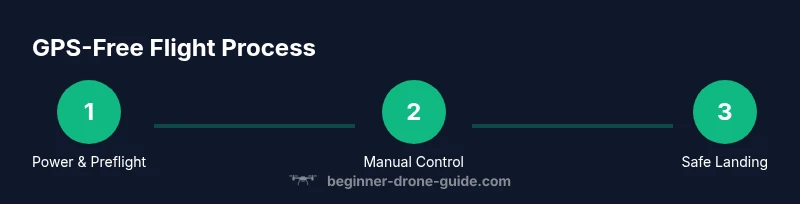
Takeoff should be gradual: lift a few feet, settle into a stable hover, and verify there’s no drift. Hovering without GPS requires continuous minor corrections to counteract wind and rotation. When landing, descend slowly while watching for sudden shifts in attitude or altitude. If you lose stability, pause, re-establish a steady hover, and proceed with a controlled landing in the safest possible spot. The objective is smooth, reliable execution rather than speed.
Best practices: choose a clear, flat surface; avoid uneven ground; and keep your descent slow enough to recover if the drone begins to drift.
Troubleshooting GPS-denied scenarios and wind
In GPS-denied flight, wind is a major factor. If you notice unexpected drift, halt forward motion and correct by micro-adjusting pitch and roll to re-center the drone in the air. If the drone starts to drift toward obstacles, back away slowly and re-establish a new path with conservative angles. Being prepared with a quick abort plan and a downward awareness of the ground helps prevent collisions. Beginner Drone Guide recommends practicing in moderate wind first to understand the drone’s response curve without GPS data.
Common issues: sudden yaw changes, altitude loss without noticeable input, and drift toward hazards. Systematic practice helps you anticipate and counteract these behaviors.
After-action and practice plan to build confidence
A GPS-free practice plan should be incremental and repeatable. Start with short, low-intensity flights that emphasize hover stability, then gradually add small directional movements. Track your progress by noting how long you can maintain control, how quickly you recover from drift, and how consistently you can land safely. End each session with a quick debrief: what worked well, what surprised you, and what you’ll adjust next time. As the Beginner Drone Guide team notes, consistency over aggression yields the best long-term results.
Tools & Materials
- Fully charged drone battery(Essential energy source for safe practice; bring a spare if available)
- Controller with a charged display device(Ensure telemetry and settings are visible during GPS-free flight)
- Spare propellers(Useful for quick replacement after a minor strike)
- Propeller guards (optional)(Adds protection in obstacle-rich environments)
- Calibration tools (manual/phone app guidance)(Use if IMU/compass prompts arise during setup)
- Open practice area (paved or grass, away from people)(Safe environment is non-negotiable for GPS-free drills)
Steps
Estimated time: 60-90 minutes
- 1
Power on and perform a preflight check
Turn on the drone and controller. Verify battery level, check for debris on propellers, and confirm that the drone’s compass/IMU are calibrated as per the manufacturer’s guidance. This prepares you for accurate sensor data and predictable responses.
Tip: Confirm sensor status in the app and look for any warning indicators before liftoff. - 2
Calibrate compass and IMU
Run compass and IMU calibrations in a wide-open area away from metal structures and power lines. Proper calibration reduces drift and unplanned yaw when GPS is unavailable.
Tip: Do calibrations at the same time of day and in similar environmental conditions for consistency. - 3
Switch to manual flight mode
Disable reliance on GPS-based stabilization by switching to manual or attitude mode, depending on your drone. Verify you can hold a hover with small, controlled inputs.
Tip: Practice keeping the aircraft level during hover; tiny stick movements matter more in GPS-free flight. - 4
Takeoff and establish a stable hover
Lift slowly to a few meters, then hold a steady hover. Check for any tendency to drift and correct with subtle stick inputs while watching the ground reference.
Tip: Keep a constant watch on altitude to prevent inadvertent climbs or descents. - 5
Practice precise directional movement
Gently move forward, backward, and side-to-side with small inputs. Build muscle memory for stable, predictable motion without GPS stabilization.
Tip: Reset to hover between any directional moves to re-check stability. - 6
Control altitude and wind effects
Work on maintaining altitude in light wind by making minor throttle adjustments. Wind can push the drone off course more quickly without GPS assistance.
Tip: Choose a day with minimal gusts to establish baseline performance. - 7
Handle drift and obstacle avoidance
If drift occurs toward an obstacle, reduce power, stabilize, and re-route with gradual, small movements. Always have a clear escape path.
Tip: Scan the area for potential hazards before changing direction. - 8
Post-flight checks and data review
Power down safely, inspect props and landing gear, and review flight telemetry for any anomalies that occurred during GPS-free activity.
Tip: Note what you learned and plan a focused practice drill for next time.
Frequently Asked Questions
Is it legal to fly a DJI drone without GPS in my area?
Regulations vary by country and region. Always check local aviation rules and fly in permitted zones with proper permissions. GPS-free flight typically requires keeping the aircraft within visual line of sight and avoiding restricted airspace.
Regulations vary by location, so check local rules. Fly in permitted areas and keep the aircraft in sight.
Can I still use Return-to-Home without GPS?
Most DJI models rely on GPS for RTH. Without GPS, RTH may be unavailable, so plan your landing zone in advance and be prepared to land manually.
RTH usually requires GPS; plan to land manually when GPS is not available.
What weather conditions are safe for GPS-denied flight?
Choose light winds, clear skies, and dry conditions. Wind and precipitation degrade control and increase drift risk when GPS data isn’t being used.
Stick to light winds in clear, dry conditions for GPS-free practice.
What are signs of GPS loss during flight?
Warning indicators may show on the controller, and automatic stabilization can feel off. Expect drift and reduced responsiveness when GPS data isn’t available.
Expect drift and slower response when GPS data is unavailable.
How should I practice GPS-free flight safely as a beginner?
Start in a large, open space with a calm environment, practice slow, small movements, and gradually increase complexity as you gain confidence.
Begin in a safe, open space and increase difficulty gradually as you gain control.
What gear helps during GPS-denied practice?
Spare propellers, extra batteries, and a spotter help manage risk and extend practice time in GPS-free flight.
Carry spare props and extra batteries, and fly with a spotter when possible.
Watch Video
Quick Summary
- Prepare an open practice area before GPS-free flights.
- Master manual inputs with small, controlled movements.
- Never rely on GPS features when GPS is unavailable.
- Progress gradually and review each flight for improvement.