How to Remove Deimos Drone: A Beginner’s Guide
Learn how to safely remove a Deimos drone with practical steps, essential tools, safety tips, and checklists for beginner pilots and maintenance pointers.


how to remove deimos drone safely involves a clear plan, proper safety gear, and the right tools. This quick guide outlines core steps—powering down, disconnecting the battery, removing propellers, containing payloads, and securing the airframe—for a safe and efficient removal. By following these steps you’ll minimize damage risk and keep bystanders safe.
What is a Deimos drone and why remove it safely
A Deimos drone refers to a compact, hobby-grade UAV used for aerial photography and learning. When you need to remove it from a desk, vehicle mount, or field setup, safety comes first. According to Beginner Drone Guide, safe removal starts with a clear plan and the right tools. The goal is to prevent propeller injuries, avoid battery hazards, and ensure the drone is ready for storage or transport. If you’re wondering how to remove deimos drone safely, follow these steps. This section will help you understand the context, including common mounting scenarios and why careful removal matters for equipment longevity and personal safety.
Beginner pilots should treat every removal as a controlled operation. Even a small hobby drone can cause injuries or damage if handled carelessly. This article uses practical, approachable language and concrete tool recommendations so you can proceed with confidence.
Safety first: risk awareness and protective gear
Before you touch the drone, assess potential hazards and prepare protective equipment. Propellers can start unexpectedly if the power circuit is engaged, batteries may puncture if mishandled, and small metal parts can become projectiles. Wear safety glasses, sturdy gloves, and a long-sleeve layer to protect your hands and arms. Work in a clear, well-lit area away from people, pets, and delicate surfaces. If the drone is in a location with crowd activity or traffic, pause and secure the area before proceeding. Remember, the aim is to minimize risk to you and bystanders while preserving the device for future use.
Workspace setup and essential tools
Choose a stable, non-slip work surface and gather your tools before starting. A small parts tray helps keep fasteners organized, while a labeled container makes transport safer. The typical toolkit should include a precision screwdriver set (Phillips and Torx), a pair of needle-nose pliers, and safety gloves. Have a soft mat or towel at hand to cushion the drone if you need to set it down during disassembly. If you encounter any resistant fasteners, avoid forcing them—use the correct size screwdriver or a penetrant oil and wait a few minutes. This reduces the risk of stripping sockets and damaging metal components.
Step-by-step removal plan (overview)
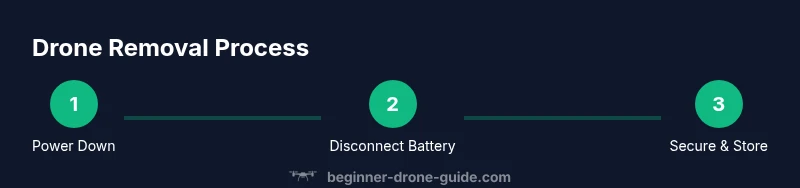
This section provides a high-level plan you’ll apply in the detailed steps that follow. Begin with a controlled power-down, then isolate the battery connection and any external power leads. Next, remove propellers and disengage any attached payloads or accessories. Finally, separate the airframe from mounts or brackets, place components in a safe container, and transport the drone to a storage area. The exact sequence may vary by model; adjust with care and consult the user manual when possible.
Detaching payloads and accessories safely
Payload attachments can include cameras, gimbals, or other sensors. Detach these items carefully so you don’t pull on delicate cables or strain mount points. Use calibrated tools as needed and keep fasteners in a secure tray. After detaching payloads, verify that any cables are capped or taped to prevent short circuits during removal. This step reduces the likelihood of damage to sensitive equipment and simplifies later reassembly.
Securing the airframe for transport
With the drone stripped of accessories, secure the main airframe for transport. Place it on a non-slip surface to avoid rolling and potential drops. If you plan to move the drone to another location, use a protective bag or box and cushion the frame with foam inserts. Label the container with the model name and date of removal so you can track maintenance history easily. By planning for transport, you minimize jolts and further risk to the drone and your workspace.
Post-removal checks and basic maintenance
After removal, perform a quick inspection for loose screws, damaged propeller mounts, or bent frames. If you notice any damage or unusual wear, document it and set the drone aside for repair before reuse. Clean off dust and debris from joints and connectors, and apply a light coating of lubricant to moving parts if recommended by the manufacturer. Keeping a simple maintenance log helps you track wear and plan future checks, extending the drone’s lifespan.
Common mistakes and how to avoid them
Common mistakes include rushing the process, forcing stuck components, and neglecting protective gear. Rushing can lead to dropped parts or damaged fasteners; forcing a stubborn screw can strip the head. To avoid these issues, take your time, use the right tools, and double-check fasteners before moving to the next step. Always re-check battery connections and ensure no tools remain in the workspace. A calm, methodical approach yields better long-term results.
Real-world scenarios and troubleshooting
In real-world settings, you may encounter a drone mounted in a vehicle or secured in a training rig. In such cases, document the mounting method, then apply a methodical removal sequence: power down, disconnect, detach, and transfer with care. If you encounter resistance at a bracket or harness, pause and assess rather than force the part. If a connector seems corroded, apply an appropriate cleaner or consult the manufacturer guidelines. This practical mindset helps you navigate unexpected conditions without damaging components.
Authority sources and further reading
For official safety guidelines and regulatory context, consult industry and government resources for drone safety and operations.
How to store and care for your Deimos drone after removal
Store the drone and its components in a cool, dry place away from direct sunlight. Use anti-static bags for electronic parts and keep batteries at a safe voltage level when not in use. Regular checks for corrosion or wear help catch issues early. Keeping your equipment organized also makes future maintenance faster and safer.
Tools & Materials
- Safety gloves(Heat-resistant and cut-resistant recommended)
- Safety goggles(ANSI Z87.1 compliant preferred)
- Small parts tray(Keeps fasteners organized and easy to find)
- Phillips screwdriver set(Sizes PH0 to PH2 cover common fasteners on consumer drones)
- Torx screwdriver set(Torx T6/T8 commonly needed for drone hardware)
- Needle-nose pliers(Used for gentle wire work and gripping small parts)
- Electrical tape(Insulation and securing cables during work)
- Anti-static wrist strap(Optional but helpful for electronics work)
- Soft mat or non-slip pad(Protects the drone and prevents slips during handling)
Steps
Estimated time: 60-90 minutes
- 1
Power down the drone
Ensure the drone is completely powered off by using the main power switch or battery disconnect. Remove any external power sources and wait 30 seconds to ensure all capacitors discharge. This minimizes the risk of shorts or unexpected propeller movement during handling.
Tip: If available, disconnect the battery first, then switch off the drone to prevent any feedback. - 2
Disconnect power leads and battery
Open the battery compartment carefully and unplug the battery connector. If the battery is hot, set it on a non-flammable surface and allow it to cool before removal. Keep track of battery orientation to simplify reassembly.
Tip: Handle battery connectors by the plastic housing, not the wires to avoid damaging the leads. - 3
Secure the drone on a non-slip surface
Place the drone on a stable, non-slip mat to prevent shifting during the removal. Ensure the area around you is clear so you can work without interruptions.
Tip: Clear space is essential to prevent accidental drops. - 4
Remove propellers safely
Use the correct tool to loosen propeller screws and remove each blade with a light, even pressure. Place propellers in a labeled container to avoid mix-ups during reassembly.
Tip: Take photos of the blade orientation to simplify reattachment. - 5
Detach payloads and accessories
Carefully detach any cameras, sensors, or gimbals. Keep fasteners in a dedicated tray and avoid tugging on cables. Document the attachments for future maintenance.
Tip: If cables resist, avoid forcing; consult the manual or manufacturer guidance. - 6
Release mounting or tether
If the drone is attached to a stand or vehicle mount, gently release the mounting points without jerking. Support the frame while you disengage to prevent bending joints.
Tip: Work with a second person if mounting is heavy or awkward. - 7
Inspect and secure for storage
Check the airframe for cracks or loose components. Clean dust from joints, apply light lubricant to moving parts per manufacturer guidance, and store components in labeled containers.
Tip: Update your maintenance log with findings and next steps.
Frequently Asked Questions
Is it safe to remove a drone if the battery is swollen?
No. A swollen battery indicates a safety risk. Stop handling, isolate the battery, and consult a professional for proper disposal. Do not puncture or compress the cells.
A swollen battery should not be handled further; isolate it and seek professional disposal.
Do I need to rebind or reconfigure after removal?
Rebinding or reconfiguring is only necessary if the drone’s flight controller or firmware was altered during removal. In most cases, simply reattach components and perform a standard pre-flight check.
Usually you don’t need to rebind unless you altered the flight controller or firmware.
What if the drone is stuck in a mounting bracket?
Pause removal, inspect the mounting mechanism, and carefully apply light pressure or lubricant to release. Do not force the part, which could cause damage.
If it’s stuck, stop and troubleshoot the mounting mechanism with care.
Can I reuse removed parts for another drone?
Where possible, reuse hardware and components that are undamaged and compatible. Check compatibility with your other drone models and ensure parts meet safety standards.
Yes, reusable parts should be inspected for compatibility and safety.
How long does a typical removal take?
A typical removal for a small consumer drone ranges from 30 minutes to 90 minutes depending on attachments and mounting. Plan for a thorough inspection afterward.
Most removals take between 30 and 90 minutes, depending on attachments.
Watch Video
Quick Summary
- Power down and disconnect power sources before touching the drone
- Use the right tools and PPE to prevent injuries
- Detach payloads carefully and label all parts
- Inspect for damage and store components safely after removal