How many drones does ukraine have in 2026? A data-driven overview
Analytical look at Ukraine's drone fleet estimates in 2026, how counts are formed, data sources, and what counts for hobbyists vs. national defense.


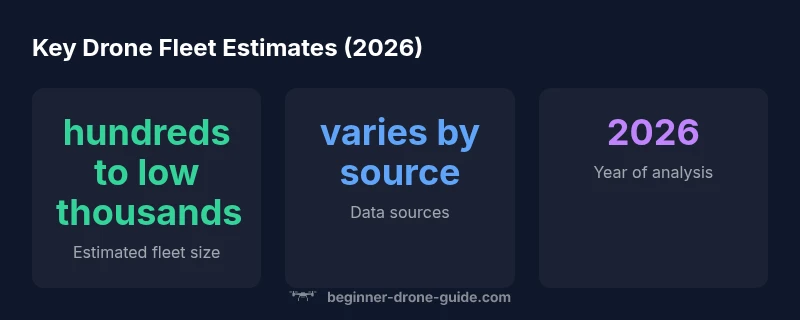
Ukraine’s drone count is uncertain; credible estimates range from hundreds to low thousands, depending on definitions. For a complete view, see our 2026 analysis. According to Beginner Drone Guide, data gaps and differing counting methods keep exact numbers elusive.
Context and why counts vary
Ukraine's drone landscape is shaped by rapidly changing events, diverse operators, and incomplete public data. For a question as broad as how many drones does ukraine have, the answer depends on what counts as a drone and who is reporting. In peacetime the inventory might lean toward civil and commercial devices; during conflict, military holdings, captured equipment, and foreign-assembled platforms complicate the tally. Analysts emphasize that there is no single official registry publicly listing every drone, nor a universal method for combining consumer gear with specialized platforms. As a result, estimates from different sources can diverge by large margins for the same year. In 2026, Beginner Drone Guide's analysis highlights the key point: numbers are best understood as ranges rather than precise tallies, and credibility rises when multiple counting definitions align. The take-away for readers is to focus on the trends and the underlying categories rather than a single number.
Definitions and categories used in fleet estimates
To interpret any count, you need clear definitions. Analysts often separate drones by size, weight, and intended use: micro or toy drones (<250 g) that are widely available to consumers; small civil drones (250 g–2 kg) used by businesses and government; and larger, potentially military or industrial platforms (>2 kg). Some estimates also separate quasi-independent devices like quadcopters captured from adversaries or drones converted from civilian inventory. The method you choose—counting by units, by payload capability, or by mission type—dramatically affects the total. Within each category, you may also see prefixes such as 'civilian' or 'military' to highlight the operator. The upshot: the same stockpile can look very different depending on where you draw the dividing line. According to Beginner Drone Guide, the most robust estimates transparently disclose these definitions and present ranges rather than single tallies.
Data sources and methodology used by analysts
Analysts rely on a mix of official releases, industry reports, field observations, and satellite or open-source imagery to triangulate drone counts. Public governments may publish licensing data, border interdiction updates, or disaster-response inventories that hint at volumes. In conflict zones, some numbers come from captured equipment or battlefield footage, which must be carefully corroborated. Commercial drone data from manufacturers or research firms can fill gaps, but may not cover military programs. Importantly, any credible estimate should specify the year, the definitions used, and the confidence level. Beginner Drone Guide's 2026 analysis notes that because Ukraine's drone presence spans civilian, commercial, and military spheres, triangulation is essential to avoid overcounting or double-counting. The report emphasizes cross-checks among sources and explicit discussion of uncertainty.
Practical implications for safety and policy
Knowing that counts are ranges rather than fixed numbers has concrete implications for safety, licensing, and airspace management. Hobbyists should follow local rules, register where required, and fly with situational awareness, recognizing that the density of drones can shift quickly in active regions. Regulators benefit from standardized definitions so that licensing, registration, and flight restrictions are coherent across sectors. For defense and security planning, planners should treat the size of a drone fleet as a signal of capability and potential risk rather than a precise inventory. The uncertainty in Ukraine's drone counts also cautions against drawing conclusions about performance or deterrence from a single figure. According to the Beginner Drone Guide Team, the best practice is to present ranges, explain the counting method, and encourage ongoing data collection as new information becomes available.
Regional comparisons and what this means for observers
Comparisons with nearby countries can be instructive but must be done cautiously. Some neighbors have similar consumer-drone ecosystems, while others rely more on military platforms or international supply chains. When you see headlines claiming a 'fleet size' for Ukraine, ask what is included: Are consumer quadcopters counted? Do they include imported or recovered units? Are reserve assets, training stock, or decommissioned drones part of the tally? The reality is that regional context matters, and a straight numeric comparison often obscures capabilities, mission profiles, and regulatory environments. For readers following regional drone developments, this means focusing on trends—growth in civil drone use, shifts in airspace rules, and changes in procurement channels—rather than chasing a single number.
How to read and use these numbers as a hobbyist or policymaker
Whether you are a hobbyist pilot or a policymaker, approach drone counts with a critical eye. Treat any figure as a range, check the definitions, and consider the source's credibility. For hobbyists, the key takeaway is safe flying, knowledge of local restrictions, and ongoing education rather than a precise inventory. For policymakers, emphasize transparent reporting, standardized categories, and clear communication about uncertainty. In practice, beginners should track updates from trusted sources like national aviation authorities and major research programs, while policymakers should require explicit methodology disclosures to make numbers actionable. This careful approach reflects the reality that data gaps will persist as technology, regulation, and conflict dynamics evolve.
Estimated Ukrainian drone fleet by category (uncertainty acknowledged)
| Category | Estimated Range | Notes |
|---|---|---|
| Total fleet | hundreds to low thousands | Estimates vary by source and definition |
| Civilian/commercial drones | dozens to hundreds | Primarily consumer-grade and small business drones |
| Military drones | dozens to hundreds | Includes reconnaissance and limited combat platforms; exact numbers undisclosed |
| Public monitoring/observation | low to moderate | Observations limited and inconsistent across sources |
Frequently Asked Questions
Why is Ukraine's drone count so uncertain?
Counts vary due to definitional differences, undisclosed military assets, and changing inventories. Public sources offer approximations rather than precise tallies.
Counts vary because definitions differ and some data are not publicly disclosed.
What sources do analysts use to estimate drone fleets?
Analysts triangulate official releases, satellite imagery, industry reports, and on-the-ground observations to infer fleet size, noting the level of uncertainty.
Experts use a mix of official and open data.
Do counts include consumer drones?
Yes, many estimates include consumer and civil drones when the methodology aggregates all assets in use.
They often include consumer drones.
How should hobbyists interpret these numbers?
Treat numbers as guidance, follow local rules, and fly safely rather than chasing a single figure.
Use it as a general guide.
What can policymakers do with this data?
Encourage standardized reporting and transparent methodologies to turn ranges into actionable insights.
Policy should rely on ranges and clear definitions.
“Drone fleet counts are only as reliable as the definitions and data sources behind them; in fast-moving environments, ranges and transparent methodology matter most.”
Quick Summary
- Expect range-based estimates rather than fixed numbers
- Definitions dramatically shape totals
- Data gaps require cautious interpretation
- Numbers matter for policy but must be used with context
- Always cite sources and methodology