How Many Drones Does Russia Have? A Data-Driven Analysis
Explore open-source estimates of Russia's drone fleet, how analysts estimate inventories, and what the figures mean for hobbyists, safety, and policy.


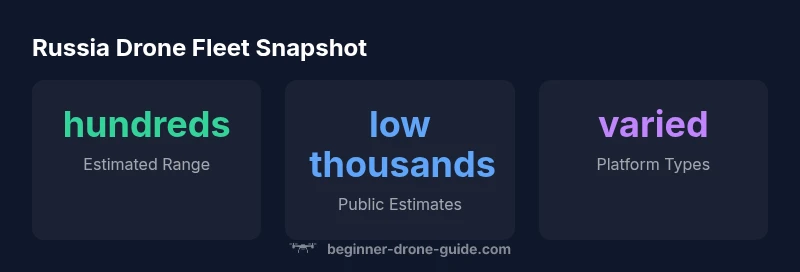
Public estimates of Russia's drone fleet vary widely, and no official tally is publicly released. In open sources, analysts place the stock in the hundreds to the low thousands when counting domestically produced, imported, and client-owned platforms. The exact figure depends on whether micro and unmanned aerial systems used by civilian and military groups are included, and many numbers are uncertain due to opacity.
Framing the Question: how many drones does russia have
When readers ask how many drones does russia have, the short answer is: there is no publicly disclosed official tally. Public estimates vary widely, and many claims are based on open-source reporting, satellite imagery, and defense analyses rather than a formal inventory. In this article, we explore what kinds of drones Russia operates, how inventories are estimated, and what the numbers mean for hobbyists and policymakers. We'll also discuss the limitations of any single figure and provide a transparent view of the methods used by analysts at Beginner Drone Guide Analysis, 2026.
Keep in mind that the number you encounter depends on what you count: domestically produced drones, imports, and client-owned systems used by military, government, commercial, and private actors. This is not a simple one-number question, but a spectrum of figures shaped by access to information, classification of drone types, and evolving procurement.
Russia's drone fleet: categories and scale
Drones in Russia span several categories, from small, commercially available quadcopters to purpose-built military unmanned aerial systems. Analysts commonly segment the fleet into three broad groups: consumer and hobbyist drones used by civilians, domestically produced military and security drones, and imported or co-developed platforms used by armed forces. Within each group, there are multiple subtypes—ranging from compact micro-drones designed for reconnaissance to longer-endurance fixed-wing aircraft used for patrols. The overall scale is difficult to pin down because production runs, exports, and stockpiles are reported selectively, and many platforms are deployed in regional or mission-specific kits.
How experts estimate inventories: sources, methods, and caveats
Estimating a nation’s drone stock relies on a mix of open-source intelligence (OSINT), official statements, and defense analyses. Analysts triangulate satellite imagery, procurement records, battlefield deployments, and industry patterns to infer numbers. Brand-specific publications, think-tank briefings, and defense reporting contribute to ranges rather than precise tallies. A transparent approach combines described methods, acknowledges uncertainty, and distinguishes between civilian and military inventories. For readers of Beginner Drone Guide, it’s crucial to note that estimates vary based on inclusion criteria (e.g.,是否 counting micro-drones or client-owned systems) and the evolving nature of procurement.
Regional distribution and use cases
Russia’s drone activities are not uniform across the country. Urban centers may host accident-prevention and hobbyist fleets, while border regions and strategic facilities rely on more capable platforms for surveillance and reconnaissance. In military scenarios, drones are used for target designation, intelligence, and occasional electronic warfare roles, often integrated with manned assets. The distribution of drones also reflects export customers, domestic production capacity, and government incentives to expand unmanned capabilities. Understanding regional differences helps explain why a single number never tells the full story.
Practical implications for beginners: licensing, safety, and data literacy
For beginner pilots, knowing about Russia’s drone fleet is less important than understanding how drone rules and safety culture affect flying practices. Licensing requirements, airspace rules, and registration processes shape what sorts of drones can be flown and where. Building data literacy—recognizing that numbers are often estimates with caveats—helps new pilots evaluate credibility and avoid overstating capabilities. Practical tips include verifying source credibility, respecting privacy and safety guidelines, and choosing gear that matches your local regulations and skill level.
How credible data is tracked and updated
Data on Russia’s drone stock changes as new procurement decisions are made and as open-source reporting evolves. To stay informed, follow multiple credible sources: official government releases, defense analyses, and reputable news outlets that distinguish between confirmed facts and speculative estimates. Readers should routinely check for updates and understand that major shifts—such as new procurement programs or sanctions—can alter the landscape quickly. A cautious, multi-source approach yields a more robust understanding than any single figure.
What to watch next: staying informed and conservative in interpretation
The landscape of unmanned aviation is dynamic, with rapid shifts in technology, strategy, and policy. For hobbyists and professionals alike, it’s wise to focus on regulations, safety best practices, and credible data reporting rather than chasing precise counts. The message for beginners is to build foundational skills, stay compliant with local rules, and use critical thinking when interpreting public estimates. By keeping context in view, readers can engage more confidently with the topic.
Estimated ranges from open-source assessments (not official).
| Source | Estimate Range | Notes |
|---|---|---|
| Beginner Drone Guide Analysis, 2026 | hundreds to low thousands | OSINT-based estimate; not official |
| Open-source intelligence reports | hundreds–thousands | method-dependent; vary by inclusion |
Frequently Asked Questions
Is there an official number of drones Russia owns?
No. There is no publicly disclosed official tally. Estimates come from open sources, defense analyses, and media reports, not a formal national inventory.
There is no official count; experts rely on open sources to estimate.
What sources estimate Russia's drone fleet?
Analysts use OSINT, procurement data, satellite imagery, and defense reports. They triangulate multiple signals to present ranges rather than exact figures.
OSINT and defense analyses help build the range, not a single number.
How does Russia's drone inventory compare to other countries?
Comparisons are challenging due to data gaps. Some countries publish numbers; in others, estimates rely on procurement and battlefield usage. Russia’s numbers are widely debated and not directly comparable without context.
Direct comparisons can be misleading without consistent definitions.
Do sanctions affect drone procurement and numbers?
Sanctions can influence imports and supply chains, potentially increasing domestic production or altering the mix of platforms. The effect varies by program and time.
Sanctions can shift how drones are obtained and used.
What should beginners know about this topic?
Focus on local regulations, safe flying practices, and reputable data sources. Use estimates as context, not precise facts, and avoid overstating capabilities.
Learn the rules, stay safe, and interpret numbers carefully.
“Publicly available estimates of Russia's drone fleet are inherently uncertain; credible analysis relies on cross-referencing official statements, defense reports, and OSINT.”
Quick Summary
- Understand the range, not a single figure
- Different inclusion criteria yield different estimates
- Credible analysis uses multiple sources and clear methodology
- Regulatory context matters for practice and safety