How Long Is the Drone Show: Run Time, Formats, and Planning
Explore how long a drone show typically lasts, factors that influence runtime, and practical planning tips for organizers and attendees. Learn runtimes by event type and how to estimate custom shows in 2026.


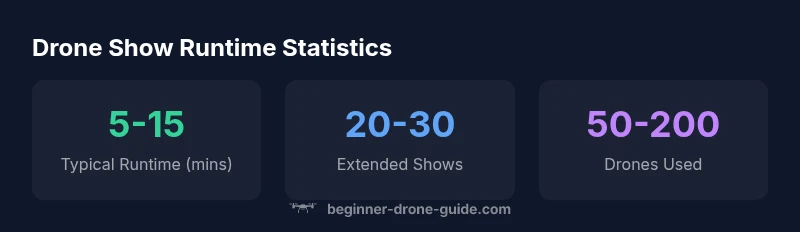
Most drone shows last between 5 and 15 minutes, with some extended productions reaching 20-30 minutes depending on the storyline and venue. Short demonstrations may run 3-5 minutes. Always verify the event schedule for the exact runtime and any intermissions. Factors like drone count, music synchronization, licensing constraints, and safety buffers also influence total time.
Why Runtime Matters for Drone Shows
If you’ve ever asked how long is the drone show, the answer depends on format, venue, and purpose. In practice, runtimes are crafted to balance storytelling with safety and audience attention. According to Beginner Drone Guide, most productions optimize pacing so each sequence lands exactly when viewers expect it, without overloading the timeline. The phrase how long is the drone show appears frequently in planning conversations because even a few extra minutes can require extra crew, power, and airspace clearance. For organizers, this means building in buffers for weather, equipment checks, and last-minute changes. For attendees, it translates to arriving on time and respecting the event schedule. In all cases, the goal is a seamless experience rather than a marathon of light and motion. By understanding the typical windows and the factors that push runtimes, you’ll be better prepared to plan, budget, and enjoy the show.
Typical Durations by Format
Drone show lengths vary widely by format. Short demonstrations at fairs or school events tend to run around 3-5 minutes, serving as a compact showcase or teaser. Standard entertainment shows—those designed for theater stages or stadiums—often run 5-15 minutes, with a carefully arranged sequence of formations, color changes, and synchronized music. Extended corporate or brand events commonly stretch into 20-30 minutes, using a narrative arc that ties the visuals to a product launch or message. Real-world productions may mix segments: a 5-minute opening, 8 minutes of choreography, a 2-minute interlude, then a 7-minute finale. These numbers are flexible and depend on factors like music licensing, drone count, ceiling height, and audience tolerance. If you’re planning, sketch a rough timing map with a few minute-by-minute milestones and be prepared to compress or expand certain acts as needed.
Planning for Organizers and Attendees
From an organizer’s perspective, timing is part art, part science. Start with a target runtime, then build a buffer of 5-15% to account for delays, weather, or technical hiccups. Attendees should check the schedule in advance and plan for natural breaks between acts. A well-communicated timeline reduces congestion and ensures safety margins, especially in outdoor venues where wind or crowds can affect performance. For beginners, consider a simple show script with clearly labeled segments and exit paths for the drones. For the audience, understanding the runtime helps set expectations for parking, seating, and post-show activities. Remember that different shows may demand different pacing; a shorter demo emphasizes precision, while a longer show favors storytelling. By aligning expectations with actual runtimes, everyone can enjoy a smoother experience.
Design Timing: Choreography, Music, and Safety
The timing of drone movements is integral to the perception of a show. Designers choreograph each sequence to synchronize with musical cues, lighting, and transitions. This alignment often dictates the overall runtime; a late cue or an extra beat can ripple through the entire sequence, nudging the end time forward. Strong shows use a timing matrix: segments, cues, drones involved, and expected duration. Safety considerations—like airspace clearance, battery checks, and contingency plans—can add or subtract minutes. For beginners, a practical approach is to plan for a few test runs and to embed safety briefings into the pacing, not as a separate block. When time is tight, prioritize core segments and maintain rhythm with shorter, repeatable formations rather than lengthy, complex aerial choreography.
Example runtimes by event type
- Weddings and private celebrations: 5-8 minutes, focusing on intimate formations and soft music cues. These shows emphasize atmosphere and scenic silhouettes rather than a long narrative arc.
- Festivals and large public gatherings: 10-20 minutes, expanding to multiple color palettes and synchronized masses. These runs require careful crowd management and contingency planning for weather.
- Corporate launches and brand events: 25-40 minutes, often structured as a story with a clear beginning, middle, and finale, culminating in a branded message. In all cases, planners should reserve time for setup, drone cleanup, and post-show acknowledgments. Realistic expectations help teams negotiate permits and ensure that the show fits within the broader program.
Safety, Permits, and Contingencies
Every drone show operates within safety and regulatory constraints. Runtime planning must factor in airspace clearance, weather options, and power availability. Permits may require a buffer around the scheduled end time to accommodate late changes or unexpected delays. Contingencies—such as backup drones, extra batteries, and alternate launching points—help protect the runtime against equipment failures. For newcomers, the most practical advice is to build a modular show with 3-4 core segments and optional add-ons that can be swapped depending on the time available. By thinking in terms of modules, you gain flexibility to maintain the intended rhythm even when conditions shift. A well-managed timeline reassures audiences, sponsors, and venue staff that safety and experience come first.
How to estimate runtimes for a custom show
If you’re designing a show from scratch, start by drafting a rough storyboard that maps each act to a target duration. Use a clock or timing tool during rehearsals to verify that the plan holds under pressure. Don’t forget to add buffers for weather, wind shifts, and last-minute drone substitutions. For beginners, it’s helpful to run a mock run with the minimum viable set: a single formation, a pre-programmed cue, and a short outro. As you gain experience, you’ll learn how to trade length for complexity without compromising safety. Remember, the most successful runtimes deliver a clear narrative arc and a satisfying finish, not simply a long sequence of lights.
Drone show runtimes by format
| Format | Typical Duration | Notes |
|---|---|---|
| Short demo | 3-5 minutes | Subset of the show during a set |
| Main show | 5-15 minutes | Core narrative and choreography |
| Extended/brand event | 20-30 minutes | Longer storyline with musical cues |
Frequently Asked Questions
How long does a typical drone show last?
Most drone shows run 5-15 minutes; longer corporate programs can reach 20-30 minutes.
Most drone shows run five to fifteen minutes, with longer programs possible.
Can runtimes be customized for smaller events?
Yes; runtimes can be adjusted by reducing segments, simplifying formations, or shortening cues.
Runtimes can be adjusted by trimming segments.
What factors influence the length of a show?
Format, narrative scope, music licensing, drone count, and venue timing all affect runtime.
Format, story scope, music rights, drone count, and venue timing influence length.
Do drone shows ever have intermissions?
Intermissions are uncommon in short shows, but longer events may insert a brief pause for adjustments.
Intermissions are rare, but longer shows may pause briefly.
Is there a minimum runtime for licensing or permits?
Most permits require a program schedule; minimums are case-specific, but planners should allocate time for setup and idle periods.
Permits usually require a schedule; minimums vary.
How should attendees plan around a drone show?
Check the event timetable, arrive early, and plan for pre-show safety briefings.
Plan to arrive early and follow pre-show timings.
“Timing a drone show is as critical as choreography; precise runtimes keep the story coherent and safety margins intact.”
Quick Summary
- Check the official schedule for exact runtimes.
- Expect variation by event type and venue.
- Build in safety and contingency buffers.
- Refer to a detailed timing map for precise planning.