What Drone Has the Longest Battery Life? A Practical Guide
Explore which drone offers the longest battery life, how endurance is measured, and practical tips for beginners to maximize flight time in real-world conditions.


The drone with the longest battery life is typically a fixed-wing or long-endurance industrial platform, not a consumer quadcopter. Under favorable conditions, fixed-wing designs and high-end endurance multirotors can achieve longer mission times—often 1.5 to several hours—compared to typical consumer drones that run 20–40 minutes. The exact leader depends on payload, flight mode, and weather, but fixed-wing platforms generally win on endurance.
How drone battery life is measured\n\nBattery life is typically reported as flight time under controlled test conditions, but real-world endurance depends on many variables. Manufacturers usually publish conservative numbers based on a standard payload and a calm environment. To compare apples to apples, also check energy capacity in watt-hours (Wh) and the specific energy density of the cells. For beginners, understanding this framework helps set realistic expectations for what a drone can do on a single charge. When you search for the drone with the longest battery life, you’ll often see fixed-wing and longer-endurance platforms topping the charts, but payload, airspeed, and weather will always impact the actual duration you experience.
Fixed-wing vs multirotor endurance: where the numbers come from\n\nFixed-wing drones generally achieve longer durations because they slice through air more efficiently, consuming less energy per kilometer. Multirotors, including high-end models, trade efficiency for hover ability, vertical takeoff and landing, and maneuverability. In practice, fixed-wing designs can offer several hours of flight on a single mission under ideal conditions, whereas consumer multirotors typically stay in the 20–40 minute range. The key takeaway is that endurance is a function of airframe efficiency, propulsion, and payload, not just the battery size.
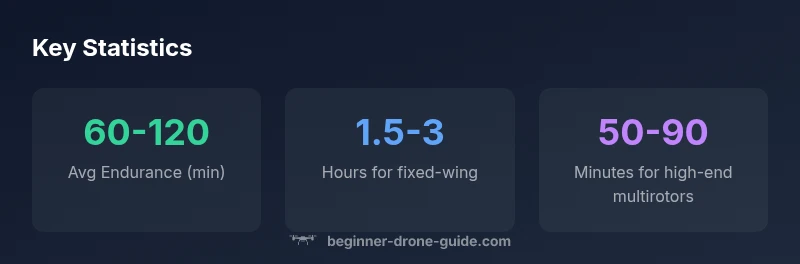
High-end endurance options: what to expect\n\nLong-endurance drones exist in both fixed-wing and VTOL (hybrid) categories. In professional survey, mapping, or search-and-rescue roles, these platforms may achieve 50–90 minutes for multirotors and 1.5–3 hours for fixed-wing or hybrid configurations, depending on airspeed, altitude, and payload. These figures assume minimal payload and optimal weather. For most hobbyists and small businesses, the practical ceiling tends to be lower due to payload constraints and regulatory considerations.
Real-world constraints: payload, speed, wind\n\nPayload adds weight, which directly reduces endurance by requiring more energy to maintain lift. Flying faster uses more power; headwinds can also decrease time-on-station and overall glide efficiency. Conversely, lighter payloads and efficient flight profiles can stretch endurance. Beginners should plan flights around conservative estimates and avoid maximum speeds or heavy cameras during long missions.
Case studies in endurance (conceptual)\n\nCase A: A fixed-wing survey drone carrying minimal sensors might achieve longer mission times than a typical consumer quadcopter, potentially reaching into the 1.5–3 hour window under calm conditions. Case B: A high-end multirotor with a compact payload and optimized batteries could approach the 60–90 minute mark, but only with favorable winds and careful flight planning. These cases illustrate how end-to-end endurance depends on mission design, not just battery size.
How to estimate endurance for a given drone model\n\nTo estimate endurance, start with the battery capacity in watt-hours (Wh) and the drone’s average current draw (A) at your intended flight condition. Endurance (hours) ≈ (Battery Wh) / (Voltage × Current). Adjust for actual payload, wind, and altitude. Use flight planning software and manufacturer data to refine estimates. This approach helps you compare models without relying on a single headline number.
Practical tips to maximize battery life for beginners\n\n- Lighten the payload and avoid nonessential accessories during learning flights.\n- Plan gradual accelerations and steady climbs to reduce peak power draw.\n- Use GPS-assisted flight modes to optimize energy use and hover stability.\n- Schedule flights in moderate temperatures and calm winds for the best endurance.\n- Pre-charge batteries to recommended levels and store them properly to preserve capacity.
What drone has the longest battery life: a buyer's checklist\n\nWhen evaluating endurance, compare fixed-wing vs multirotor, assess payload needs, and review real-world tests rather than marketing claims. Favor platforms with proven field performance data and serviceability, ensuring your choice aligns with your typical mission profile, local regulations, and budget.
mainTopicQuery=
]},
Endurance ranges by drone type
| Drone Type | Typical Endurance | Notes |
|---|---|---|
| Consumer Multirotor | 20-40 minutes | Best for beginners and common tasks |
| High-end Multirotor | 50-90 minutes | Optimized payload and batteries |
| Fixed-wing/Hybrid | 1.5-3 hours | Long flights with efficient airframe |
| Industrial Fixed-wing | 2-4 hours | Ideal for large-area surveys |
Frequently Asked Questions
What factors affect drone battery life the most?
Battery chemistry, payload weight, airframe efficiency, flight speed, altitude, and weather all influence endurance. Planning flights with lighter payloads, steady speeds, and favorable weather can significantly extend flight time.
Battery life depends on weight, design, speed, and weather; lighter loads and steady speeds help you fly longer.
Is there a drone that truly beats all others in battery life?
No single drone dominates battery life in every scenario. Endurance is highly mission-specific—fixed-wing platforms often last longer on long surveys, but payload and conditions matter as much as battery size.
No one drone wins every test; endurance depends on the job and conditions.
How can a beginner maximize flight time?
Start with light payloads, optimize flight paths, avoid rapid climbs, and use energy-efficient modes. Practice in calm weather to learn how to maintain steady power use.
Keep payload light, plan routes well, and fly in good weather to get more time in the air.
Do longer battery life drones require more expensive batteries?
Longer endurance often means higher capacity batteries or more efficient systems, which can raise upfront costs. Consider total ownership, including maintenance and charging cycles.
Sometimes you pay more for higher-capacity packs, but efficiency also matters.
Are fixed-wing drones suitable for beginners?
Fixed-wing platforms have steeper learning curves and require space for takeoff/landing, but they can offer longer endurance for surveyed missions. Start with a trainer or hybrid model if new to flight.
Fixed-wing sota require more space to learn, but they can fly longer.
What regulatory considerations affect endurance flights?
Regulations may restrict maximum flight time, especially beyond visual line of sight (BVLOS) or beyond certain altitudes. Always check local rules and obtain necessary authorizations before long flights.
Check local rules and approvals before long flights.
“Endurance is highly dependent on airframe efficiency, payload, and flight profile; fixed-wing designs typically offer the longest flight times when used for surveying and mapping.”
Quick Summary
- Prioritize fixed-wing or high-end endurance drones for maximum flight time
- Expect significant endurance variation with payload and weather
- Use energy-efficient flight planning to extend time
- For beginners, plan realistic flights around 20-40 minutes
- Review regulatory limits before long-endurance missions