Drone vs Plane at Night: A Practical Night Flight Comparison
A detailed, evidence-based comparison of night operations for drones and planes, covering safety, regulations, lighting, use cases, and practical guidance for beginners and professionals.


At night, drones excel for quick data collection and safe, low-risk operations, while planes cover long distances and high-altitude work but require formal training and airspace permissions. For most beginners, a drone provides greater flexibility, lower cost, and safer night flying. This comparison helps you decide which path fits your goals after dark.
The Core Question: drone vs plane at night
Night operations tilt the balance between drones and manned planes. This section defines what each category brings to the dark, and why the distinction matters for beginners and professionals alike. According to Beginner Drone Guide, understanding the basic capabilities, limitations, and regulatory requirements helps you choose a safer path and avoid costly missteps. A drone is typically a small, electric aircraft controlled remotely or autonomously with GPS and sensors. A manned plane is a full-size aircraft piloted by a trained crew, designed for longer-range travel, heavier payloads, and operations at higher speeds. The contrast becomes especially important after sunset when visibility declines and airspace restrictions tighten. In practice, most hobbyists start with a small drone to learn fundamentals such as control, stabilization, and safe takeoffs, while larger organizations rely on planes for rapid, wide-area reconnaissance or cargo runs. The central question isn’t simply which is better; it’s which tool aligns with your risk tolerance, budget, daylight-to-night workload, and local regulations. The choice sets the foundation for safe night flying and responsible airspace use.
Night Operation Capabilities: Drones vs Planes
When darkness falls, the practical differences between drones and manned planes become more pronounced. Drones benefit from compact, highly maneuverable airframes that can operate at low altitude, hover in tight spaces, and pause mid-air for precise sensing. Modern drones use GPS stabilization, optical flow, and obstacle avoidance to maintain position even in dim conditions, and many models feature redundant sensors for safety. Planes, by contrast, are built for speed, range, and sustained altitude; at night they rely on trained pilots, instrument flight rules, and robust nav systems. The trade-off is that planes can cover larger areas quickly but require more planning, clearance, and coordination with air traffic control. According to Beginner Drone Guide Analysis, 2026, hobbyist night operations are dominated by drones because of lower costs, simpler setup, and a gentler learning curve. For operators who need long-range or high-altitude coverage, planes provide capabilities that drones cannot easily match, but with considerably higher barriers to entry and responsibility. The right choice depends on your mission profile, risk tolerance, and access to appropriate permissions.
Lighting and Visibility Essentials
Night visibility is the core constraint in any flight operations. Drones rely on a combination of on-board navigation lights, anti-collision beacons, and sometimes ground-based lighting alliances to mark flight paths. The operator’s line of sight and the drone’s positioning systems are critical for safe operation in low light. Plane operations at night depend on runway lighting, approach lighting systems, and cockpit illumination; pilots also rely on flight instruments and ground-based visual cues. To fly safely after dark, ensure your drone has compliant lighting, calibrate sensors for low-light conditions, and maintain situational awareness. For planes, ensure the airfield is properly lit, with clear communication channels and a documented flight plan. It is worth noting that lighting requirements vary by jurisdiction, so verify local rules before you fly. Beginner Drone Guide emphasizes proper lighting as a fundamental safety measure for night flights, and recommends routine preflight checks to confirm visibility from takeoff through landing.
Regulatory and Safety Landscape at Night
Night operations introduce additional regulatory considerations for both drones and manned aircraft. Drones may require night-ops waivers, remote ID compliance, and adherence to controlled airspace rules; many jurisdictions also require specific training or briefing for night flights. Manned planes operate under separate airspace frameworks, which typically demand certified pilots, route clearances, instrument procedures, and adherence to night-specific procedures. The complexity increases when the two systems interact, such as drone flights near airfields or corridors used by airplanes. Beginner Drone Guide Analysis, 2026 highlights how regulators are tying safety to accountability, with increased emphasis on risk assessment, flight planning, and species of restrictions around airports. Always check the latest local regulations, complete any required trainings, and maintain thorough flight logs. The goal is to reduce risk and ensure safety for all airspace users during nocturnal operations.
Use-Case Scenarios: Night Data vs Night Transport
Consider a regional mapping project at night: a drone can cover a small footprint with high-resolution imagery, making it ideal for turning around data quickly. If the need is to move passengers or cargo over long distances after dark, a plane's speed and endurance become indispensable, but the safety, training, and cost of operation rise accordingly. For search-and-rescue in a dim environment, drones can hover, inspect, and deploy sensors without risking human life; planes may be deployed when time-to-target is critical and weather permits. In many real-world operations, teams use drones as a first responder or reconnaissance tool at night and then coordinate with manned aircraft for broader coverage. This layered approach often provides the best balance of safety, cost, and efficiency.
Technical Considerations: Sensors, Batteries, and Data
Night flight testing reveals how choices in sensor payloads, battery capacity, and data processing affect outcomes. Drones can pair cameras with infrared sensors, allowing thermal imaging and enhanced detection through darkness; this can be essential for identifying heat signatures on the ground or in structures. Batteries often drain faster in cold night air, reducing endurance; drone operators address this with extra packs and careful thermal management. Planes use advanced avionics, radar, and full-frame night cameras, enabling rapid, wide-area surveys that deliver consistent data at scale. However, the higher complexity means greater maintenance and more variance in data quality under different lighting. In practice, success at night relies on harmonizing hardware with software—flight controllers, autopilots, geofencing, and data pipelines that turn noisy nighttime images into usable information.
Training and Skill Requirements
Beginner drone pilots typically start with basic controls in daylight and gradually introduce night sessions with supervision, increasing resilience to glare, shadows, and low contrast scenes. For planes, formal pilot certification, instrument ratings, and ongoing recurrent training are standard, with extensive simulations and live practice before taking to night skies. The dual need for weather awareness, radio communication, and emergency procedures means that night flight is both harder and more expensive to master. A practical plan is to complete a foundational ground school, practice in a controlled area, obtain any required waivers, and progressively test your limits under cooler, clearer conditions before attempting peak- night operations. Highlighting the learning curve, Beginner Drone Guide's team emphasizes structured, progressive practice as the fastest path to safe nocturnal flight.
Risk Management and Checklists
Develop a formal risk assessment for each flight, listing hazards such as limited visibility, glare from water or glass, and potential interference from urban lighting. Create a preflight checklist that covers weather, night lighting, battery health, control links, and emergency procedures. Make contingency plans for loss of signal, high wind, or unexpected obstacles. In night operations, maintain more conservative margins and have a clear plan for abort points and safe landing zones. Drones should have an extra safety margin and a defined line-of-sight practice; planes require formal coordination with air traffic control or ground stations when near controlled airspace. Finally, log every flight with notes on lighting, weather, and observed anomalies to track long-term performance and safety improvements.
Weather and Environmental Factors at Night
Weather conditions take on new meaning after dark. Low surface temperatures, humidity, or urban heat can affect sensor performance and perception. Wind gusts, temperature inversions, and limited visibility complicate pilot decision-making for both drones and planes. Drones may struggle with battery drain and wind gust sensitivity in tight urban canyons; planes maintain stability but require larger margins and instrument reliance. Effective night operations account for microclimates, lighting reflections from water or glass, and the possibility of nocturnal wildlife. In all cases, a conservative approach and flexible plans are essential to avoid surprises when visibility drops and darkness thickens.
Practical Field Protocols for Beginners
Establish a routine for preflight checks, site surveys, and mission rehearsals. Begin with daylight practice, then transition to civil twilight, and only then attempt fully dark operations when you are confident. Keep a personal night flight log, noting times, weather, lighting, and any anomalies. Use a dedicated checklist for each flight that includes a risk assessment, emergency procedures, and a plan for safe return. For planes, coordinate with appropriate authorities and ensure you have the necessary permissions; for drones, ensure compliance with lighting requirements and geofencing settings. Above all, maintain situational awareness, avoid crowded areas, and always have a clear abort trigger.
Advanced Topics: Night Vision and Infrared Sensing
Infrared and thermal imaging offer a distinct advantage in low-light environments, revealing heat patterns humans cannot see. Night vision equipment, when paired with high-sensitivity cameras, can help identify hazards, locate people, and assess structural integrity in the dark. Drones can carry compact infrared cameras for search-and-rescue missions; planes can leverage more powerful imaging systems to map large areas in one pass. However, infrared data requires careful interpretation, calibration, and software to generate useful insights. The choice between drone-based infrared and plane-based sensing depends on the required resolution, coverage, and budget. Advanced operators also consider data fusion, which combines thermal imagery with visible-light data to create robust nighttime analyses.
From Night Tests to Policy: Next Steps and Resources
Commissioners and pilots should schedule practical night flight sessions to build confidence, finalize procedures, and refine risk management. Practice in controlled environments, apply for any necessary waivers, and collaborate with local aviation authorities to align your operations with policy. Build a simple night flight plan that you can reuse across missions, and gradually extend to darker conditions as you gain experience. For ongoing learning, consult official guidance from aviation safety agencies and invest in high-quality training materials from reputable sources. The goal is to move from initial, cautious night flights toward broader capabilities while maintaining safety and regulatory compliance.
Comparison
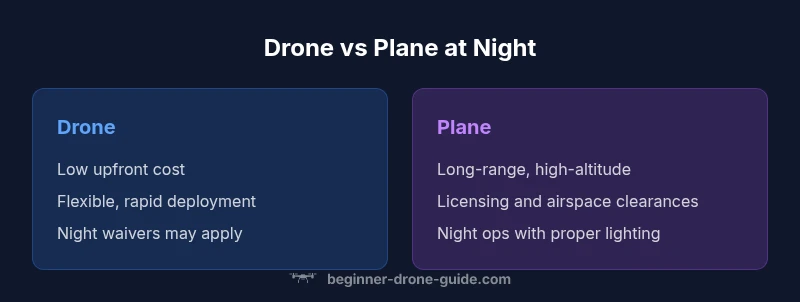
| Feature | Drone | Manned Plane |
|---|---|---|
| Night Visibility and Lighting Requirements | On-board lights and beacons; LOS with operator | Airfield lighting; cockpit lighting; runway procedures |
| Operational Scope | Short-range, agile, localized tasks | Long-range, high-speed, high-altitude missions |
| Learning Curve and Access | Low barrier; quick start for basics | High barrier; extensive certification and training |
| Regulatory Burden | Night waivers and remote-ID compliance for some regions | Pilot licensing, airspace clearances, and formal procedures |
| Cost of Entry | Low upfront; affordable maintenance | High upfront and ongoing costs (crew, compliance, maintenance) |
| Data Capabilities | High-resolution, flexible data capture; easy turnaround | Very large-scale data and advanced instrumentation |
| Risk to Public | Lower risk to bystanders; controllable operations | Higher risk potential due to crew and aviation operations |
| Weather Sensitivity | More sensitive to wind and cold; relies on GPS | Greater stability in some conditions but regulated environments apply |
Benefits
- Lower upfront cost and access for beginners
- Greater flexibility and rapid deployment at night
- Safer in many urban environments due to ground-risk control
- Continuous data collection with quick turnaround
Weaknesses
- Limited range and payload compared to planes
- Regulatory hurdles and waivers required for night ops
- Weather and lighting constraints can still limit use
Drones typically win for night tasks; planes fit long-range, high-altitude needs
Drones are the practical choice for nocturnal data work and safety. Planes excel when speed, range, or heavy payloads are non-negotiable, but they demand greater training and regulatory compliance. The Beginner Drone Guide Team recommends starting with a night-proficient drone and expanding to planes only when mission demands justify the added complexity.
Frequently Asked Questions
What are the basic rules for flying a drone at night?
Night drone flights typically require visible lights, maintained line of sight, and adherence to local airspace rules. Many regions also require waivers or certifications for nocturnal operation. Always verify current regulations before flight.
For night drone flights, you usually need proper lighting, keep the drone in sight, and follow local airspace rules. Check your local regulations and obtain any required waivers before flying.
Can a drone replace a plane for all night missions?
Drones are ideal for small-area, low-risk nocturnal tasks, but planes remain essential for long-range, high-altitude needs or large payloads. They are not universally interchangeable for every mission.
Drones work well for night tasks in a small area, but planes are needed for long-range or heavy payloads. They’re not interchangeable for every mission.
What lighting is required for night drone flights?
Drones should have visible navigation lights and anti-collision beacons as required by local rules. Ensure lighting is consistent from takeoff to landing and during transitions.
Drones need visible lights and beacons per local rules, and you should keep them on during the entire flight.
Do I need a license to fly a drone at night?
In many regions, you must complete operator training and obtain permissions or waivers for night operations. Certification requirements vary by jurisdiction and intended use.
Often you need some form of training and permissions for night flights, depending on where you operate.
What are common safety risks at night?
Reduced visibility increases collision risk; glare can obscure hazards; and fatigue impairs judgment. Implement strict risk assessments, conservative flight margins, and robust preflight checks.
Night flight raises collision and glare risks, plus fatigue. Use careful risk planning and thorough preflight checks.
How should a beginner start night flying?
Begin in a controlled area with daylight, then twilight, before attempting fully dark sessions. Use a progressive training plan and document each flight for learning and safety.
Start in a safe area, progress from daylight to twilight, then to dark. Keep a training log to improve safely.
Quick Summary
- Assess mission scope before night flights
- Start with a drone for safety and cost efficiency
- Learn local rules and obtain necessary permissions
- Prioritize lighting and weather planning
- Progress with structured training and practice