How to Tell a Drone from a Plane at Night
A practical, beginner-friendly guide to distinguishing drones from planes after dark using light cues, motion patterns, altitude cues, and safe observation practices. Includes regulatory context and observation tips for confident, safe viewing.


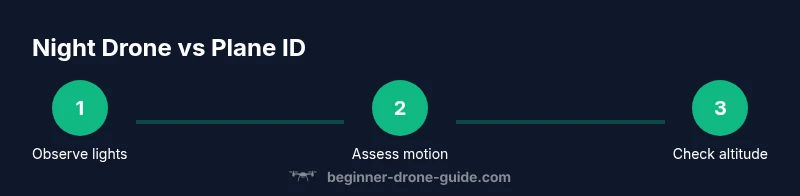
By the end of this guide, you’ll be able to tell a drone from a plane at night using safe, practical cues. Start with light patterns, motion, and altitude, then corroborate with timing and path. According to Beginner Drone Guide, focus on consistent scanning, clear landmarks, and patient observation first.
Visual cues for night identification
At night, the most reliable clues come from light patterns, motion, and contextual cues. Drones typically display small, irregular patterns: blinking indicators, and sometimes green or white LEDs in a configuration that may not match typical aircraft. Planes, even at low altitude, usually show a steady, familiar set of navigation lights (red on the left wing, green on the right, white tail lights) and a longer, linear flight path. To a careful observer, the drone's lights may appear to “dance” as it changes direction, while aircraft lights form a consistent sequence. In addition to lights, note the flight path relative to known airspace corridors; drones tend to operate within more localized ranges and may hover or perform sudden moves. By combining these visual cues with time and location awareness, beginners can start distinguishing drones from planes without specialized equipment. According to Beginner Drone Guide analysis, practice in varied dusk conditions strengthens recognition and reduces misidentification.
Movement patterns and altitude cues
When differentiating at night, observe how the object moves across the sky. Drones often maneuver with short, abrupt shifts and may hover or circle slowly in a radius, especially near visible landmarks. Planes tend to follow relatively longer, more predictable trajectories, especially in known flight corridors or near airports. Altitude cues help: drones commonly stay lower than most manned aircraft in typical hobbyist operations, while planes maintain higher cruise altitudes even when approaching airfields. Combine speed with direction changes to estimate distance and altitude, but avoid relying on speed alone—perspective distortion at night can mislead. Regular practice across different dusk lighting (early twilight, late dusk) helps refine your eye for scale and distance. This approach aligns with guidance from Beginner Drone Guide (2026) on practical night observation and identification.
Sound and other signals (when audible)
Sound can supplement visual cues, but at night, engines' noise may be muffled by distance or terrain. If you can hear a hum or rotor whine distinctly different from a distant aircraft, use it as a supplementary clue—but never rely on sound alone. Drones emit a characteristic buzz that, from far away, blends with wind or city noise. Airplanes produce a louder, more consistent engine roar that can carry farther. For beginners, pairing auditory cues with light patterns increases confidence, but prioritize visibility and safe observation. Always respect local regulations and airspace rules; if you are uncertain, maintain a wide margin and do not attempt to intercept or approach aircraft. This safety-first mindset is emphasized in Beginner Drone Guide's night-flying tips.
Safe observation and regulatory context
Before you observe at night, review your local regulations about night-time drone operations and the rights of pilots and air traffic. In many jurisdictions, it's legal to observe but illegal to interfere with aircraft or to operate unsafely near airports. If you think you see a drone near restricted airspace, report it to the appropriate authorities rather than attempting to shadow or contact the craft directly. Use established safe viewing distances and avoid shining lights directly at aircraft. The FAA in the United States, for example, requires operators to keep clear of aircraft and to follow altitude limits; night operations require additional precautionary steps and awareness of airspace restrictions. Always log the observation details: time, location, light pattern, movement, and any other cues that might help authorities.
Practice drills for beginners
To build proficiency, practice with a simple, repeatable drill: pick a clear night in a safe area and observe a target for 2-5 minutes, note lights, motion, and path; then compare to archived footage or diagrams that show drone vs plane cues. Repeat with different weather and light conditions. Keep a log; re-check before you fly your own drone at night. The practice routines recommended by Beginner Drone Guide help novices sharpen pattern recognition.
Tools & Materials
- Red-filtered flashlight(Preserves night vision; helps signal observers)
- Binoculars or monocular(Useful for distant lights and pattern recognition)
- Notebook and pencil(Record times, location, lights, and path)
- Mobile device with night-mode camera(Capture stills or videos for later analysis)
- High-visibility clothing or safety whistle(Enhances safety and visibility during outdoor observation)
Steps
Estimated time: 25-40 minutes
- 1
Choose a safe observation location
Select an open, unobstructed area away from crowded spaces and away from sensitive airspace. Ensure you have clear lines of sight and a plan to retreat if needed. Check local rules about where observers can stand and avoid proximity to roads or crowds.
Tip: Stand at least a few dozen meters from any actual or simulated flight paths and use a friend as a spotter. - 2
Prepare your night-vision setup
Set up your red-filtered light or lamp to minimize night-vision disruption. Keep a notebook ready to log times, positions, and light patterns. If you’re using optics, practice focusing in low light to avoid missing subtle cues.
Tip: Avoid looking directly at bright lights; use the red light to preserve adaptation. - 3
Scan for lights and patterns
Begin with wide sweeps across the sky, then zoom in on any bright lights. Note blinking sequences, color of lights, and their arrangement. Drones may show irregular blinking or moving lights; aircraft usually maintain a predictable pattern.
Tip: Pause to compare two consecutive observations for consistency. - 4
Assess trajectory and altitude
Observe whether the object holds a steady path, makes abrupt changes, or hovers. Use perspective cues (relative size, apparent speed) to gauge distance and height. Remember that night distortion can affect depth perception.
Tip: If in doubt, assume a safe distance and record the observation for later review. - 5
Cross-check with known flight patterns
Correlate your observation with typical flight corridors and times, and respect restricted airspace. Look for cues that align with drones (localized, hovering) vs planes (longer, regulated paths).
Tip: Consult local airspace maps before observing near airports. - 6
Document and respond safely
Log all details: time, location, light pattern, movement, and perceived altitude. If you suspect a threat or near-miss, contact authorities and avoid attempting to intercept or follow the aircraft.
Tip: Never interfere with aircraft or contact pilots directly.
Frequently Asked Questions
Is it legal to observe drones at night in my area?
In many regions, observing without interfering is allowed, but you must follow local airspace rules and avoid any interference with aircraft. Check your jurisdiction’s regulations before conducting night-time observation.
Yes, you can observe, but don’t interfere with aircraft and follow local airspace laws.
What if I can’t tell which is which at night?
If identification isn’t clear, increase distance, log your observations, and rely on multiple cues (lights, movement, altitude). When in doubt, treat it as a precautionary situation and avoid action.
If you’re unsure, step back, note details, and consult authorities if necessary.
Can I use apps to help identify drones at night?
Apps can assist with reference information, but visual cues and regulatory context are more reliable for real-time night identification. Use apps as a supplemental tool, not the primary method.
Apps aren’t enough by themselves; rely on your eyes and safety rules first.
How should I observe near airports or controlled airspace?
Near controlled airspace, observation should be cautious and compliant with airspace restrictions. Do not attempt to identify or engage aircraft; report anything suspicious to authorities.
Near airports, follow the airspace rules and report unusual activity to the right authorities.
What are the key cues to tell drones from planes at night?
Key cues include blinking vs. steady lights, irregular versus steady trajectories, and lower versus higher altitude expectations. Combine these with environmental context and regulatory knowledge.
Look for light patterns, how it moves, and how high it is compared to typical aircraft.
Watch Video
Quick Summary
- Observe lights, patterns, and motion to differentiate drones from planes
- Practice across dusk light levels to improve accuracy
- Maintain safe distances and follow airspace rules
- Document observations for reporting or regulatory review