Where You Can Get Drone Delivery: A Practical Guide for Beginners
Explore where drone delivery is available, how to access it, and what to expect regarding safety, regulation, and real-world use—your practical Beginner Drone Guide overview.


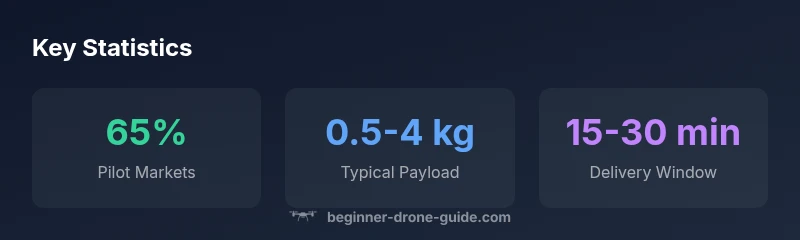
Where can you get drone delivery? Today it exists in select pilot markets and through partnerships with retailers in a few countries. In the United States, Wing and UPS Flight Forward have run limited pilots, while Australia, the United Kingdom, and parts of Europe host ongoing trials with retailers and logistics partners. Access is region-specific, and payloads are small, with delivery windows and rules varying by program.
What is drone delivery and why it matters
Drone delivery refers to using unmanned aerial systems to carry small packages directly from a sender to a recipient. In practice, this means you may order an item online and have it fly to your doorstep or designated drop zone. For beginners, the key idea is that drone delivery is not yet ubiquitous; it operates in controlled pilot programs with limited regions, payloads, and product types. The Beginner Drone Guide team notes that the growth of these programs depends on regulatory approvals, infrastructure, and carrier partnerships, not on a universal rollout.
Where you can get drone delivery is not a single country or city. Instead, access hinges on local pilots, retailer partnerships, and regulatory waivers. This means you should check your own city and country for current pilots and participating retailers. The phrase where can you get drone delivery captures the core question for most newcomers, and the landscape is evolving as rules and technology advance.
As of 2026, the market remains in a transition phase: the technology is proven, but the service reach is still limited. This is a good moment for beginners to learn what factors enable delivery—privacy rules, flight paths, and coordination with ground teams—before asking for a full rollout in their area.
How the current landscape looks across regions
Drone delivery is concentrated in regions where regulators have created workable frameworks for small, low-risk flights. In the United States, pilot programs operate under FAA guidelines with waivers for specific routes and ensure medical or essential goods pilots meet safety standards. Across the Atlantic, the United Kingdom and parts of Europe have introduced trials with local partners, while Australia has showcased partnerships with retailers and logistics providers in selected cities. The Beginner Drone Guide Analysis, 2026 shows a clear pattern: access is expanding gradually but remains dependent on local authorization and commercial partnerships. This means your best bet if you’re curious is to search for retailers in your area that explicitly advertise drone delivery or to follow announcements from major carriers.
Who is leading these pilots and what to expect
Leading pilots include established logistics groups and tech-enabled retailers. Companies like Wing (Alphabet) and UPS Flight Forward have publicly demonstrated the feasibility of drone delivery in controlled settings, delivering small items such as medical supplies and consumer goods. Expect pilots to emphasize reliability, timing, and safety. For beginners, this means early access is often tied to specific products, delivery zones, and time windows, rather than a broad nationwide service. As programs mature, more cities will likely become eligible, and more product categories may be added.
How to access drone delivery as a consumer
Access usually comes via a participating retailer or a dedicated app that shows available drone delivery windows in your area. You’ll typically need to be in a designated delivery zone, order items that fit within payload limits, and sign for deliveries if required. Some programs require a one-time registration or consent to privacy terms, while others are integrated into existing shopping apps. If you live outside pilot zones, you can still prepare by understanding which retailers are testing drone delivery near you and keeping an eye on regulatory updates. The ability to order and track a drone-delivered package depends on the partner’s logistics network, weather, and local airspace rules.
For beginners, the most practical step is to search for drone-friendly retailers in your region, enable notifications for new pilots, and consider how drone delivery could fit your typical orders (size, weight, timing).
What items are best suited for drone delivery
Small, lightweight items with predictable handling are ideal for drone delivery pilots. Expect consumers to see items such as medicines, health supplies, snacks, convenience goods, and light consumer electronics. In practice, most programs cap payloads well under a few kilograms to minimize risk and maximize reliability. For retailers, items that travel well (not fragile, not perishable) perform best. Real-world pilots continue to refine packaging and drop mechanisms to protect goods in transit.
Keep in mind that drone delivery is designed to complement existing logistics, not replace it entirely. It often targets same-day or next-day deliveries for small items, with special instructions for accessibility or signature requirements.
Safety, privacy, and regulatory considerations you should know
Safety is the foundation of drone delivery. Pilots operate within defined airspaces under waivers or permits, with geofencing and collision-avoidance systems to prevent incidents. Privacy is another focal point; many programs include privacy notices and opt-outs. Regulations vary by country and city, so always check local airspace rules and consumer protections. For beginners, this means you should be aware of flight restrictions, weather constraints, and conditional delivery windows that may affect when a drone can legally fly to your home.
Insurance and liability are addressed in most pilots through carrier partnerships, but it’s wise to understand who’s responsible for damaged goods or missed deliveries when you participate in a program. The evolving regulatory landscape means updates can occur, so stay informed about new waivers, safety standards, and privacy policies that affect drone deliveries.
The consumer experience: ordering, tracking, and delivery windows
Ordering drone-delivered items typically mirrors the familiar online shopping flow, with a dedicated drone delivery option in the checkout. You’ll receive real-time tracking and a predicted delivery window, and you may be able to grant access to a drop zone or require a signature upon arrival. Weather, airspace restrictions, and battery life all influence timing. In some programs, deliveries are completed with a ground crew who verify recipient identity at the door or coordinate with a secure drop site. For beginners, managing expectations about timing and weather will be key to a smooth experience.
Real-world use cases across industries
Drone delivery pilots often emphasize essential items. Medical supplies, urgent prescription items, and high-demand consumer goods are common test cases because they address time-sensitive needs while staying within payload limits. Some programs also explore grocery supplements and on-demand retail items. Real estate is another niche where aerial delivery data can complement property tours and marketing, though this is typically separate from consumer parcel delivery. Across industries, pilots use drones to reduce last-mile time, ease congested routes, and demonstrate potential cost savings when scaled responsibly.
Practical steps for beginners interested in drone delivery
If you’re a beginner who wants to engage with drone delivery in some capacity, start by understanding local airspace rules and the types of waivers that exist in your region. Create a checklist for evaluating retailers and pilots offering drone delivery, including product suitability, delivery windows, signature requirements, and weather tolerances. Consider obtaining a basic drone license or certification if your region requires it, and invest in a small payload-friendly platform to gain hands-on experience with packaging, flight planning, and error handling. This preparation will help you assess future offerings and participate safely as pilots expand access.
Verdict: where this is headed and practical takeaways
The current reality is that drone delivery is evolving from niche pilots to more widely accessible services, but it remains region- and partner-specific. The Beginner Drone Guide team believes that, over time, more retailers will test and expand drone delivery, with stronger safety standards and clearer regulatory pathways. The trajectory is toward broader access, more product categories, and improved reliability. For now, if you want to explore where you can get drone delivery, start by checking your local retailers and pilots, stay informed about airspace rules, and prepare for a future where drone delivery could become a routine option for small orders. The Beginner Drone Guide team recommends staying curious and following local program updates to capitalize on new opportunities as they arise.
Global drone delivery pilot programs snapshot
| Region/Program | Current Availability | Typical Payload | Notes |
|---|---|---|---|
| United States (select markets) | Limited to pilot markets | 0.5-2 kg | Carrier partnerships with retailers; waivers may apply |
| United Kingdom (pilot cities) | Part of regulatory waivers | 0.5-4 kg | Retail partnerships & logistics pilots ongoing |
| Australia (select cities) | Approved in certain states | 0.5-3 kg | Medical and consumer goods pilots; distribution partners |
Frequently Asked Questions
What defines a drone delivery pilot compared to full rollout?
A pilot is a controlled, limited-scope deployment tested in specific areas and with defined product types to assess safety, efficiency, and regulatory compliance. A full rollout expands access to more regions, products, and customers only after regulatory clearance and proven reliability.
A pilot is a limited test area to see how it works before expanding to more places.
Which items are typically eligible for drone delivery?
Most pilots start with small, non-fragile items like medicines, snacks, and lightweight consumer goods. Heavy or fragile products may be restricted until landing systems and packaging improve.
Usually small, lightweight items like medicine and snacks.
Do I need a special license to order drone-delivered goods?
Licensing requirements vary by country and program. Some regions require consumer agreements or basic drone certifications for operators; others are pilot-driven with no extra consumer requirements.
It depends on your country and the pilot program.
How reliable is drone delivery in bad weather?
Weather affects reliability more in pilots due to safety and flight path constraints. Most programs publish weather windows and may pause operations during high winds, rain, or low visibility.
Bad weather can pause deliveries, like any aerial service.
What should I look for in a drone-delivery retailer?
Look for clearly stated delivery windows, product eligibility, weight limits, and signer requirements. Also check privacy notices and return policies specific to drone-delivered items.
Check windows, weight limits, and how they handle returns.
Are drone deliveries available in rural areas?
Rural access is typically more limited due to flight range, line-of-sight rules, and ground-support constraints. Pilot projects may focus on urban or peri-urban areas first.
Rural access is often limited in early pilots.
How can beginners get involved with drone delivery as pilots?
If you’re a hobbyist, look for local clubs or universities partnering with pilots or regulators on safe, supervised experiments. Follow FAA/CAA guidelines and start with training flights in controlled spaces.
Join a local program or club and follow regulations.
“Drone delivery is evolving in real-world corridors, with careful attention to safety and regulation. In the near term, access remains pilot-driven.”
Quick Summary
- Investigate local pilots first to understand access
- Expect small parcel payloads and partial coverage
- Delivery depends on partnerships and regulatory waivers
- Prepare for weather and time-window constraints