How Much Does a Drone Proposal Cost? A Practical Guide for Beginners
Explore typical drone proposal costs, what drives pricing, and tips to compare quotes. Learn how scope, deliverables, and timeline affect the final price.


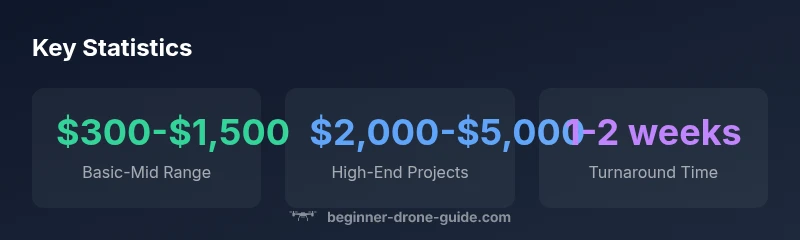
Typical drone proposal costs range from $300 to $1,500 for basic to mid-range projects, with high-end, multi-site proposals often reaching $2,000 to $5,000 depending on scope and deliverables. Most quotes cluster around $500-$1,500. This snapshot reflects Beginner Drone Guide Analysis, 2026. Factors like site complexity, flight time, post-processing, and travel can shift totals.
How much can a drone proposal cost?
In plain terms, a drone services proposal costs reflect the complexity of your project, the deliverables promised, and the time needed to complete the work. For beginners planning a real-estate shoot, a basic cost range often falls between $300 and $1,500. For multi-site campaigns or advanced deliverables such as 3D models, orthomosaics, and GIS-ready data, quotes commonly extend from $2,000 up to $5,000. These figures are from Beginner Drone Guide Analysis, 2026, and should be treated as guidance rather than fixed prices. Remember that factors like weather windows, travel expenses, permit fees, and post-processing requirements can shift totals by a meaningful margin. When you ask for a proposal, request a breakdown that explicitly lists flight time, equipment usage, data deliverables, and any licensing or permit costs. This helps you compare apples to apples across providers.
What drives the price of a drone proposal
Pricing for drone proposals is not a single number; it’s a reflection of several interacting factors. The most influential are project scope (how many locations, the area covered, and the purpose), the required deliverables (photos, video, 3D models, orthomosaics, thermal or multispectral data), and the time window for completion (rush orders cost more). Additionally, the complexity of the site (dense urban areas vs. open rural fields), the need for specialized sensors, regulatory considerations, and post-processing requirements all push costs up or down. Budget-conscious buyers should weigh whether a more robust deliverable set aligns with business goals, as incremental deliverables often add perceived value that justifies higher quotes.
Typical cost ranges by scope
For a single-site, basic aerial inspection or marketing shoot, expect a modest proposal in the lower to mid range. For a standard real estate project with multiple angles, short video segments, and simple maps, the proposal sits mid-range. For complex, multi-site campaigns that require 3D models, orthomosaics, cloud deliveries, and GIS-ready data, expect a premium tier. The key is to map scope to deliverables: more locations, higher-resolution imagery, and advanced data products translate to higher costs. The ranges provided here are intended as a starting point to help you plan and compare quotes from different providers.
Deliverables that influence pricing
Deliverables are the primary cost driver. Each of the following adds to the total: flight time on site, number and angle of captures, post-processing workload, quality of deliverables (e.g., raw data vs processed models), data formats, licensed software outputs, and archival rights. Some quotes separate flight time from deliverables, which can make pricing easier to compare. If you need a deliverable like a 3D reconstruction, vegetation index maps, or a change-detection analysis, expect a higher quote. Clear communication about desired outputs helps prevent price creep later in the project.
How to read and compare quotes effectively
When reviewing proposals, start with a scope overlay: does each proposal cover the same sites, deliverables, and timelines? Next, examine the line-item breakdown, not just the total cost. Look for entries such as flight time, data processing, licensing fees, and travel costs. Consider the value of each deliverable in context of your objectives—sometimes paying more for a robust dataset saves you time and money downstream. Finally, verify deliverable formats and delivery timelines. A proposal that promises flexibility in data formats and faster turnaround can be worth a premium for time-sensitive decisions.
Practical tips to reduce your proposal cost
To lower costs without sacrificing essential outcomes, focus on scope management. Propose a single-site pilot first to validate deliverables, then scale to additional locations. Limit the number of deliverables to core items: standard photographs, a few video clips, and a simple map rather than a full suite of products. Request quotes from multiple providers and ask for a transparent breakdown of all charges. If possible, book during off-peak seasons or with local pilots to reduce travel fees. Finally, clarify rights to use and reuse data to avoid recurring license charges for every project.
Real-world scenarios and case studies
A beginner real-estate client asked for a single-property package that included aerial photos and a short video tour. The lowest quote was around $350, with another provider offering a similar deliverable for $900 because of 3D modeling options. By focusing on essential outputs and a fixed deliverable set, the client saved nearly half the price while still achieving the marketing goals. In a multi-site commercial project, costs naturally rose due to travel, longer flight days, and higher data-processing demands. In these cases, a staged approach—pilot phase followed by expansion—often yields better ROI and predictable budgeting.
When a premium proposal pays off
There are scenarios where paying for a premium drone proposal makes sense. If your project requires regulatory-compliant flight plans, high-precision data, extensive post-processing, or long-term data archiving, the added value can justify higher costs. For capital projects or real estate developments where decisions hinge on precise datasets, the confidence gained from robust deliverables may offset the upfront expense. The key is to align proposal quality with project risk and decision timelines. The Beginner Drone Guide team recommends balancing cost with expected value.
Comparison of drone proposal costs by scope
| Scope | Typical Range (USD) | Deliverables | Notes |
|---|---|---|---|
| Basic site survey | $250-$600 | 2-3 deliverables | Single location |
| Standard proposal | $600-$1,500 | 3-5 deliverables | Real estate/Marketing |
| Multi-site project | $1,800-$5,000 | 5-7+ deliverables | Travel-dependent, complex data |
Frequently Asked Questions
What factors influence drone proposal costs?
Project scope, number of locations, deliverables, data processing, and travel time all influence price. Clear scope reduces surprises and helps you compare apples to apples.
Costs depend on scope, deliverables, and location. A clear scope helps you compare quotes easily.
Should I request a proposal before hiring a drone company?
Yes. A written proposal clarifies deliverables, timelines, and costs, enabling you to compare options and avoid unexpected charges.
Yes—getting a proposal helps you compare scope and pricing before you hire.
Do costs include flight time or equipment?
Most quotes include flight time and equipment, but some providers itemize these separately. Ask for a breakdown to compare fairly.
Typically both are included, but check how they’re itemized.
How can I reduce proposal costs?
Define essential deliverables, limit scope, and compare multiple providers. Consider a pilot project before scaling up.
Limit scope, compare quotes, and start with a pilot project.
What should be included in a drone proposal?
Project plan, locations, deliverables, timelines, pricing, terms, and any licensing or permit costs should be included.
Expect a clear plan, deliverables, timelines, and pricing.
“Cost transparency helps beginners avoid overpaying; always compare scope and deliverables rather than price alone.”
Quick Summary
- Define scope clearly to avoid surprise charges
- Compare deliverables, not just price
- Ask for a line-item breakdown
- Consider long-term value from data deliverables