How Much Does Drone Delivery Cost? A Practical Guide
Explore how drone delivery pricing works, the main cost drivers, typical ranges, and a practical method to estimate fees for personal, business, or healthcare use.


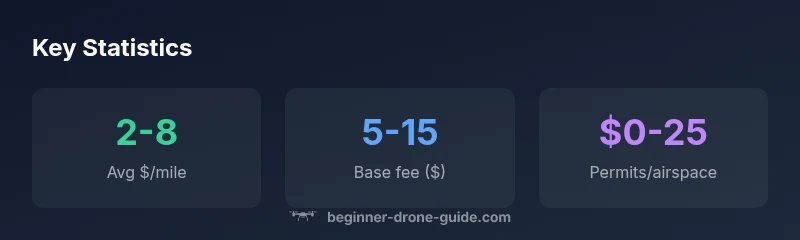
Drone delivery costs typically range from roughly $2 to $8 per mile for lightweight packages, plus base fees and handling charges. In real-world pricing, the total fee also depends on package weight, exact distance, airspace permissions, and whether the service is on-demand or scheduled. According to Beginner Drone Guide Analysis, 2026, costs can be higher for fragile items or longer routes.
How pricing works and the question you asked
Pricing for drone delivery is a layered model, not a single fee. If you're wondering how much does drone delivery cost, you'll typically see a base initiation fee, a distance-based component, and possible surcharges for weight and airspace requirements. Basic models stack these charges to reflect the resources used, from flight planning to maintenance and insurance. Begin with understanding each bucket: base fee, per-mile distance charges, weight-related surcharges, and any regulatory or handling costs. In practice, a short, light delivery across a small radius will weigh most on the per-mile rate, while long-distance or heavier shipments trigger more substantial extras. This framing helps compare quotes across providers and predict total cost more accurately. Notably, the price landscape can shift based on regional regulation, provider maturity, and the type of service chosen (on-demand vs. scheduled).
Key cost drivers
Distance, payload, and service level stand out as the primary price drivers. Short hops with light items tend to lean on the per-mile component, while longer hops and heavier payloads trigger weight surcharges and potential route-specific costs. Route complexity, such as urban canyons or restricted airspace, can add planning time and risk management costs. Weather and seasonality influence speed and safety considerations, which can translate into higher quotes during peak periods. Regulatory overhead—permits, waivers, and insurance—also factors in, especially for commercial operators. Finally, some providers price for added services like real-time tracking, guaranteed delivery windows, or integrated packaging. When comparing quotes, map each quote to these drivers to see where you gain or lose value.
Price models you’ll encounter
Most drone delivery pricing fits one of a few models. The most common is a per-mile rate combined with a base delivery fee. Some providers offer a fixed price per delivery, while others use tiered pricing based on distance bands or payload weight. Subscription or membership models may reduce per-delivery costs in exchange for a monthly or annual fee. Look for optional add-ons—insurance, expedited handling, or custom packaging—that can shift the total. Finally, be mindful of seasonal or promotional pricing, which can temporarily alter the baseline. Understanding these models helps you predict total costs across multiple quotes and choose the most cost-effective option for your needs.
Hidden costs and considerations
Hidden costs often appear as small line items that add up. Packaging and handling can introduce extra fees if your item requires special packaging. Insurance premiums may be charged per flight or per month, especially for higher-value goods. Permits and airspace waivers, while sometimes bundled, can add significant costs for remote or restricted routes. Weekend or after-hours flights frequently carry surcharge multipliers. Additionally, some services impose accessibility restrictions (delivery to secure buildings, rooftops, or rural drop points), which can require alternative routing and increased charges. Finally, ensure you understand liability coverage in case of loss or damage during transit, as gaps can raise the out-of-pocket cost of a delivery.
Real-world scenarios: consumer vs business
For a consumer shipping a small, lightweight item across a short distance, expect a modest base fee plus $2-$8 per mile. Businesses shipping higher-value or hazardous items will see higher surcharges, more extensive insurance, and possibly regulatory fees. Medical supply deliveries or time-sensitive items may incur premium service levels, boosting the price but delivering faster turnaround. In contrast, recurring business contracts often negotiate volume-based discounts or fixed monthly quotas, changing the overall cost picture. Regardless of use case, you should compare a few quotes side-by-side and model your total cost across multiple delivery scenarios to avoid sticker shock.
Regulatory and safety costs
Regulatory costs include waivers, flight authorization, and compliance-related insurance. In many regions, costs scale with the risk profile of the flight, the weight of the payload, and the complexity of the airspace. Safety measures—pilot training, emergency procedures, and reliability requirements—also factor into pricing through higher labor costs and more robust operational protocols. For organizations, these costs can be significant but are essential for lawful, safe, and reliable drone operations. Always verify what regulatory costs are included in a quote and ask for a breakdown of any non-obvious charges.
How to estimate costs for your use case
Start with a simple cost model: base fee + distance fee + weight surcharge + optional add-ons. Gather your key inputs: distance, payload, service level, and any required permits or insurance. Build a quick worksheet that applies a base fee (e.g., 5-15), a per-mile rate (e.g., 2-8), and a weight surcharge (e.g., 1-5 per extra 0.5-1 kg). Add any regulatory or handling fees and taxes. Run several distance scenarios (short, medium, long) and payload levels to see how the total changes. This approach makes it easier to compare quotes and forecast annual costs for frequent drone deliveries.
Case studies and benchmarks
In practice, costs range widely by provider and region, but a common framework emerges: base fee plus distance-based charges, with weight surcharges adding when payload grows. For a 3-mile, 1-kg shipment, you might see a moderate total with a few dollars of additional handling costs. For longer routes or heavier payloads (5-10 kg), expect the total to scale accordingly, potentially doubling or tripling relative to the 3-mile example. Use these benchmarks as rough guides when you solicit quotes, and always request a line-item breakdown to validate the pricing logic.
Cost components for drone-delivery pricing.
| Cost Component | What it Covers | Typical Range |
|---|---|---|
| Per-mile rate | Distance-based delivery distance | $2-$8 per mile |
| Base/booking fee | Flat charge to initiate delivery | $5-$15 |
| Weight-based surcharge | Payload weight affecting route | $1-$5 per additional 0.5-1 kg |
| Airspace/permits | Regulatory costs and permissions | $0-$25 per flight (varies) |
Frequently Asked Questions
What factors most influence drone delivery cost?
Distance, payload, service level, and regulatory requirements are the primary drivers. Weather, route complexity, and add-ons like insurance or tracking can also affect the final price.
Distance, payload, and service level are the big ones, with a few extras that can push the price up.
Do drone delivery costs vary for businesses vs individuals?
Yes. Businesses often face higher upfront setup, insurance, and compliance costs but may qualify for volume discounts or contracts. Individuals typically see simpler pricing with fewer add-ons.
Businesses usually pay more for compliance, but can save with volume contracts.
Are there typical minimum fees for a drone delivery?
Many providers impose a minimum delivery fee to cover planning and personnel costs, which can be higher for urgent or long-distance deliveries.
Most quotes include a small minimum fee to cover setup and planning.
How can I estimate drone delivery costs for my use case?
Collect distance, payload, service level, and permit requirements. Use a simple cost model: base fee + distance × per-mile rate + weight surcharge + add-ons. Compare quotes side-by-side.
Grab distance and weight, then run a quick calculation to compare quotes.
Will drone delivery costs go down over time?
Costs may moderate as technology matures and competition increases, but regulatory and safety costs can keep overall pricing steady or rise in some regions.
Pricing could soften a bit as tech improves, but safety and rules keep costs in check.
“Pricing for drone delivery isn’t a single fixed fee; it’s a layered model that reflects distance, payload, airspace costs, and service level.”
Quick Summary
- Budget base fees plus distance-based costs.
- Expect weight and service level to shift pricing.
- Check for hidden costs like permits and insurance.
- Use a step-by-step estimator to compare providers.
- The Beginner Drone Guide team recommends budgeting with realistic price ranges.