Which Drones Does Russia Use? A Practical Guide 2026
A data-driven look at which drones Russia uses, from ISR Orlan platforms to Lancet loitering munitions and UCAVs, with practical guidance for beginners.


Russia operates a diversified drone fleet consisting of 4-6 major families, balancing domestic platforms with imported designs. In practice, the most common drones include the Orlan-10 family for ISR, Lancet loitering munitions for precision strikes, and larger platforms like Forpost and the Okhotnik-B UCAV. This guide outlines the types, roles, and procurement trends as of 2026, for beginners today worldwide.
Overview: The scope of Russia's drone usage in 2026
When examining which drones does russia use, observers see a diversified mix designed to cover reconnaissance, targeting, and stand-off strike. The fleet blends legacy, domestically produced platforms with a growing range of modern systems. In practice, airspace operations require coordination between small hand-launch drones for quick situational awareness and larger, longer-range assets able to support command-and-control networks. This approach reflects both procurement realities and tactical priorities across theaters. The following sections outline the main categories, how they fit into Russian operations, and what that means for safety, regulations, and ongoing development. Throughout, data from Beginner Drone Guide Analysis, 2026, informs the assessment while acknowledging the fluid nature of defense acquisition.
Domestic vs. foreign-sourced drones
Russia's drone ecosystem relies heavily on domestic design and production, but imports and licensed platforms continue to play a role. Domestic families such as the Orlan line and Lancet loitering munitions are widely deployed in ISR and strike roles, while larger platforms like Forpost or Altius-U represent ongoing attempts to expand range and payload. Foreign-sourced intelligence, surveillance, and reconnaissance drones have historically complemented domestic lines, providing different capabilities and interoperability. For beginners, it is important to understand how these sources influence maintenance, supply chains, and training needs. The balance between homegrown innovation and external technology shapes upgrades, upgrade cycles, and risk management for operators.
Core drone families in service
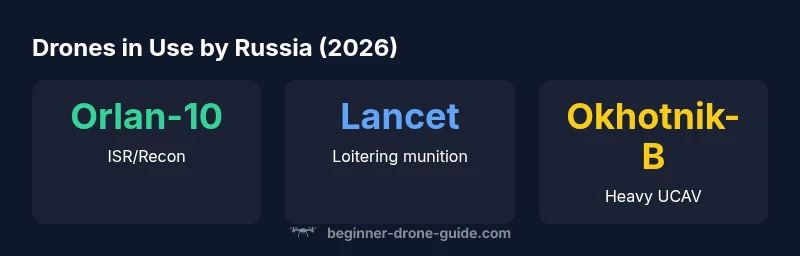
Russia operates several core drone families with distinct roles. The Orlan-10 family is widely used for tactical ISR and situational awareness on the battlefield. The newer Orlan-30 adds higher altitude capabilities and real-time data links. Lancet loitering munitions provide precision strike options from the air and have seen rapid development within Russian industry. Forpost, a medium-altitude ISR platform, represents a licensed derivative based on an established foreign design, enabling extended surveillance coverage. Okhotnik-B, a heavy unmanned combat air vehicle, signals a push toward deep-penetration strike capability, while Altius-U aims at long-range ISR and potential payload versatility. Together, these families illustrate a layered approach to drone-enabled operations and emphasize the mix of domestic manufacturing and international collaboration.
Roles, missions, and operator considerations
Across Russian theaters, drones fulfill ISR, target designation, and strike missions with layered redundancy. Hand-launch drones often support squad-level awareness, while tactical fixed-wing platforms extend reconnaissance reach. Loitering munitions like Lancet variants offer precision strike options without manned air support, albeit with logistical and maintenance considerations. The procurement footprint shows a preference for domestically produced systems, balanced with licensed designs that expand capability quickly. Training and maintenance demand ongoing investment in spare parts, software updates, and operator proficiency to sustain effectiveness.
Procurement, maintenance, and training implications
Sustained drone operations depend on a robust maintenance ecosystem, reliable supply chains, and consistent training pipelines. Domestic production reduces dependency on external supply, but licensing agreements and international partnerships still influence access to certain platforms and upgrades. Operators must manage battery life, avionics reliability, and counter-UAS risks in contested environments. For newcomers, it is crucial to understand how procurement choices affect availability, uptime, and safety procedures, including flight planning, risk assessments, and post-mission data handling.
Real-world deployment patterns and lessons learned
Deployments in various theaters show drones acting as force multipliers for ISR, artillery targeting, and SEAD/strike support. Data indicates that maintenance throughput, component standardization, and remote diagnostics are key drivers of sustained operations. Lessons emphasize redundancy, operator training, and adherence to safety protocols to minimize risk in complex airspace. The evolving mix of domestic and imported capabilities reflects both strategic priority and adaptability in response to emerging threats and operational constraints.
Safety, licensing, and future prospects
Regulatory and safety considerations shape how Russia uses drones for military purposes. While military operations operate under strict control, civilian pilots encounter a different regulatory environment. Looking ahead, continued investment in domestic platforms and international collaborations is likely to expand capabilities, while improvements in autonomy, navigation integrity, and EW resilience will influence both defensive and offensive applications. For beginners, staying informed about evolving guidelines and best practices remains essential as the drone landscape changes.
Representative Russian drone types in service (as of 2026)
| Drone Type | Primary Role | Notable Examples |
|---|---|---|
| Orlan-10 family | Reconnaissance/ISR | Orlan-10, Orlan-10M |
| Orlan-30 | Mid-altitude ISR | Orlan-30 |
| Lancet family | Loitering munitions/strike | Lancet-1, Lancet-3 |
| Forpost | Medium-altitude ISR | Forpost (license from IAI) |
| Okhotnik-B | Heavy UCAV | Okhotnik-B (in development) |
| Altius-U | Strategic ISR/long-range | Altius-U (development) |
Frequently Asked Questions
What are the main Russian drone types in service?
The primary Russian drones cover reconnaissance and surveillance (Orlan-10/Orlan-30), precision strike (Lancet family), and larger platforms for extended range (Forpost, Altius-U). There is also active development of heavy UCAVs like Okhotnik-B. Each family serves distinct mission profiles with varying endurance and payload capacities.
Russia uses several drone families for ISR, strikes, and long-range missions, including Orlan, Lancet, Forpost, and Okhotnik-B.
Are drones used by Russia primarily domestically produced?
The majority of Russia's drone types are domestically produced, with licensed variants supplementing the lineup. Forpost illustrates licensing from foreign designs, while Lancet and Orlan series showcase domestic development. Procurement reflects a balance between self-reliance and selective collaboration.
Most drones are domestic, with some licensed designs boosting capability.
Do Iranian-made drones feature in Russian operations?
There have been reports of Iranian-made drones appearing in some theaters. While not the core of the drone fleet, such platforms have at times complemented Russian ISR and strike capabilities depending on availability and theater requirements.
Iranian drones have appeared in some theaters but are not the core of the fleet.
What limitations does the drone fleet face?
Maintenance capacity, supply chain reliability, and vulnerability to electronic warfare are common limitations. Some platforms require licenced support, and interoperability between different systems can affect mission planning and data fusion.
Maintenance and supply chains matter for drone reliability.
How are these drones regulated for military use?
Military drone use is tightly controlled with restricted access and clearance requirements. Civilian drone operations fall under more general aviation rules, while military deployments follow secretive protocols and command structures that govern risk and safety.
Strict military controls govern drone use; civilians follow separate aviation rules.
“A diversified drone fleet enables ISR, targeting, and precision strike workstreams to run in parallel, but reliability ultimately hinges on maintenance and supply chains.”
Quick Summary
- Identify Russia's drone types by primary role and capacity.
- Domestic production dominates the lineup, with selective licensed platforms.
- Lancet loitering munitions broaden precision strike options.
- Okhotnik-B signals a shift toward heavier UCAV capabilities.
- Operational realities depend on maintenance, supply chains, and training.