Drone vs Missile: Key Differences for Beginners
An in-depth, beginner-friendly comparison of drones and missiles, covering control methods, guidance, use cases, safety, and regulation to help readers understand their distinct roles.


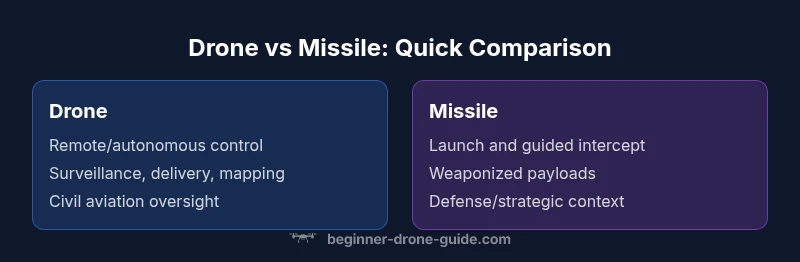
Drones are unmanned aircraft used for observation, delivery, or inspection, controlled remotely or autonomously with civilian or commercial aims; missiles are weaponized projectiles launched toward a target with guided guidance. The key differences are intent, control after launch, and regulatory context. Understanding these distinctions helps beginners navigate discussions around safety, licensing, and defense applications.
What defines a drone? Scope, control, and common uses
A drone is an unmanned aircraft system that operates without a human onboard. In practice, drones range from small consumer models for photography to professional platforms used for mapping, inspection, and delivery. The term captures both remotely piloted and autonomous platforms that rely on ground control or pre-programmed missions. A central distinction in the difference between drone and missile is how control is maintained: drones stay connected to a controller or autopilot that can be interrupted, paused, or re-routed, whereas a missile typically enters a launch sequence that, once activated, proceeds toward a target with limited or no operator input.
Regulatory bodies around the world classify drones as airspace users requiring awareness of altitude limits, line-of-sight rules, and weather considerations. For beginners, look for flight plans, waypoint navigation, and sensor payloads (camera, infrared, LiDAR) that signal a drone platform. The difference between drone and missile becomes especially clear when you map the control loop: a drone’s command-and-control chain remains active during flight; a missile relies on a launch sequence and tends to proceed toward the target with minimal operator input.
What defines a missile? Scope, propulsion, and typical domains
Missiles are guided or unguided weapons designed to reach and impact a target. They typically involve onboard propulsion, a guidance system (inertial, radar, GPS-assisted, or terminal guidance), and a warhead or payload designed for a specific effect. Unlike drones, missiles are launched with the expectation that flight control is largely autonomous after ignition, with limited or highly specialized operator input during midcourse updates or terminal guidance in some designs. The purpose behind missiles is fundamentally defense or offense, often in military or strategic contexts.
Historically, missiles emerged from rocketry and evolved into systems that can be launched from land, sea, or air. In civilian discourse, missiles are discussed in terms of defense policy, arms control, and international security. The critical point in the difference between drone and missile is the end goal and the control regime: drones prioritize ongoing command and oversight, while missiles emphasize rapid, targeted delivery with constrained post-launch input.
Core technical differences: control, guidance, and payload
- Control method: Drones rely on a ground operator or automated flight plan that can be altered mid-flight; missiles launch with limited post-launch control, often designed to follow a pre-set trajectory or respond only to terminal updates.
- Guidance systems: Drones use GPS, visual or infrared sensing, and autonomous navigation to execute missions; missiles rely on inertial guidance, satellite guidance (GPS), and refined terminal cues for accuracy.
- Propulsion: Drones typically use electric motors or small combustion engines suited for varied endurance; missiles use rocket propulsion designed for high thrust and rapid acceleration.
- End-use and payload: Drones carry cameras, sensors, or small payloads for civilian, research, or commercial tasks; missiles carry warheads or specialized payloads intended for impact or interception.
- Regulatory and safety context: Drones are governed by civil aviation rules and licensing regimes; missiles fall under defense law, export controls, and international arms regulations.
Understanding these dimensions clarifies the fundamental difference between drone and missile and helps readers evaluate news, policy debates, or educational materials with greater nuance.
Regulatory, safety, and ethical considerations
For drones, most jurisdictions require registration, a remote pilot license, and explicit operating permissions for commercial use. Safety considerations include maintaining visual line of sight, airspace awareness,周 weather assessment, and responsible operations around people and property. The regulatory framework emphasizes accountability, privacy, and safety. In contrast, missiles are subject to defense classifications, export controls, and sensitive technology restrictions. Treaties and national security policies guide development, deployment, and transfer, often restricting civilian access and sharing technical details. A key point in the difference between drone and missile is governance: civilian drones operate within public airspace rules, while missiles operate under military and strategic control with strict oversight.
From a policy perspective, educators and policymakers focus on risk management, ethical implications, and international norms. The Beginner Drone Guide analysis notes that understanding licensing and airspace integration is essential for safe drone usage, while missile control sits in a different regulatory universe focused on sovereignty and defense. This distinction informs conversations about safety, privacy, and technological responsibility among both hobbyists and professionals.
Real-world contexts: civilian and military applications
Civilian drones have become commonplace in photography, surveying, agriculture, search-and-rescue, package delivery trials, and disaster response. In these contexts, the difference between drone and missile is evident: drones enable data collection, rapid inspection of infrastructure, and aid in emergency response without directly harming people or property. Military missiles, by contrast, are designed for strategic defense or offense, with narrowly defined performance targets and strict oversight. Even when discussing modern air power or defense strategies, the civilian understanding of drones centers on safety, privacy, and practical benefits, while missiles are discussed in terms of deterrence, force projection, and arms control.
If you monitor news about space or defense, you’ll see constant emphasis on risk assessment, export control, and policy implications surrounding drone use and missile development. Public discourse benefits from distinguishing the two technologies to avoid conflating civilian unmanned aircraft with weapons platforms. The difference between drone and missile is not just a technical distinction; it shapes how communities, regulators, and educators approach each technology's opportunities and risks.
Common misconceptions and clarifications
A frequent misunderstanding is to equate all unmanned systems with weapons. In reality, many drones operate strictly for civilian applications and do not carry offensive payloads. Conversely, not every missile is a general-purpose weapon; some are specialized for interceptor roles or defensive tasks within weapons systems. Another misconception is that missiles are autonomous and uncontrollable after launch; in practice, many missiles incorporate midcourse updates and terminal guidance, but still operate within a controlled framework defined by military command and control.
The difference between drone and missile becomes clearer when you examine the lifecycle: drones are designed for ongoing control, data collection, and flexible missions; missiles follow a launch-and-intercept model with a focus on precision guidance and rapid response. Public understanding grows when discussions are grounded in these distinctions, avoiding overgeneralization and focusing on safety, ethics, and policy implications.
Looking ahead: trends and implications for beginners
As technology evolves, drones are likely to become more capable in autonomy, sensing, and safe integration into public airspace, prompting ongoing regulatory adaptation. Missiles will continue to evolve in propulsion, guidance accuracy, and defensive capabilities, all within international treaty frameworks. For beginners, staying informed about how these trends influence safety standards, licensing requirements, and educational resources is essential. The difference between drone and missile will remain a cornerstone concept for understanding aviation technology, defense policy, and the responsible use of unmanned systems.
Comparison
| Feature | Drone | Missile |
|---|---|---|
| Control method | Remote/pilot-operated or autonomous with ongoing ground control | Launched and guided toward a target with limited post-launch input |
| Guidance systems | GPS/waypoints, vision sensors, autonomous flight | Inertial guidance with GPS/terminal guidance options depending on design |
| End-use | Surveillance, mapping, delivery, inspection, agricultural monitoring | Armed defense/attack, intercept/precision strike in defense contexts |
| Regulatory framework | Civil aviation rules, licensing, airspace restrictions, privacy considerations | Defense and export controls, international arms treaties, security classifications |
| Endurance/Range | Grounded by battery or engine limits, typically shorter civilian missions | Propulsion-based with stringent security constraints and wider mission profiles |
| Payload | Cameras, sensors, delivery mechanisms, scientific instruments | Warhead options, high-precision guidance hardware, intercepting tools |
| Cost context | Generally lower upfront costs across consumer to professional tiers | Typically high cost with security and regulatory overhead |
Benefits
- Clarifies safety and regulatory implications for users and policymakers
- Helps educators design clearer curricula around unmanned technologies
- Supports responsible innovation by separating civilian and military contexts
- Encourages informed discussion about ethics and privacy in aviation
Weaknesses
- Complex regulatory and export-control landscapes can hinder learning
- Public misunderstanding may persist without clear, accessible explanations
- Security concerns around dual-use technology require careful framing
Drones and missiles serve fundamentally different roles, making the distinction clear and actionable
Drones operate under civil aviation rules with civilian applications; missiles operate under defense frameworks with strategic purposes. Understanding this gap helps learners evaluate safety, policy, and ethics more accurately.
Frequently Asked Questions
What is a drone, and how does it differ from a missile in simple terms?
A drone is an unmanned aircraft used for civilian or investigative tasks, controlled remotely or via autonomous software. A missile is a guided weapon designed to reach a target, with limited post-launch control. The difference between drone and missile centers on purpose, control, and safety frameworks.
A drone is a non-piloted aircraft for civilian tasks, while a missile is a guided weapon. The key difference is purpose and how much control you have after launch.
What regulates drones versus missiles?
Drones fall under civil aviation rules, requiring registration, licensing, and airspace compliance. Missiles are governed by defense, export controls, and international arms treaties. The regulatory gap is a major factor in the difference between drone and missile.
Drones are regulated like aircraft; missiles are regulated as defense equipment with strict export controls.
Can a drone ever become a weapon, or a missile be used for civilian tasks?
Some drones can be adapted for military roles, but civilian drones are designed for non-weaponized tasks. Missiles by definition are weapons; non-military missiles exist in test or defense contexts but are not used for civilian tasks.
Drones can have dual-use potential, but civilian drones aren’t weapons. Missiles remain weapons and aren’t used for civilian tasks.
What should beginners focus on first when learning about this topic?
Start with the basic definitions, safe operation practices for drones, and the regulatory requirements in your country. Then expand to understanding how missiles differ in purpose and control, without venturing into weaponization details.
Learn the basics of drones—safety and regulations—before delving into missile topics.
Where can I find reliable information about drone safety and regulations?
Consult official aviation authorities, such as national civil aviation administrations, and reputable educational resources. The distinction between drone and missile is easier to grasp when you anchor information in recognized safety and policy materials.
Check your national aviation authority and trusted educational guides for drone safety and rules.
Are there ethical concerns unique to drones compared to missiles?
Yes. Drones raise privacy, safety, and airspace integrity concerns in civilian spaces. Missiles raise broader ethical and strategic concerns tied to warfare, deterrence, and international law. Understanding both helps frame responsible use and policy.
Drones bring privacy and safety questions; missiles tie into warfare ethics and law.
Quick Summary
- Identify the core purpose: civilian use vs defense use
- Notice control continuity: ongoing vs launch-only control
- Map regulatory domains: aviation rules vs defense/export controls
- Recognize guidance differences: GPS/vision vs inertial/terminal guidance
- Assess safety and ethics within respective contexts