Drone vs Helicopter: Key Differences Explained
A thorough, beginner-friendly comparison of drones and helicopters, outlining technical distinctions, autonomy, safety, licensing, and practical uses to help choose the right tool for any project.


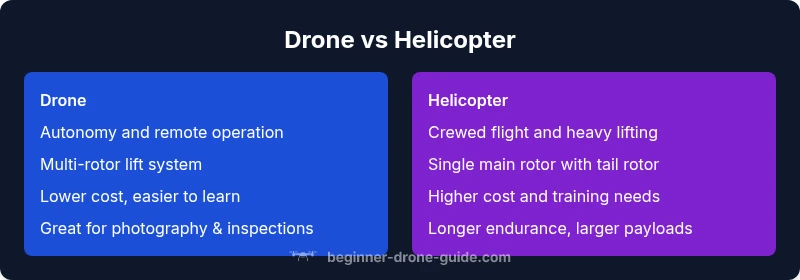
The difference between drone and helicopter centers on autonomy, control, and purpose. Drones are unmanned aerial systems operated remotely or autonomously, while helicopters are manned rotorcraft piloted from the cockpit. Drones excel in safe, scalable tasks such as filming and inspections, whereas helicopters handle heavier lift, longer endurance, and crewed missions. Regulation and training differ to reflect these roles.
Understanding the difference between drone and helicopter
The difference between drone and helicopter often confuses newcomers, but the contrast is fundamental. According to Beginner Drone Guide, a drone refers to an unmanned aerial system (UAS) that can be controlled remotely or fly autonomously, without an onboard pilot. A helicopter, by contrast, is a manned rotorcraft operated by a pilot inside the cockpit. This distinction drives how each platform is designed, how it moves through the air, and how it is used in real-world tasks. In common language, the term drone has broadened to include many small, commercially available devices, while helicopter denotes larger, traditional rotorcraft capable of carrying people or substantial payloads. Understanding this basic difference between drone and helicopter helps set expectations for capability, cost, and required training. The key is to map your needs to what each platform can safely and effectively do, not just what sounds impressive in marketing.
Core technical differences
The core technical differences between drone and helicopter start with propulsion and lift. Most drones use multiple small rotors to generate lift, which provides stability and ease of control, especially for beginners. A helicopter uses a single main rotor with a tail rotor or other anti-torque system to balance lift and yaw. This fundamental design creates different flight envelopes: drones often hover stably in tight spaces and are highly responsive to autonomous flight commands, while helicopters excel in power delivery, endurance, and the ability to perform smooth, controlled flight with a crew onboard. Another distinction is energy storage and management. Drones typically rely on compact batteries or lightweight power systems, whereas helicopters depend on larger engines and fuel reserves for longer missions. In practice, you’ll notice drones favor smaller, safer operations in constrained environments, while helicopters are built for performances that demand sustained power and greater speed.
Control systems and autonomy
Control systems reflect the autonomy gap between the two platforms. Drones are guided by ground control stations, remote controllers, or onboard autopilots that can execute programmed flight paths, return-to-home functions, and precision landing. This capability makes drones highly suitable for repeatable tasks, inspections, or data collection where a human pilot would be risky or impractical. Helicopters require a pilot on board who directly handles cyclic, collective, and pedals to steer and manage thrust. While helicopter operations can include assistance from co-pilots or ground controls for complex missions, the on-board pilot remains essential for real-time decision making, safety, and handling dynamic conditions. The training path diverges accordingly, with drone operators focusing on airspace rules and remote-pilot competencies, and helicopter pilots pursuing comprehensive rotorcraft certification and flight training.
Operational uses: everyday tasks vs specialized roles
The operational use cases highlight the practical gap between drone and helicopter. Drones are widely used for aerial photography, mapping, building inspections, wildlife surveys, search-and-rescue in inaccessible terrain, and media productions. Their ability to fly without a human aboard reduces risk to people and infrastructure. Helicopters perform roles that require vertical takeoff and landing capabilities, rapid transportation of people or cargo, medical evacuations, heavy-lift capacity, and long-endurance flights with significant payloads. While drones can deliver lightweight payloads such as cameras or sensors, helicopters are designed to move heavier loads or perform missions that demand on-site human decision-making and direct passenger capability. The choice depends on whether your priority is safety and overflight of risky areas or the need to transport, lift, or execute complex, crewed tasks.
Safety, maintenance, and reliability
Safety, maintenance, and reliability considerations further separate the two. Drones benefit from simpler maintenance regimes, modular components, and fewer life-critical systems, which translates to lower ongoing maintenance costs and quicker turnaround after routine checks. Their retractable or fixed landing gear, battery management, and propeller integrity are the primary concerns. Helicopters, by contrast, rely on sophisticated propulsion systems, avionics, and rotor assemblies, which require rigorous scheduled maintenance, specialized technicians, and more extensive preflight checks. Safety in drone operations often centers on airspace compliance, safe takeoff and landing in populated areas, and reliable battery performance. Helicopter safety emphasizes pilot training, weather judgment, rotor safety zones, and maintenance of flight-critical components. Both platforms demand appropriate risk assessments and adherence to regulatory standards.
Licensing, regulation, and legal considerations
Regulatory requirements reflect the difference between drone and helicopter in most jurisdictions. Drones typically fall under unmanned aircraft rules that require remote-pilot certification, adherence to line-of-sight rules, and operational restrictions near crowds or critical infrastructure. Many regions also require flight logging and compliance with airspace restrictions. Helicopter pilots operate under manned aircraft regulations, typically needing a private or commercial rotorcraft license, medical certification, and ongoing flight-hour requirements. The licensing ecosystem recognizes the distinct risk profiles and training demands of each platform. For international readers, expectations vary by country, but the overarching principle remains: operators must prove competence for the platform and mission, and they must respect local airspace and safety rules. Insurance and liability considerations also differ, with drone coverage focused on UAS operations and helicopter policies addressing human occupancy and crewed flight risk.
Cost, accessibility, and learning curve
Cost and accessibility shape how beginners approach each option. Drones generally offer a lower entry barrier, with affordable models suitable for learning basic flight, photography, and simple inspections. As a novice, you can grow incrementally by adding sensors and higher-quality cameras without a massive upfront investment. Helicopters demand substantially higher upfront costs, ongoing maintenance, and access to certified flight schools, which makes them a longer, more expensive commitment. The learning curve for drones is steep in terms of airspace rules and safe practices, but the physical skills required to pilot a drone are less demanding than those needed for a full rotorcraft. For those with a desire to fly professionally or transport people or heavy cargo, the investment in helicopter training is justified by capabilities that drones cannot deliver. Accessibility differences also influence how organizations deploy these tools, with many teams starting with drones for rapid prototyping and then transitioning to heavier-lift options if the project scope requires it.
Common myths and misconceptions
There are several misconceptions about drones and helicopters that can mislead beginners. A common myth is that drones are inherently less safe or incapable of operating in challenging conditions; modern drones with robust sensors and flight controllers can perform well in a range of environments when operated within limits. Another belief is that helicopters can perform every task a drone can, which ignores payload limits, crew requirements, and regulatory constraints that often make drones the more practical choice for aerial photography, inspection, and mapping. Conversely, some assume helicopters are always expensive or overkill for small jobs; however, for certain tasks requiring significant payloads, speed, or crewed operation, a rotorcraft might be the most efficient solution. Debunking these myths helps readers choose based on mission needs rather than marketing claims.
Choosing the right tool for your project: a practical framework
To decide between a drone and a helicopter, use a practical framework that includes a clear goal, mission constraints, and risk considerations. Start by outlining the objective: are you capturing imagery, inspecting assets, delivering payloads, or transporting personnel? Next, evaluate payload capacity, endurance, and required speed. Consider weather tolerance, airspace access, and regulatory compliance, as drone operations may be more restricted near crowds or airports, while rotorcraft operations require pilot licensing and heavier infrastructure. Finally, assess budget and training time. A step-by-step decision chart can help you compare options side by side and choose the tool that aligns with safety, efficiency, and cost-effectiveness.
Comparison
| Feature | Drone (Unmanned Aerial Vehicle) | Helicopter (Manned Rotorcraft) |
|---|---|---|
| Autonomy/Operation | Remote or autonomous flight with no onboard pilot | Onboard pilot in control, with passenger or crew |
| Control Method | Ground station, remote controller, or autopilot | Pilot in cockpit with cyclic/collective pedals |
| Lift & Propulsion | Multi-rotor or fixed-wing variants using electric or gas power | Single main rotor with tail rotor or equivalent anti-torque system |
| Typical Use Cases | Aerial photography, inspection, mapping, search-and-rescue in risky areas | Passenger transport, heavy-lift, long-endurance missions |
| Payload Capacity | Limited payload; optimized for cameras, sensors, and small tools | Large payload capacity; designed for people and heavy equipment |
| Regulatory & Training Needs | Remote pilot certification and airspace rules | Rotorcraft pilot license with medical certification and ongoing hours |
| Cost & Accessibility | Lower upfront cost; easier entry for beginners | Higher upfront cost; extensive training and facilities required |
| Maintenance & Reliability | Simpler maintenance; many modular parts | Complex maintenance; specialized technicians and inspections |
Benefits
- Lower upfront cost and maintenance for many hobby drones
- Faster time-to-start for learning basic piloting and aerial tasks
- Safer operations over crowds and dangerous terrain for many tasks
- High versatility with modular payloads and sensors
Weaknesses
- Limited payload and range compared to helicopters
- Regulatory complexity for certain commercial uses
- Drones cannot transport people or heavy loads safely
- Weather sensitivity and flight restrictions can limit use
Drones win for most light, aerial tasks; helicopters win for heavy lift and crewed missions
Choose a drone for safe, scalable, and cost-effective aerial work. Opt for a helicopter when payload, speed, or crewed operation is essential.
Frequently Asked Questions
What is the fundamental difference between a drone and a helicopter?
The fundamental difference is that drones are unmanned aerial systems operated remotely or autonomously, while helicopters are manned rotorcraft piloted from inside the cockpit. This leads to distinct design choices, safety considerations, and use cases.
Drones are unmanned and controlled remotely or autonomously, while helicopters are piloted from the inside and can carry people and large loads.
Do drones require licensing to fly commercially?
Yes, many regions require a remote pilot or similar certification for commercial drone flight, along with adherence to airspace rules. Licensing ensures operators understand safety, privacy, and regulatory boundaries.
Most places require a remote pilot certificate for commercial drone work and knowledge of airspace rules.
Can drones perform tasks that helicopters do?
Drones can perform many aerial tasks like filming, inspections, and light payload delivery, but they cannot match a helicopter's heavy-lift capacity, crewed operation, or long-range endurance in most scenarios.
Drones handle many light tasks, but helicopters excel at heavy lifting and crewed missions.
What safety considerations should beginners know?
Beginners should conduct risk assessments, learn local airspace rules, perform preflight checks, and start with small, forgiving platforms. Always follow manufacturer guidelines and stay within line-of-sight and regulatory limits.
Do a risk check, know the local rules, test in safe areas, and keep within line of sight.
How should a beginner decide between a drone and a helicopter for a project?
Start with the mission goals, required payload, safety considerations, and budget. If you need safe overhead work with minimal risk and lower costs, a drone is usually best. For heavy lift, crewed transport, or long endurance missions, a helicopter is more suitable.
Match your goal to platform capabilities, cost, and safety requirements.
Quick Summary
- Define your goal before choosing a platform
- Drones excel in safety and scalability for light tasks
- Helicopters provide heavy lift and crewed capabilities
- Regulatory requirements shape how you can operate