Difference Between Drone and UAV: A Practical Guide for Beginners
Explore the difference between drone and UAV with clear definitions, regulatory context, and practical guidance for beginners. Learn terminology, usage, and how to talk about unmanned aircraft safely and accurately.


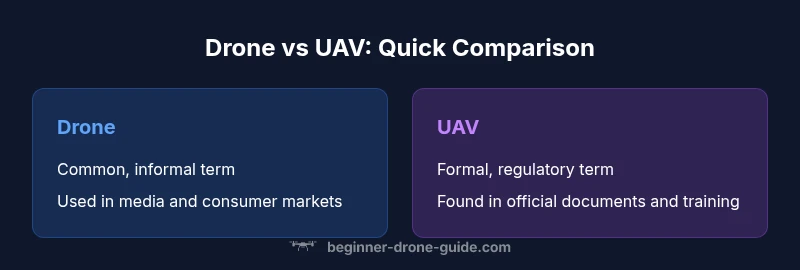
Difference between drone and UAV is largely semantic, but it matters in formal contexts. A UAV stands for Unmanned Aerial Vehicle and is the official aviation term used in regulations and documentation. A drone is the everyday, public-facing term used by media and hobbyists. For beginners, focus on safe flying and local licensing, not jargon.
Core Definitions: Drone, UAV, and Related Terms
When discussing unmanned aircraft, the terms drone and UAV are often used interchangeably in everyday speech, but they originate from different contexts. UAV stands for Unmanned Aerial Vehicle and is the formal, technical term you’ll encounter in aviation regulations, safety manuals, and official filings. The word drone, by contrast, is the public-facing, colloquial label that most people use in news stories, hobbyist forums, and consumer product marketing. A common way to frame it for beginners is: UAV = formal acronym; drone = common vernacular. This distinction is more about audience and accuracy in specific environments than about a fundamentally different device. According to Beginner Drone Guide, understanding this distinction helps new pilots communicate clearly with regulators, instructors, and insurers, reducing confusion in documentation and training materials. In practice, both terms describe aircraft capable of flight without a human on board, but the choice of term signals the setting and level of formality.
The key takeaway for new pilots is to align your language with your audience. If you’re writing a permit request, insurance claim, or regulatory submission, use UAV. If you’re sharing a flight video, posting on social media, or shopping for consumer gear, drone is perfectly acceptable. The language you choose should enable you to convey capability, compliance, and intent without ambiguity. This terminology groundwork will help you move from hobbyist to responsible operator.
Historical Context and Usage Trends
The words drone and UAV have traveled different linguistic paths. UAV emerged from military and aviation circles as a precise, technical term. It encapsulated a class of aircraft able to operate without a pilot on board, aligning with policy language and airspace governance. Over time, the word drone gained momentum in the public sphere, propelled by media coverage, consumer products, and new pilots discovering unmanned flight for photography, delivery, or inspection.
From a trend perspective, most beginner pilots will default to drone in everyday conversation, but they’ll encounter UAV in official guidelines, training curricula, and written regulations. The Beginner Drone Guide team notes that this split in usage reflects a broader shift: as unmanned aircraft become more common in everyday life, the public lexicon broadens to include the familiar term while the regulatory vocabulary remains precise. Recognizing this helps new pilots prepare for both friendly conversations and formal paperwork without stalling on terminology.
Regulatory and Safety Perspectives
Safety and compliance sit at the heart of the drone/UAV terminology discussion. Regulators often rely on the term UAV in statutes, airspace rules, and licensing requirements, while marketing and consumer education frequently use drone. For practitioners, using the correct term in the right context matters: mislabeling a document or misinterpreting a regulation can complicate approvals, impose unnecessary risk, or slow down inspections. The core principles—maintain line of sight, respect altitude limits, obtain necessary permissions, and carry liability coverage—apply regardless of which term you use. The Beginner Drone Guide analysis shows that consistency matters more than the label itself: keep terminology aligned with the audience and the governing rules you’re addressing. In training environments, instructors emphasize that accurate language supports safer operation and clearer risk communication for flight planning and incident reporting.
Common Misconceptions and Real-World Implications
A frequent misconception is that drone and UAV refer to completely different machines. In reality, they describe the same class of aircraft; the difference is largely about context. Another pitfall is assuming UAVs require more advanced equipment by default. In many hobbyist and commercial scenarios, the hardware and software ecosystems overlap, and the operations you perform—surveying, filming, search and rescue, inspection—do not depend on the term used. Misconceptions can influence how pilots approach insurance, registration, and training. If you encounter a policy that uses UAV, treat it as a formal document and ensure your license, if required, matches the same scope of operation described there. Real-world flying hinges on understanding airspace rules, weather, and safe operation, not on vocabulary alone. The goal is clear, compliant, and safe flights every time.
Technical Differences: Capabilities and Specs
In practical terms, the capabilities of unmanned aircraft come from design choices rather than the name you attach to them. A consumer drone might emphasize ease of use, camera quality, and autonomous flight features, while a professional UAV could prioritize endurance, payload capacity, and sensor integration for surveying or inspection tasks. Two devices with similar flight envelopes can differ in software: some prioritize obstacle avoidance and autonomous waypoint navigation, others emphasize real-time data streaming and precision payload control. For beginners, the important distinction is not the label but the aircraft’s certification, flight capabilities, and operating envelope in your region. Always verify that your chosen model and its software can meet your intended tasks and comply with local rules.
From the regulatory viewpoint, the term UAV often signals a broader category that includes military or industrial platforms, whereas drone tends to reference consumer and commercial grade equipment in civilian use. Understanding this nuance helps you select appropriate training, endorsements, and operating permissions for your intended work.
How to Apply the Terms in Real-World Scenarios
When purchasing gear, you’ll often see consumer models labeled as drones. In contrast, when you read regulatory notices, operation permits, or OEM documentation, UAV is more common. Apply the terms consistently in your flight logs, maintenance records, and safety briefings. In marketing materials, a drone label communicates approachability to new pilots; in policy documents, UAV communicates precision and formality. The practical effect is not about changing the device itself but ensuring your communication aligns with expectations of your audience—whether you’re filling out a permit, submitting a training record, or briefing a team before a flight. The distinction also matters when seeking insurance coverage or certifications, where regulators may use UAV in policy language and coverage terms. Keeping your terminology straight reduces confusion and strengthens professional credibility.
Practical Guidelines for Beginners
- Use UAV in formal documents (permits, training records) and drone in casual conversations (social media, lighthearted blogs).
- Cross-check the context: regulatory text, insurance forms, and official communications typically expect UAV.
- Align your terminology with your audience and your operating environment to avoid misinterpretation.
- Keep a simple glossary in your flight log: UAV = formal term; drone = informal term.
- Practice speaking and writing with consistent terminology to build confidence when you graduate to more complex operations or regulatory compliance.
Quick Reference: Key Distinctions to Remember
- UAV is the formal acronym used in aviation and policy, drone is the everyday term.
- In casual contexts, drone is perfectly acceptable; in official documents, UAV is preferred.
- The device may be the same; the naming reflects audience and intent, not fundamental hardware differences.
- Always prioritize safety, licensing, and airspace compliance over terminology choices.
Comparison
| Feature | Drone | UAV |
|---|---|---|
| Definition / Meaning | Common, non-technical term for unmanned aircraft | Technical acronym for Unmanned Aerial Vehicle |
| Common Usage | Public media, hobbyists, consumer marketing | Regulatory documents, policy, aviation context |
| Regulatory Terminology | Less formal; often used in product specs and marketing | Used in official aviation rules and licensing |
| Typical Users | General public, content creators, hobbyists | Regulators, manufacturers, professional operators |
| Industry Naming | Interchangeable in many consumer contexts | Preferred in formal documentation and compliance |
| Impact on Licensing | Terminology generally does not affect license type | Licensing references may specify UAV in scope |
Benefits
- Clarifies communication with regulators when using the formal term
- Reduces ambiguity in official documents and training materials
- Supports professional credibility in aviation contexts
- Helps consumers understand regulatory requirements when UAV appears in policy
Weaknesses
- Beginners may feel overwhelmed by formal terminology
- Inconsistent usage across media can cause confusion
- Frequent term changes in newer regulations can slow adaptation
- Marketing materials may rely on the informal term, blurring lines
Drone is the informal label; UAV is the formal term
Use UAV in regulatory and professional contexts, drone in casual communication. This alignment improves accuracy in paperwork and safety discussions, while keeping everyday conversation approachable.
Frequently Asked Questions
What is the difference between drone and UAV?
UAV is the formal acronym for Unmanned Aerial Vehicle, used in official contexts. Drone is the common, informal term used in media and everyday speech. The two refer to the same class of aircraft depending on the setting.
UAV is the formal term, drone is the everyday word. Use UAV in official paperwork and drone in casual talk.
Do regulations require UAV instead of drone?
Regulations often use UAV in official text, but many jurisdictions allow the use of drone in informal discourse. Always follow the terminology specified in the relevant regulation or guidance you’re following.
Regulations may use UAV; follow the exact terms in the rule you’re applying.
Can I use both terms interchangeably?
In casual conversation, yes. In official documents, use UAV to ensure precision and avoid misinterpretation. Consistency is key when communicating with authorities or insurers.
Yes, but reserve UAV for official documents and drone for casual talk.
Are there other terms like RPAS I should know?
RPAS (Remotely Piloted Aircraft System) is another term used in some jurisdictions to describe a managing system that includes both the aircraft and the remote pilot. It’s less common in casual use but appears in formal regulations.
RPAS is another formal term you might see in law and policy.
Does terminology affect licensing or safety training?
Term usage itself does not change safety practices; however, following the correct term in licensing and records helps ensure your documentation is understandable and compliant with local rules.
Terminology matters for compliance, not for flight safety at the moment of operation.
Quick Summary
- Know UAV = formal term; drone = everyday term
- Use terminology that matches the audience and document type
- Safety, licensing, and compliance come first, not jargon
- Maintain consistency across logs, permits, and training records