NJ Drone Update: A Practical Guide for New Jersey Pilots
A beginner-friendly guide to the latest n j drone update in New Jersey, covering licensing, airspace, local rules, and practical safety tips for responsible flight in 2026.


This guide helps you navigate the latest n j drone update for New Jersey pilots, outlining current regulatory status, licensing needs, local restrictions, and practical safety tips. By the end you’ll know what’s required to fly legally, safely, and confidently. It’s designed for beginners, with steps you can follow to check permits, register devices, and plan flights around schools, airports, and state parks.
Overview of the n j drone update
The n j drone update brings together federal guidance from the FAA with New Jersey’s state and local rules to help new pilots plan safe and legal flights. For beginners, this means focusing on three core areas: licensing scope, where you may fly, and the steps you must take to stay compliant in urban and rural environments. According to Beginner Drone Guide, the most important shift is to clarify licensing requirements, understand airspace access, and coordinate with local authorities before flights. This update also emphasizes practical safety habits you can build from day one. In this section you’ll learn the big picture: licensing categories, registration considerations, the difference between recreational and commercial use, and how to locate official references. You’ll find a simple workflow that applies to flight planning, map checks, and respecting private property, wildlife zones, and critical infrastructure in New Jersey.
Federal vs state vs local regulation under the n j drone update
Regulatory authority in the United States places airspace rules primarily with the federal level, but state and local jurisdictions add layers that affect where you can fly, how you obtain permissions, and what reporting is expected. The FAA sets baseline rules for remote identification, registration, pilot certification, flight ceilings, and general safety. New Jersey complements these with statutes and ordinances that cover state parks, coastal zones, and municipal limitations. The NJ drone landscape is dynamic: local governments may update codes or create pilot programs that tailor enforcement to their communities. For beginners, the key takeaway is to check FAA guidance first, then search for state and town rules for each planned flight. This approach reduces risk and keeps your flights compliant across the state.
Licensing, registration, and permissions
Understanding licensing and registration is essential for any n j drone update scenario. If you fly commercially, you’ll need a current Part 107 remote pilot certificate or equivalent, with the drone registered in your name. Recreational flyers must follow FAA rules for hobby use, including marking the aircraft and operating within visual line of sight. In New Jersey, you should verify whether your flight requires permissions for specific sites, such as state parks or near critical infrastructure. Always register your drone if its weight triggers registration requirements, and keep proof of registration handy during flights. By familiarizing yourself with both federal and state expectations, you’ll avoid fines and flight interruptions while building a safe flight habit.
Recreational vs commercial pilots: what changed
The n j drone update reinforces a clear distinction between recreational and commercial use. Recreational flyers must adhere to FAA guidelines for hobby flights, while commercial operators must meet professional standards, obtain appropriate waivers when necessary, and maintain records of flight operations. In NJ, this split influences where you can fly, the type of permissions required for certain venues, and the documentation you should carry. Beginners should treat every flight as potentially commercial until proven otherwise; this mindset helps you build compliant routines from day one. The update also encourages ongoing education, with resources for training and renewals.
Airspace rules and flight planning in New Jersey
Airspace is one of the most important considerations under the n j drone update. In practice, you’ll need to know whether you’re operating in Class G, E, or near controlled airspace where authorization is required. Always check airspace restrictions before you fly, using the FAA B4UFLY app and NJ-specific advisories. Planning includes assessing weather, visibility, wind, and potential obstacles such as tall structures and power lines. In New Jersey, you’ll often plan around busy urban corridors, coastal areas, and busy event venues, so preflight checks and a defined flight path are essential. By layering airspace awareness with local restrictions, you minimize risk and maximize safe operating margins.
Prohibited areas and sensitive sites in NJ
Certain zones are off-limits or require special permissions due to safety and security concerns. Airports, heliports, prisons, critical infrastructure, certain wildlife sanctuaries, and school zones are typical examples where extra care is needed. The n j drone update emphasizes avoiding these zones unless you have explicit authorization. Always consult official maps, signage, and authorities when planning a flight in or near restricted areas. Beginners should build a habit of scanning for restricted zones during route planning and incorporate those zones into a preflight safety checklist.
Getting permissions for challenging flights
When a planned flight intersects restricted zones or special events, you’ll likely need permission from authorities or a formal waiver. The NJ drone update points pilots to official channels for such authorizations, including coordinating with airport operations, event organizers, or local police where required. For commercial operations, you may need to file waivers or obtain coordination through airspace management tools. In all cases, document your permissions and keep them with your flight records. A proactive approach to permissions minimizes delays and demonstrates responsible operating behavior.
Local ordinances and parks in New Jersey
Local laws can differ from statewide rules, so check municipal codes and park regulations before flying in city parks, beaches, and recreation areas. Some counties and towns may restrict flights during certain hours, seasons, or events, even if federal rules permit operation. The n j drone update encourages pilots to seek written permissions when a site is sensitive or crowded. Start with the park authority or municipal clerk’s office to understand permit requirements, posted signs, and designated takeoff zones. This layer of due diligence protects you from fines and ensures community safety.
Preflight planning, risk management, and safety culture
A strong safety culture begins before takeoff. The n j drone update recommends a comprehensive preflight checklist that includes weather checks, equipment inspection, personnel awareness, and contingency planning. Use checklists to verify battery levels, GPS lock, compass calibration, and prop integrity. Anticipate emergencies, such as loss of signal or GPS outage, and have a rescue plan. Document your flight plan, location, time, and purpose, and review it with a spotter when operating in busy areas. Building consistent habits reduces risk and increases pilot confidence.
Insurance, records, and incident reporting
Insurance coverage is an important risk-management tool for drone pilots. Although not every flight requires insurance, many commercial operations benefit from liability protection and equipment coverage. Keep digital copies of registration, certifications, and flight logs, and maintain incident reporting procedures in case of a mishap. The n j drone update underscores the value of record-keeping for compliance audits and post-flight reviews. Regularly update your logs and keep a clear archive of maintenance, calibrations, and repairs for all aircraft used in New Jersey.
Real-world use cases and best practices for NJ pilots
Real-world pilots in New Jersey frequently leverage drones for real estate, agriculture, surveying, and search-and-rescue support in coastal communities. The n j drone update supports practical applications by clarifying when licenses and permissions are required and how to stay within airspace rules during complex missions. Beginners can learn best practices from case studies and safety drills; follow a predictable flight workflow, and continuously expand your knowledge with state-specific resources, training, and community groups. This approach helps you fly smarter, safer, and with growing confidence across the Garden State.
AUTHORITY SOURCES
- FAA UAS resources: https://www.faa.gov/uas/ and https://www.faa.gov/uas/getting_started/
- New Jersey Department of Environmental Protection: https://www.nj.gov/dep/
- New Jersey parks and recreation guidelines: https://www.nj.gov/parksandrecreation/
- Beginner Drone Guide Analysis, 2026 (attribution): this article synthesizes findings from our ongoing review of federal and state drone policies to help beginners navigate the n j drone update with practical steps.
Tools & Materials
- Drone with GPS and return-to-home feature(Ensure firmware is up to date and geofencing is enabled)
- Remote controller(Fully charged; carry a backup battery if possible)
- Smartphone or tablet with weather/maps apps(Install FAA B4UFLY app and NJ alert tools)
- FAA UAS registration (if applicable)(Register if your drone or usage category requires it)
- Preflight planning map(Use official aeronautical charts and local park maps)
- Insurance documents (recommended)(Liability coverage for commercial operations)
- Notebook or digital flight log(Record flight details, permissions, incidents, and maintenance)
- Emergency contact list(Include airport ops, park staff, and local authorities)
Steps
Estimated time: 2-4 hours
- 1
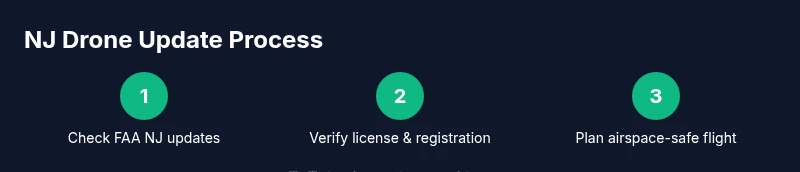
Check the latest n j drone update
Review FAA notices and New Jersey state/local updates. Confirm licensing status, airspace changes, and any new permissions required for your planned area.
Tip: Set up a recurring monthly review reminder so you don’t miss important changes. - 2
Verify licensing and registration
Confirm you hold the correct certification for your operation and that the drone is registered if required. Print or store digital copies for quick access during flights.
Tip: If operating commercially, ensure your certificate matches the operation type (visual line of sight, payload, etc.). - 3
Check airspace and weather
Use FAA tools and local NJ advisories to determine airspace class, altitude limits, and weather windows suitable for your flight.
Tip: Do not fly in marginal weather; plan an alternative window for post-storm or high-wind days. - 4
Plan your flight path and designate a spotter
Map a conservative route that avoids restricted zones, tall obstacles, and sensitive sites. Assign a spotter to help observe hazards and maintain situational awareness.
Tip: Pre-define a fail-safe route and a secondary landing area in case of wind shifts. - 5
Obtain necessary permissions
If your flight intersects restricted areas, obtain airport coordination or site-specific waivers as required by the n j drone update.
Tip: Document all permissions in your flight log and carry contact details for authorities. - 6
Conduct a thorough preflight check
Inspect airframe, sensors, propellers, battery health, GPS lock, and compass calibration; verify remote control linkage and flight mode.
Tip: Use a standardized checklist to ensure nothing is overlooked before takeoff. - 7
Perform the flight with clear boundaries
Maintain visual line of sight, stay within altitude limits, and respect privacy and property boundaries during the flight.
Tip: Avoid flying over crowds or near critical infrastructure unless explicitly authorized. - 8
Monitor and respond to changes
Watch for changing winds, GPS dropouts, or interference. Have a quick plan to land safely if any risk arises.
Tip: Keep a buffer zone around you for unexpected gusts or rotor noise disturbances. - 9
Post-flight documentation
Log flight duration, battery usage, anomalies, and any incidents. Update maintenance records and review the flight for future improvements.
Tip: Share a debrief with your team or partner to reinforce safety practices. - 10
Archive permissions and references
Store all permissions, flight logs, and contact info for future audits or inspections.
Tip: Use a dedicated folder or cloud folder with clear naming conventions. - 11
Stay informed about ongoing updates
Subscribe to FAA, state, and local updates and participate in community groups to keep your knowledge current.
Tip: Set annual training goals to renew knowledge on evolving regulations. - 12
Review and adjust your process
Regularly assess your workflow to identify gaps in safety or compliance, and adjust your plan accordingly.
Tip: Treat safety as a habit, not a checklist—continuous improvement matters.
Frequently Asked Questions
Do I need a license to fly a drone in New Jersey?
Yes, licensing depends on your operation type. Commercial flights require a remote pilot certificate; recreational flights follow FAA hobby guidelines. Always verify specific site permissions in NJ before flying.
Yes, licenses are required for commercial flights and hobby flights must follow FAA guidelines. Check site permissions in New Jersey before you fly.
What is the difference between recreational and commercial use under the n j drone update?
Recreational use follows FAA hobby rules and typically does not require a Part 107 certificate, whereas commercial use requires certification, proper registrations, and possible waivers for certain operations.
Recreational use follows hobby rules; commercial use needs proper certification and waivers when necessary.
How can I check current airspace restrictions in New Jersey?
Use FAA tools like B4UFLY in combination with state and local notices to verify airspace classes, temporary flight restrictions, and local park rules before each flight.
Check airspace with the FAA B4UFLY app and state/local notices before every flight.
Are there New Jersey-specific fees or permits?
NJ rules may require permissions for certain venues; fees vary by municipality. Always verify permit requirements with the relevant local authority.
Yes, some venues may require permits with possible fees; check locally for specifics.
Can I fly in state parks or near schools in New Jersey?
You can fly in some parks or near schools only with explicit permissions or waivers. Always consult park authorities and school policies before flights.
Only with permissions; check with park officials and schools before flying near them.
Where can I find official New Jersey drone rules?
Start with the FAA UAS pages and then consult New Jersey state sites like the Department of Environmental Protection and park authorities for local rules.
Check FAA pages first, then NJ state and park authorities for local rules.
Watch Video
Quick Summary
- Stay current with the n j drone update via official sources.
- Differentiate between recreational and commercial use and plan accordingly.
- Always verify airspace restrictions before takeoff.
- Obtain permissions for restricted or sensitive sites when required.
- Document permissions, logs, and maintenance for compliance.