How to Check Drone Registration: A Step-by-Step Guide
Learn how to verify your drone's registration quickly and safely with a practical, step-by-step guide. This beginner-friendly overview covers essential tools, regulatory context, and next steps.


To check drone registration, start with the drone's serial or registration number and locate the official regulator's database. Enter the number to confirm active status, owner details (where allowed), and expiration date. If your jurisdiction allows, you can search by operator name or model. Beginner Drone Guide emphasizes following local rules and recording results.
How to check drone registration: What it is and why it matters
Registration is the formal record that links a drone to its operator. It supports accountability, safety, and traceability, and it helps authorities verify compliance after incidents or audits. In practice, the process varies by country, but the core idea is the same: you register a drone so regulators can connect it to you as the operator. The keyword how to check drone registration is central to this guide, helping you find the exact steps you’ll follow in real life. According to Beginner Drone Guide, starting with a clear understanding of what registration covers makes later checks faster and less error-prone. This section will lay the foundation: what you are checking, why it matters, and how a registered drone differs from an unregistered one.
Regulatory context and responsibilities you should know
Drone registration rules exist to ensure safety, privacy, and accountability. Most jurisdictions require drones above certain weights or used for specific purposes to be registered. The aim is to help authorities identify who operates which aircraft and to ensure that pilots understand and follow flight rules. As you learn how to check drone registration, remember that keeping your own records up to date is a key part of responsible flying. The Beginner Drone Guide team notes that checking registration status before flights reduces the risk of fines and flight restrictions, and it demonstrates good stewardship of airspace. In short: registration is not a one-time form; it is an ongoing responsibility that follows the drone and its operator.
What you need before you start
Before you dive into verifying registration, gather a few essentials. First, have the drone's unique identifiers handy, typically the serial number or registration number. Second, know your jurisdiction or the country where the drone is operated, as rules and databases differ. Third, ensure you have access to an official registry portal on a device with internet access. Fourth, have any supporting documents or proof of ownership ready, if required by your regulator. Finally, prepare a simple note-taking tool to log results for future reference. These preparations prevent backtracking and speed up the process.
Tools and resources you can rely on
To perform a reliable registration check, you will need a few tools and resources. A smartphone or computer with internet access is essential. Use only official regulator portals or apps to avoid scams or counterfeit sites. You may also want a pen and notebook for offline notes, and a secure password manager for online accounts. Some registries let you search by the drone's serial number, the operator's name, or the model type, so having the exact model information on hand helps. If you operate commercially, your license or certificate might be tied to your registration, so keep those handy as well. Always use a trusted network and avoid shared public Wi-Fi when submitting identifiers.
Where to look: official registries by country
Different countries maintain separate drone registries, and the exact lookup options vary. In many places you can search the registry by the drone's serial number, the operator's name, or the registration certificate number. In some regions, the database is only accessible to authorities or to the drone owner, while others offer public lookup with limited details. A few regulators publish a general status feed showing whether a drone is currently registered. If you are unsure where to start, check your national aviation authority’s website for the official links to the registry and any recent updates to the process. Always verify you are on the correct site to avoid spoofing attempts.
Step-by-step overview of the verification process
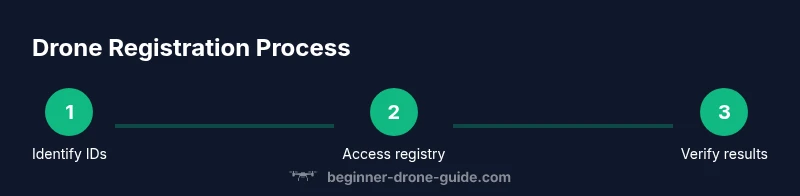
This high-level overview gives you the roadmap for how to check drone registration in a typical scenario: gather identifiers, access the official registry, enter the data, review the results, and log your findings. You will usually start with the drone's serial number, then choose the search parameter that applies to your situation. Depending on the registry, you might need to log in, provide contact details, or confirm your location. After you submit the search, check active status, expiration date, and any notes about restrictions or waivers. If the system shows a match, save the results for your records. If not, review whether you entered the correct data or contact the regulator for assistance. This process aligns with best practices highlighted by the Beginner Drone Guide team.
Check by serial number: a practical workflow
The serial number is the most precise identifier and is usually printed on the drone or its packaging. Start by locating the serial number and ensure you copy it exactly as shown, including any letters, numbers, or hyphens. Visit the official registry portal, select the serial number search option, and paste or type the value carefully. Do not rely on model name alone, as models can be shared by many devices. After submitting, interpret the result: a valid, active registration means you can fly under the rules; an expired or missing record means you need to renew or register. If the database provides you with an owner name or contact details, compare them to who you know to minimize errors. Finally, export or print a copy of the result for your records. Beginner Drone Guide recommends double-checking the entry against your drone's packaging and labels to avoid misreads.
Alternative search methods: operator name, model, or certificate number
Some registries allow checks by operator name or model type when the serial number is unavailable. This can be helpful if a drone is lost, recovered, or borrowed, or if you are validating a fleet. When using operator search, enter the registered name exactly as it appears in the registry and compare any returned details with your own records. Model-based searches are less precise but can narrow down possibilities when you have a family of similar drones. Remember that privacy and data sharing rules may limit what information is publicly visible, so do not expect full owner details in every case. These alternatives complement serial number checks and help you confirm compliance more broadly.
Interpreting results and next steps after a check
A successful match indicates that the drone is registered to the operator and that the registration is under proper status. If you see an active status with an upcoming expiration date, you should note the date and set a reminder to renew on time. If you find an expired or invalid record, do not fly the drone until the issue is resolved with the regulator or the owner. If the information does not match your own records, exercise caution and consider reporting it to the appropriate authority. In all cases, keep a clear log of your lookup attempts and outcomes. The practice of documenting checks helps you stay compliant and prepared for audits or enforcement actions, which is a core recommendation in many Beginner Drone Guide tutorials.
Record-keeping and staying compliant over time
Keeping durable records of your drone registrations is a smart habit for beginners. Save screenshots or PDFs of your registry checks, along with date stamps and identifiers used. Maintain a simple log showing the status, expiration dates, and notes about any updates you receive from the regulator. Review your records at least annually or whenever you update the drone or its ownership. When you scale up to multiple drones, adopt a consistent naming and filing scheme so you can rapidly verify each device's registration in the field or during inspections. Good record-keeping reduces risk of non-compliance and helps you stay confident while flying.
Common mistakes to avoid
- Checking the wrong registry or using unofficial sites can lead to incorrect conclusions. Always confirm the URL and use official portals. - Mistyping the serial number is a frequent source of errors and can produce no results or wrong matches. Take your time and copy/paste accurately where possible. - Confusing model name with a serial number is a common pitfall; only a precise identifier yields reliable results. - Assuming a lack of data means non-compliance; some registries restrict what is publicly visible and still allow you to verify status if you have proper credentials. - Waiting until flight day to check registration leaves little room for renewal or fixes; perform checks ahead of time and maintain reminders. The goal is to stay proactive and reduce surprises.
Tools & Materials
- Smartphone or computer with internet access(Secure connection; avoid public Wi-Fi when submitting identifiers)
- Official regulator portal or app(Use only government or regulator sites to avoid scams)
- Drone serial number and model information(Copy exactly as printed on drone or packaging)
- Proof of ownership documents (if requested)(Keep handy in case verification is needed)
- Notebook or digital log for results(Record date, identifiers used, and outcome)
- Secure password manager (optional)(If you have regulator accounts, store credentials securely)
Steps
Estimated time: 15-30 minutes
- 1
Identify your drone identifiers
Locate the serial number and model for your drone. Double-check the exact string, including letters, numbers, and hyphens. This ensures you search the correct field in the registry.
Tip: Copy and paste the serial number to avoid transcription errors - 2
Open the official registry portal
Navigate to the regulator's official website or app. Confirm you are on the authenticated domain and avoid third-party mirrors. If you need login, prepare your credentials before starting.
Tip: Bookmark the official site and verify the URL before entering data - 3
Choose the appropriate search field
Select the search option that matches your identifiers, typically serial number or registration certificate. Do not mix fields, as this can yield no results or incorrect matches.
Tip: If unsure, start with the serial number search first - 4
Enter data and submit the search
Enter the exact identifier and submit the query. Review any confirmation prompts and ensure the data was transmitted correctly. Expect a brief processing period on slow connections.
Tip: Use copy-paste for accuracy and review the confirmation message - 5
Review the results
Check the registration status, expiration date, and any notes about restrictions or special waivers. Compare with your records or with the drone's labels to confirm accuracy.
Tip: If there is a mismatch, draft a note and contact the regulator for clarification - 6
Log and preserve your findings
Save a copy of the results as a PDF or screenshot and record the search date, identifiers used, and outcome in your log. Keep backups in a secure location.
Tip: Organize by drone, with clear file naming for quick retrieval - 7
Plan follow-up actions
If registration is missing or expired, initiate renewal or re-registration as required by your regulator, and note any timelines or steps involved.
Tip: Set reminders in your calendar to renew before expiration
Frequently Asked Questions
Do I need to register every drone?
Most jurisdictions require registration for drones that meet weight or usage criteria. Check your local rules to confirm, and register the drone you fly most often if in doubt.
Most drones need registration if they meet weight or usage criteria; check local rules to confirm.
How often should I re-check registration?
Re-check when you renew registration, after ownership changes, or if you modify the drone. Some regulators send expiration notices; set reminders.
Re-check on renewal or ownership changes; set reminders.
What should I do if I find no record or a mismatch?
Do not fly until you verify with the regulator or owner. Log the inquiry and follow up to resolve discrepancies.
If no record or a mismatch, do not fly and contact the regulator.
Can I access registration details on a mobile device?
Many registries offer mobile-friendly pages or apps. Ensure you are on the official site and protect your data when using mobile.
Mobile access is often supported via official apps or sites.
What about foreign-registered drones?
If you fly internationally, check the host country's rules. You may need to verify with local authorities or ensure your home registration is valid for that airspace.
Foreign drones follow host country rules; verify with authorities.
Watch Video
Quick Summary
- Identify accurate drone identifiers before searching
- Use official registries to verify status
- Log each lookup with date and result
- Renew or correct registration before flight
- Keep organized records for audits and compliance