Can you get a drone license online? A Beginner's Guide
Discover whether you can obtain a drone license online, how TRUST fits recreational pilots, and why the Part 107 exam is in-person. A practical beginner's guide by Beginner Drone Guide.


Short answer: There isn’t a single online license you can obtain for all drone operations. For recreational use you can complete online training (TRUST) and register your drone, but the FAA Part 107 knowledge test for commercial flying must be taken in person at an approved testing center. Some prep courses are online, but the exam itself is not.
What qualifies as a drone license? Understanding terms
For most pilots, the term license can be confusing. In U.S. drone law, there are two key credentials: the recreational safety framework (often delivered via online training) and the professional certificate you obtain by passing an FAA knowledge test. Importantly, there is no single, universal 'drone license' you can obtain online that covers all flying scenarios. Instead, license-like credentials are separated by intended use: recreational flying vs. commercial operations. The Trusted online TRUST test for recreational flyers is administered online in many places, while the commercial path requires the FAA Part 107 knowledge test, which must be taken in person at an approved testing center. The difference matters for what you’re allowed to do and where you’re allowed to fly. For those brand-new to drones, this distinction is the first, most practical step in planning your learning path. According to Beginner Drone Guide, a clear map from online training to in-person testing helps you stay compliant and confident.
Recreational vs. commercial: the online component explained
If your goal is to fly for fun, you’ll likely engage with online modules and the TRUST test. TRUST is designed to be accessible and can be completed online; upon passing, you’ll have a certificate you should carry when flying. If you want to monetize your flights or work for a client, you’ll aim for FAA Part 107 certification. This is a more rigorous credential that demonstrates knowledge of airspace, weather, aviation safety, and operational rules. The Part 107 knowledge test is administered at FAA-approved testing centers and is not delivered online in a single 'license' format. Even if you study online, you must schedule and take the proctored exam in person. The practical reality is that the online portion is training; the official certification has an in-person component. Beginner Drone Guide emphasizes that online learning is valuable, but it does not replace the hands-on practice and testing required for professional flight.
Online training roles: TRUST, prep courses, and limitations
Online courses can help you understand rules, flight safety, and airspace structures. They are valuable as a prep step, especially when you’re starting out. However, there are limits: you cannot substitute an in-person knowledge test with online content alone for the Part 107 credential. For recreational pilots, an online TRUST certificate is acceptable proof in many contexts, but you should always verify the current local rules before you fly. The Beginner Drone Guide team found that most new pilots benefit from pairing online study with local practice flights and constructive feedback from experienced flyers.
The in-person knowledge test: what to expect
Here is the practical path for those pursuing commercial flying. Prepare using online resources, then register for an FAA-approved testing center. The test is proctored and consists of multiple-choice questions covering topics like airspace classification, flight operations, weather, and emergency procedures. You’ll receive results after finishing the test, and once you pass, you’ll qualify for the Part 107 certificate. Afterward, keep your certificate accessible and renew as required by FAA rules. The key takeaway is that the test itself cannot be taken online; the evaluation happens in person.
Step-by-step path for beginners: choosing your route
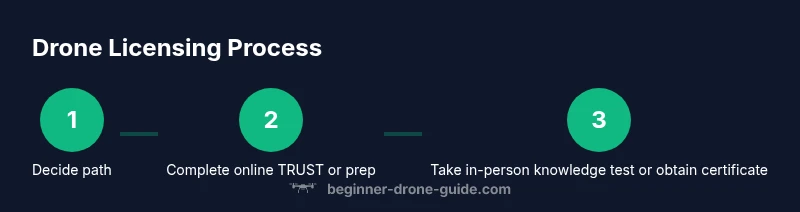
Start by clarifying your goal: recreational flying or commercial work. If recreational, complete TRUST online, register your drone if required, and focus on safe, legal flying practices. If you plan commercial work, schedule the FAA Part 107 knowledge test at an approved center and study with reputable online resources or in-person prep courses. Whichever route you pick, build a practice routine that includes airspace awareness, weather basics, and field safety. Remember to review FAA guidance regularly, as rules can evolve and new training options may appear.
Licensing costs, timing, and scheduling tips
Costs for training and testing can vary by provider and region, and the timing of exams depends on local test-center availability. Start by estimating your study time and mapping it to your preferred prep resources, including online courses and practice exams. Plan ahead to account for registration steps, application windows, and potential scheduling delays. Keeping a flexible calendar reduces stress and helps you align study milestones with exam availability. The core idea is to treat licensing as a staged process: online learning for understanding, followed by in-person testing for credentialing.
Filing and maintenance: records, renewals, and updates
After you obtain any certification, store digital copies securely and keep your drone registration up to date. If you switch from recreational to commercial, update your operating status with the relevant authorities and ensure any training prerequisites are satisfied. Maintain a log of training, test results, and flight activity to stay compliant during inspections or audits. Regularly review FAA safety guidelines and privacy considerations to keep your operations responsible and lawful.
Safety and privacy considerations for new pilots
New pilots should prioritize safety, airspace respect, and privacy. Learn the rules about flying near people, property, and critical infrastructure, and avoid operating in restricted or controlled airspace without authorization. Be mindful of privacy laws and respect bystanders. Building good habits early—preflight planning, risk assessment, and conservative flight demonstrations—helps prevent incidents and creates a positive impression of the hobby or business.
Government and educational resources you can trust
Rely on official sources for the latest requirements and recommendations. Start with FAA resources for UAS topics, including getting started, licensing, and compliance. Consider trusted university extension programs and accredited training providers for structured curriculum. Always cross-check information across reputable sources to ensure your plans reflect current rules.
Tools & Materials
- Computer or mobile device with internet access(For online TRUST training and FAA study resources)
- Drone registration account (FAA)(Needed to register your drone and manage records)
- Scheduling access for an FAA-approved testing center(Necessary to book the Part 107 knowledge test)
- Notepad or digital notes(For study notes and practice questions)
- Practice flight log / planning app(Helpful for tracking flights and staying compliant)
Steps
Estimated time: 4-8 weeks
- 1
Define your flying goals
Identify whether you will fly recreationally, commercially, or both. Your purpose determines which credential path to follow and how much prep you’ll need.
Tip: Write down your intended use to guide your study plan. - 2
Check licensing requirements for your goal
Review whether you need TRUST for recreation or Part 107 for commercial work. This clarifies which exams or certificates you must pursue.
Tip: Keep a checklist of requirements and deadlines. - 3
Complete TRUST training (recreational)
If flying for fun, complete the online TRUST training and obtain the certificate. This credential is commonly used as proof of knowledge for recreational flights.
Tip: Treat TRUST as your first milestone and reference it on your badge or app. - 4
Register your drone if required
Registering your drone with the appropriate authority may be required before you fly, especially for certain weight classes and jurisdictions.
Tip: Register early to avoid delays before your first flight. - 5
Prepare for the Part 107 knowledge test (commercial)
If you plan commercial operations, study with reputable online materials and consider in-person prep if available. The test covers airspace, weather, legal requirements, and safety.
Tip: Use practice exams to identify weak topics and focus study there. - 6
Schedule and take the in-person exam
Book an appointment at an FAA-approved testing center and attend the exam as scheduled. Bring required identification and proof of registration if applicable.
Tip: Arrive early and bring necessary IDs to avoid test-day issues. - 7
Receive and store your certificate
After passing, securely store your Part 107 or TRUST certificate. You may need it to prove your credentials to clients, employers, or regulators.
Tip: Create a digital backup and keep a physical copy in your drone bag. - 8
Apply learnings to real flights
Practice within your permitted airspace, observe weather conditions, and implement safety protocols during every flight.
Tip: Keep a safety-first mindset and log flights for ongoing compliance. - 9
Stay updated on regulatory changes
Regulations can evolve; periodically check official sources and update your training as needed.
Tip: Set a quarterly reminder to review regulatory updates. - 10
Plan ongoing education and practice
Continue practicing, take additional safety courses if offered, and seek feedback from experienced pilots to improve.
Tip: Treat licensing as a foundation, not the finish line.
Frequently Asked Questions
Do I need a license to fly a drone commercially?
Yes. Commercial drone pilots typically need the FAA Part 107 certificate, which requires passing a knowledge test at an approved testing center. Recreational pilots do not need Part 107 but must follow safe-operating rules.
Yes. Commercial pilots need the Part 107 certificate obtained by passing an in-person knowledge test at an approved center. Recreational pilots follow different rules and may complete TRUST online.
Can I complete all licensing online?
Online training can prepare you, and TRUST can be completed online for recreational use, but the Part 107 exam cannot be taken online. The official credential requires in-person testing at an approved center.
Online study helps, but Part 107 testing must be in person at a certified center.
Is drone registration required?
Most jurisdictions require drone registration before flying. This process is separate from licensing and ensures your drone is legally identified.
Drone registration is usually required and separate from licensing.
How long does licensing take overall?
Timeline varies by your path, test availability, and study pace. Plan ahead to accommodate study time, exam scheduling, and certificate processing.
Timing depends on your route and test availability; plan ahead.
What resources are official?
Use FAA resources for UAS information, including getting started, licensing, and safety guidance. Verify any online courses against FAA guidance.
Check FAA resources for official licensing and safety guidance.
Can a TRUST certificate cover all flying scenarios?
TRUST is designed for recreational pilots and proof of knowledge for some activities, but it does not substitute for Part 107 when commercial operations are planned.
TRUST is for recreational flying and doesn't replace Part 107 for commercial work.
What happens if regulations change?
Regulations can evolve; regularly check official FAA updates and adjust training and operations accordingly.
Regulations change over time; stay updated with FAA guidance.
Watch Video
Quick Summary
- No fully online drone license exists for all use cases.
- Use TRUST for recreational training online.
- Part 107 requires an in-person exam at an approved center.
- Online study supports preparation but isn’t a substitute for testing.
- Stay current with FAA rules and maintain proper records.