Can You Fly a Drone in NYC? Rules, Safety, and Practical Guidance
Learn where you can fly a drone in New York City, the required waivers and permits, safety best practices, and practical steps to fly legally, safely, and confidently in urban skies.


NYC drone flights are possible, but you may not fly everywhere. Before lifting off, verify FAA airspace classifications, obtain required waivers for controlled zones, and comply with local restrictions. Start in permitted areas, stay in visual line of sight, and plan for safety distances from people and property. With proper authorization and careful planning, you can conduct safe, legal urban flights in NYC.
NYC Drone Flying Landscape: Legal Framework and Practical Realities
Urban drone operation sits at the intersection of federal aviation law, city policies, and real-world risk. For beginners, this can feel overwhelming, but breaking it into rules and practical steps makes it manageable. According to Beginner Drone Guide, NYC drone flying is not a free-for-all; you can fly legally, but only after you understand the airspace structure and obtain any required permissions. The FAA governs flight operations nationwide, with two broad tracks: recreational pilots who adhere to the FAA Safety Code and commercial operators who use Part 107 with necessary waivers. In New York City, the airspace is particularly dense and many zones are effectively restricted. The Beginner Drone Guide team emphasizes that successful urban flights start with three pillars: accurate airspace identification, explicit authorization for the intended flight, and a clearly defined risk mitigation plan. This section lays out how those pillars apply in practice, and how to plan a flight that minimizes risk to people, property, and public interests.
Airspace and Access: What Every Pilot Should Know
New York City sits inside some of the nation’s most intricate airspace. Most flights near the city require clearance to operate in controlled airspace, and near major airports the need for authorization is even more stringent. Before you lift off, consult official resources such as sectional charts and airspace maps, and use trusted digital tools to determine the current status. In many cases, you’ll need a waiver or approval through LAANC for automated authorization, or a manual FAA review for more complex operations. The complexity is heightened by Temporary Flight Restrictions during events, as well as the proximity of critical infrastructure. The Beginner Drone Guide analysis shows that the probability of denial increases when operators skip these steps or attempt to fly in restricted zones without permission. Practically, this means your preflight check should include a live airspace verification, a schedule check for events, and a plan B that avoids sensitive corridors near the city core.
Where You Can Fly Legally (and Where You Should Avoid)
Outside core dense urban corridors and restricted zones, there are still opportunities for legal drone flights. You may find modest, lower-risk areas in outer boroughs or suburban pockets where local ordinances are less restrictive, but you must still comply with FAA rules and stay within visual line of sight, maintain altitude discipline, and observe privacy expectations. In parks, plazas, and densely populated neighborhoods, flying is either prohibited or tightly controlled, with many parks requiring explicit authorization and special event permits. The policy framework is evolving, and city agencies periodically update maps and guidance as drone usage expands for photography, mapping, and inspection work. If you’re unsure, contact the local FAA office or city authority to confirm whether a planned location is allowed. This clarity can prevent penalties, confiscations, or flight bans that derisk your learning journey.
Permits, Waivers, and the Process of Getting Access
Urban drone operations in NYC frequently require FAA waivers, even for recreational pilots, if the flight will take place in or near controlled airspace, over people, or at night. The typical path begins with a risk assessment, a flight plan, and a safety plan. For commercial work, you’ll likely operate under Part 107 and must obtain a certificate; for certain complex operations, a Section 333 exemption (older term) has evolved into waivers under Part 107. The process generally involves submitting an online request to the FAA, providing a detailed description of the flight, safety mitigations, and a contact plan. Local permitting for filming or event-specific shoots may also be required; these permits are issued by city agencies or by the film office, and sometimes by private property owners. Start early, as processing times vary by case and season.
Practical Flight Planning in a Dense Urban Environment
Effective flight planning in NYC begins with a robust risk assessment and an exit strategy. Check the weather, wind conditions between buildings, and potential gusts that can funnel through canyons of skyscrapers. Create a preflight checklist that includes drone health, controller readiness, compass calibration, and a plan for returns if comms are lost. In cities with high population density, it’s essential to set conservative altitude limits and avoid flying over crowds, sidewalks, or performance venues. Use geofencing and remote ID features to comply with regulatory expectations; ensure insurance coverage and have a visible permit or authorization document ready for inspection. Practical operators build a flight log, including times, coordinates, and outcomes, so future operations can be adjusted based on what worked well and what didn’t.
Gear and Best Practices for NYC
Choosing the right gear for city flights means balancing camera quality with portability and safety. Lightweight, reliable drones with good obstacle avoidance perform best in urban environments. Always enable geofencing, return-to-home with a known safe landing zone, and remote ID. Carry spare batteries, a charged phone, and data backups of your flight plan. In addition to technical readiness, get into the habit of communicating with people on the ground when safe and appropriate to reduce surprises. Insurance coverage, a visible operator ID, and up-to-date firmware keep you compliant and protected. Learning resources from reputable sources, including the Beginner Drone Guide Team’s practice guides, can accelerate your skill growth and help you read city-specific cues such as wind channels, reflections, and areas with heavy pedestrian activity.
Real-World Use Cases: Filming, Real Estate, and Aerial Inspections
Urban drone work in NYC is highly sought after for real estate tours, film production, and structures inspection. With permission and appropriate waivers, you can capture iconic skyline shots, map building facades for inspections, or create marketing footage that communicates value. However, every project requires careful coordination with stakeholders, location-specific permissions, and a clear chain of custody for footage. Use planned flight routes to minimize privacy concerns, shot angles that avoid crowds, and post-flight data handling that makes it easier to document compliance. Real-world operators often work with licensed pilots, licensed photographers, and production coordinators who understand the regulatory landscape and the local geometry of the city’s airspace.
How to Stay Compliant and Keep Learning
Rules change, and technology evolves, so ongoing education is essential. Stay current with FAA advisories, NYC Parks rules, and local permit processes. Join a local drone club or online community to share experiences and receive feedback on new waivers, event schedules, and best practices. Always audit your flights against a personal learning plan and use simulation tools to practice unusual scenarios—like wind shifts between tall buildings or night operations in permitted zones. The Beginner Drone Guide team recommends building a playbook that blends preparation, permissions, and practical operations, so you can fly smarter, safer, and with confidence in NYC.
Key NYC drone operations considerations
| Aspect | NYC Consideration | Typical Operational Note |
|---|---|---|
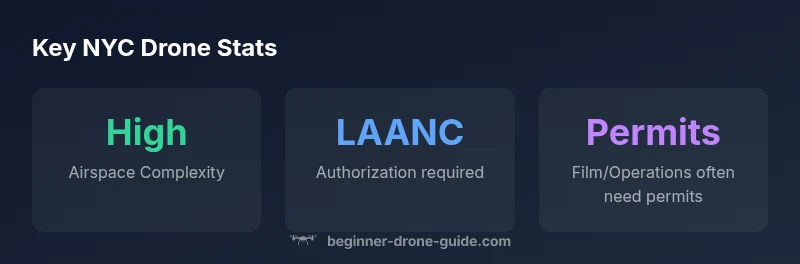
| Airspace Type | Class B and controlled airspace around NYC | Requires authorization; consult LAANC/FAA |
| Permits Required | FAA waivers often needed; local permits vary | For film: film permit may be required |
| Flight Safety Constraints | Crowded high-rise density, pedestrians, property | Need risk assessment and insurance |
Frequently Asked Questions
Is it legal to fly a drone in NYC?
Yes, but only with FAA authorization and local permissions; many areas are restricted. Plans should include airspace checks, waivers, and a safety protocol.
You can fly in NYC, but you must have FAA authorization and local permissions; most areas are restricted.
Do I need a license to fly a drone in NYC?
Commercial flights require FAA Part 107 certification; recreational pilots must follow the FAA Safety Code. If your flight is for education or hobby, you still need to follow rules.
For commercial work you need Part 107; recreational pilots must follow the FAA Safety Code.
What airspace rules apply near NYC?
NYC sits in heavily controlled airspace with nearby major airports. Always verify current classifications and obtain waivers as needed.
The airspace around NYC is heavily controlled; check classifications and apply for waivers.
Can I fly in Central Park?
Central Park is generally restricted for drone flights; exceptions require explicit permits or filming permissions and coordination with authorities.
Central Park flights are highly restricted unless you have special permission.
What permits are needed for filming in NYC?
Filming typically requires FAA authorization for the flight plus local permits from city agencies or the film office.
Filming usually needs both FAA authorization and local permits.
How can I apply for FAA waivers?
Submit a waiver request through the FAA with a detailed flight plan, safety mitigations, and contingency plans. Processing times vary.
Apply for FAA waivers; plan ahead and provide detailed safety measures.
“Urban drone operations demand meticulous planning and ongoing learning; legality isn't optional—it's foundational. Even in a city as busy as NYC, proper authorization and disciplined flight planning make the difference between a successful shot and an enforcement action.”
Quick Summary
- Plan airspace checks before every flight.
- Obtain FAA waivers and local permits when needed.
- Choose permitted areas to minimize risk.
- Stay current with evolving NYC drone rules.