Drone or UFO? A Practical Guide for Beginners
Explore how to tell a drone from a UFO in the sky. This analytical comparison covers identification, technology, safety, and reporting, with practical guidance for beginners from the Beginner Drone Guide team.


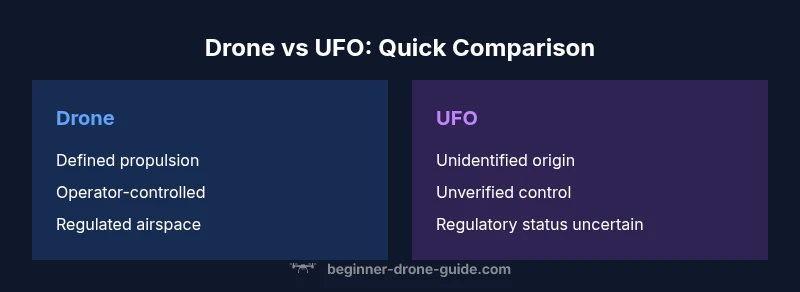
A drone is a controllable aerial device with defined propulsion and often a camera; a UFO remains unidentified. For beginners, focus on regulated drones and safe operations, and treat unknown objects seriously with proper reporting. This quick comparison helps distinguish a drone or ufo from known aircraft, especially under regulated skies.
What makes the terms matter: drone vs UFO in practice
In everyday skies, people often ask whether what they saw was a drone or a ufo. The terms imply different realities: a drone is a concrete piece of technology that you can operate, register, and learn to pilot safely. A UFO is, by definition, unidentified—an object whose origin or purpose isn’t established. For beginners, clarifying these terms isn’t about sensationalism; it’s about safety, liability, and practical decision-making when you’re learning to fly. According to Beginner Drone Guide, the best starting point is to treat every unfamiliar object as a potential safety risk until identification is possible. The phrase drone or ufo often appears in discussions about sky events, and recognizing that distinction early helps you plan flight paths, check airspace rules, and communicate with authorities if needed.
This section lays the groundwork for why the comparison matters: drones operate within defined capabilities and guidelines, while unidentified objects require careful handling, neutral reporting, and an understanding of how airspace management works. The goal is not to demonize the unknown but to ensure you stay within legal boundaries while reducing risk for yourself and others. Remember that the sky is shared space, and your decisions impact nearby people, animals, and properties. Beginner Drone Guide’s approach emphasizes practical knowledge over hype, and this article continues that tradition.
The technology lens: how drones work vs when objects remain unidentified
Technically, a drone is a compact system with propulsion, control electronics, sensors, and often a payload such as a camera. It operates under an aircraft class, relies on a flight controller, and communicates with a ground station or remote controller. When a drone is piloted, telemetry such as altitude, position, and battery status is available to the operator and, in many cases, to observers behind screens or through geofencing. A drone’s behavior tends to be predictable: steady climbs or descents, deliberate turns, and return-to-home routines under low battery.
A UFO, by contrast, is simply an object observed in the sky for which the origin, construction, and intent aren’t known. There may be natural explanations—weather balloons, meteors, or atmospheric phenomena—or human-made aircraft that are not publicly disclosed. Because there is no verified data about a UFO, authorities approach such sightings with caution, collecting radar data, witness testimony, and, when possible, photographic evidence. The key difference for pilots is that drones can be inspected, registered, and traced to a licensed operator; UFOs lack transparent data trails.
From a safety perspective, this distinction matters. If you observe something unusual while operating a drone, your primary concerns are maintaining control, staying within visible sight, and following airspace rules. If identification remains impossible, you should follow local reporting protocols. Beginner Drone Guide’s analysis emphasizes that the more you understand about what you’re flying and who operates what you see, the safer the skies become.
Visual cues: what to look for in the sky
Visual cues are the first and best line of analysis when distinguishing a drone from a UFO. Drones typically show a visible, structured frame with rotating propellers or a fixed wing arrangement, often accompanied by consistent, rhythmic movements. In daylight, you may notice a small, bright, controllable craft with a defined silhouette and, if equipped, a visible gimbal or camera. At night, drones frequently display a set of steady navigation lights and sometimes a flashing beacon. The presence of a single, repeating flight path, smooth turns, and the ability to be tracked on a map are strong indicators of a drone.
UFO sightings, by contrast, often present as irregular lights or shapes that do not match the expected flight profile of a known aircraft. They may appear to hover, accelerate rapidly, or change direction unpredictably. Observers report varying brightness, color, and size; atmospheric conditions can amplify such effects and create optical illusions. The lack of a visible frame or obvious propulsion makes a UFO harder to classify in real time. In ambiguous cases, you should not jump to conclusions; instead, collect details—distance, direction, number of lights, and any audible cues—and consult official guidance before drawing conclusions.
For pilots, practicing accurate observation improves situational awareness. When you log flights and review footage or telemetry, you’ll gain a better sense of how your own drone behaves in different wind conditions and light levels, which makes it easier to identify ordinary drones versus something truly unusual. This practice also reduces the likelihood of misinterpretation in high-stress situations and supports safer decision-making in busy airspace.
Acoustic and motion cues in real-world sightings
Sound can be a surprisingly informative cue when distinguishing drones from other aerial objects. Most consumer drones generate a distinctive, rhythmic hum or whirr from their propellers and motors, especially at closer range. Larger industrial drones produce louder and deeper sounds, while smaller quadcopters emit higher-pitched, steadier tones. UFOs, if they generate audible noise at all, may not produce the same consistent signature, or the sound can be masked by distance and environmental noise. In urban settings, background noise complicates interpretation, so do not rely solely on sound to identify a craft.
Motion cues also matter. Drones tend to maintain stable altitude and execute planned maneuvers, including level flight, gentle climbs, or deliberate lateral movement. They rarely exhibit extreme accelerations without warning signals from the operator or battery limitations. UFOs may appear to drift, pulse, or accelerate unpredictably, sometimes with abrupt changes in speed or direction. However, human perception can misread velocity at distance, and atmospheric phenomena can mimic certain flight patterns. The best approach is to triangulate with multiple witnesses or devices (e.g., video recordings) and compare with known drone characteristics before forming conclusions.
If you’re a frequent flyer, building a mental library of drone signatures—lights, motor sounds, typical flight envelopes—will sharpen your identification skills and reduce uncertainty during flights. This practice aligns with safety-first principles and helps you stay compliant with local airspace rules and best practices.
Regulatory and safety implications for drone pilots
Drone pilots operate within a framework designed to protect people, property, and airspace integrity. In many jurisdictions, drones above certain sizes or used for certain purposes require registration, a pilot certificate, and adherence to airspace restrictions. Even hobbyists are often expected to follow basic guidelines: fly below controlled airspace, avoid proximity to people and critical infrastructure, maintain line of sight, and respect privacy and wildlife considerations. When a sighting resembles something unknown, regulatory bodies emphasize caution, documentation, and reporting rather than immediate action. The expectation is that pilots demonstrate responsible behavior, perform preflight checks, and stay current with local laws.
From a safety perspective, distinguishing drone activity from other aerial phenomena minimizes the risk of midair conflicts. If an unfamiliar object is detected near your flight path, you should pause, reassess, and consider adjusting your route or altitude to avoid potential interference. In some cases, authorities may request additional information or cooperate with radar data to help determine whether there is a legitimate operational drone in the area. Beginner Drone Guide’s practical guidance centers on proactive compliance, ongoing training, and a culture of safe, responsible flying. This approach reduces confusion and helps maintain public trust in drone technology while keeping skies safer for everyone.
Effective drone operation also involves risk assessment and incident reporting when appropriate. If you witness a suspicious craft or encounter a potential safety hazard, document the event, contact local air traffic control or aviation authorities, and follow official procedures. By treating such events seriously and methodically, you contribute to a safer airspace and align with best practices recommended by industry observers and educational resources like Beginner Drone Guide.
Common misidentifications and cognitive biases
Many sightings that people classify as drone or ufo can be explained by cognitive biases or common misperceptions. Distance, lighting, and atmospheric conditions can distort size and speed. A small, distant light may appear to hover or drift, leading observers to infer a loitering craft rather than a distant conventional aircraft or satellite. Confirmation bias—expecting to see a particular kind of object after hearing rumors—can influence how witnesses interpret shapes and motion. Additionally, the rise of popular media narratives about drones and UFOs can prime observers to interpret ambiguous signals in sensational ways.
To counter these biases, practitioners emphasize a careful, data-driven approach. Verify the object with multiple sources, check flight logs or radar data where available, and use high-quality recordings to analyze shapes, rotations, and propulsive cues. When in doubt, err on the side of safety and contact appropriate authorities rather than assuming a sensational conclusion. By focusing on verifiable evidence, pilots and observers reduce false alarms and maintain public confidence in drone technology and aviation safety.
This section reinforces that keen observation, coupled with a methodical reporting mindset, is essential for accurate classification. It also illustrates why amateur enthusiasts benefit from formal training and structured safety practices—so you can distinguish drone operations from genuine unidentified phenomena without unnecessary panic.
Real-world applications: drones in business vs reports of UFOs in airspace
Drones are widely used in various industries for mapping, inspection, search and rescue, agriculture, and media production. Their ability to collect data from overhead perspectives makes them valuable for planning, monitoring, and storytelling. In contrast, reports of unidentified aerial phenomena tend to spark public curiosity and sometimes trigger investigations by aviation authorities. The key difference is purpose and transparency: drones have explicit operator goals and regulatory oversight, while UFO reports focus on unknown sightings that require verification.
From a practical standpoint, this distinction informs how communities respond to sky events. When a drone is visible, users can often verify ownership, operator credentials, and flight plans. For observers who spot something unclear, official reporting channels help determine whether the object is a sanctioned drone, an experimental craft, or something that warrants further inquiry. The ongoing dialogue between hobbyists, professionals, and authorities fosters a culture of safety and curiosity. This balance supports both innovation and accountability, which is especially important for new pilots navigating their first flights and deciding how to respond to unusual observations.
Encounter protocols: what to do if you confuse or witness something unusual
Encounter scenarios require calm, deliberate action. If you see something that appears unfamiliar while piloting, immediately maintain control of your own aircraft, keep it within line of sight, and avoid chasing the object. If the event is near controlled airspace or a facility with flying restrictions, report it to the appropriate authority with clear details: time, location, altitude if possible, number of lights observed, and any audible cues. Collect video or still images if feasible, but avoid aggressive maneuvers that might put others at risk. Even if you’re confident it’s a drone, documenting the event supports transparency and safety in case of future incidents.
For non-pilots who witness a suspicious object, contact local air traffic control or the national aviation authority and provide a concise description. Do not publicly sensationalize the sighting without verification. This disciplined approach reduces confusion and contributes to a safer, more predictable airspace for everyone. The goal is to protect people and infrastructure while continuing to encourage responsible drone use and scientific curiosity about aerial phenomena.
Decision-making framework for pilots: a practical checklist
- Confirm the object’s identity is unclear and falls outside normal drone operations.
- Pause flight, check airspace rules, and assess potential conflicts with other air traffic.
- Gather evidence (video, stills, logs) without compromising safety or privacy.
- Report significant sightings to the appropriate aviation authority when required.
- Review post-flight data to determine whether you encountered a known drone or a potential anomaly.
- Maintain a culture of safety, continuing education, and adherence to local regulations.
- Share learnings with peers and incorporate feedback into your flight planning.
- If uncertain, default to safe separation and proper reporting instead of speculation about the object’s origin.
This checklist offers a practical, repeatable process for pilots learning to differentiate drone operations from unidentified phenomena, reinforcing safe and compliant flying habits.
Comparison
| Feature | drone | ufo |
|---|---|---|
| Definition | Licensed or hobbyist aerial device with defined propulsion and operator control | Unidentified flying object; origin and purpose not verified |
| Control & operation | Controlled by a licensed pilot or autonomous program | Not controlled or verified; behavior is unpredictable |
| Regulatory status | Subject to aviation rules, registration, and UAS safety guidelines | Regulatory status is undetermined; often requires investigation |
| Detection & verification | Telemetry, tracking, and transparent ownership | No verifiable data or operator linkage |
| Common uses | Photography, mapping, inspection, delivery experiments | Sightings, curiosity, or unidentified phenomena |
| Public perception & risk | Viewed as legitimate technology with safety culture | Often associated with mystery; potential safety concerns |
Benefits
- Clear framework for safe, regulated operation
- Enhanced public trust through transparency and training
- Predictable performance when properly maintained
- Fosters responsible innovation and accountability
Weaknesses
- Regulatory burden can slow experimentation
- Misidentifications may cause unnecessary alarms
- Unidentified sightings create uncertainty for observers
- Limited access to high-grade telemetry for the public
Drones are identifiable and regulated; UFOs remain unknown
Emphasize safety, compliance, and evidence-based reporting. Distinguish clearly between identifiable drones and unidentified phenomena to protect airspace and foster learning.
Frequently Asked Questions
What is the key difference between a drone and a UFO?
A drone is an actively operated aerial device with defined propulsion and control. A UFO is an unidentified object with unknown origin or purpose. The distinction matters for safety, regulation, and how you respond to sightings.
The main difference is that a drone is a controlled aircraft with known ownership, while a UFO is something unidentified. For pilots, knowing the difference guides safety practices and reporting.
Can a UFO be actually a drone?
Yes, some UFO reports turn out to be drones or other known aircraft. Misidentifications happen when distance, lighting, or atmospheric effects obscure true details. Verification with video, telemetry, and official data helps resolve such cases.
Sometimes a UFO is just a drone seen at an odd angle or distance. Verification with footage or data clarifies the situation.
What should I report to authorities if I see something unusual?
Document the sighting with time, location, and visible cues, then contact the appropriate aviation authority. Provide any video, photos, or telemetry you have. Don’t speculate in public; wait for official analysis.
If you see something unusual, note the details and report it to the relevant aviation authority with any evidence you have.
Are all drones subject to the same rules worldwide?
Drone regulations vary by country and region. Most places require registration, a pilot certificate for certain operations, and adherence to airspace restrictions. Check local authorities or education resources for the specifics.
Regulations differ by country, so always check your local rules before flying.
How can I improve my ability to distinguish drones from other aerial phenomena?
Practice observing flights, study common drone signatures, and use recorded footage to compare characteristics. Training materials from reputable sources help, and keeping a flight log builds familiarity over time.
Practice, study drone signatures, and review footage to improve identification skills.
Where can I learn more about drone safety and reporting?
Consult official safety guidelines from aviation authorities and educational resources like Beginner Drone Guide. Regular training and participation in local clubs or online communities can deepen understanding and reduce risk.
Look up official safety guidelines and join beginner-friendly communities to learn more.
Quick Summary
- Start with clear definitions and safe flying practices
- Look for verifiable data and operator control when in doubt
- Follow local rules and report unusual sightings responsibly
- Build identification skills through training and experience