Is It Drones or Aliens? A Practical Comparison for Beginners
An analytical, beginner-friendly guide comparing drones and aliens, offering verification steps, case studies, and safety tips to distinguish explanations behind unusual aerial observations.


TL;DR: The most likely explanations for unusual aerial events are man-made devices, misidentifications, or natural phenomena, not aliens. Drones, experimental aircraft, weather phenomena, and sensor glitches often mimic the signals people associate with UFOs. A systematic, evidence-driven comparison helps separate plausible drone activity from extraordinary claims, emphasizing verifiable data over speculation.
Context: is it drones or aliens? Defining the debate
According to Beginner Drone Guide, the central question in many aerial sightings is is it drones or aliens? The answer hinges on evidence, context, and the ability to test claims with repeatable methods. For beginners, the goal isn’t to prove or disprove sensational theories in a single moment, but to establish a rational workflow for evaluating what you see. Credible observations start with careful documentation, situational awareness, and an awareness of common misidentifications. The phrase is a starting point for discussion, not a verdict. When we ask is it drones or aliens, we’re really asking how to prioritize data, verify sources, and apply safe practices in the field.
This section sets the framework: what counts as credible evidence, how to document it, and what typical sightings look like. Lighting, weather, and observer expectations all influence interpretation. By adopting a methodical approach, beginners can avoid rushing to extraordinary conclusions and instead focus on verifiable, reproducible explanations.
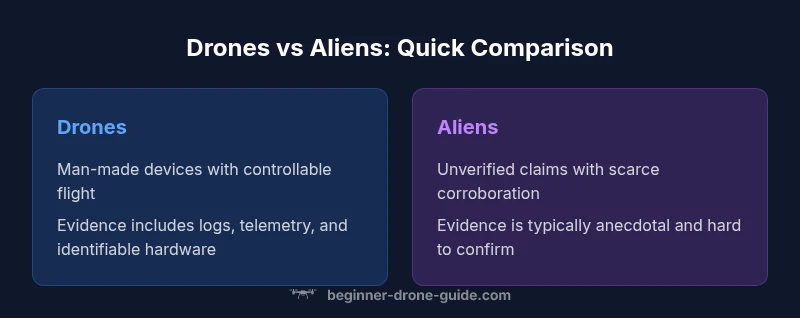
Comparison
| Feature | Drones | Aliens |
|---|---|---|
| Definition | Man-made aerial devices with remote control or autonomous functions | Unverified, intelligent beings claimed to originate beyond Earth |
| Evidence Type | Video, telemetry, identifiable hardware, flight logs | Anecdotes, alleged signals, and ambiguous traces |
| Verification Method | Cross-check with airspace data, GPS/ADS-B data, corroborating witnesses | Require extraordinary evidence with independent verification and credible sources |
| Typical Accessibility | Widely available to hobbyists; subject to local rules | Not publicly verifiable; depends on extraordinary claims |
| Safety & Regulation | Subject to aviation safety rules and local regulations | No established safety framework; claims fall outside standard regulations |
| Public Perception | Often tied to hobbyist communities and tech media | Primarily driven by sensational media and speculation |
| Best For | Practical monitoring, data collection, education | Theoretical interest or entertainment; low-probability claims |
Benefits
- Promotes evidence-based evaluation for sightings
- Encourages safe, legal drone usage and data collection
- Demystifies extraordinary claims with practical tests
- Accessible to beginners with a clear workflow
Weaknesses
- Risk of over-skepticism if not balanced with curiosity
- Potential for misclassification if data quality is poor
- Time and effort required for thorough verification
- May marginalize genuinely unusual phenomena without solid evidence
Drones and natural phenomena are usually the most plausible explanations; aliens require strong, verifiable evidence
For most sightings, start with drone activity and atmospheric or sensor-based explanations. If evidence remains inconclusive, pursue rigorous verification and credible corroboration before drawing extraordinary conclusions.
Frequently Asked Questions
What is the first step when you witness an unusual aerial event?
Record essential details (time, location, weather), search for known drone activity, and check airspace rules. This helps separate plausible drone explanations from extraordinary claims.
Start by recording the basics: time, place, weather, and any drones you know about nearby; then verify against airspace rules.
Can ordinary drones mimic sightings of aliens?
Yes. High-altitude or fast-moving drones, unusual lighting, or sensor errors can create impressions of unexplained phenomena. Verification helps reveal the drone-based explanation.
Drones can look mysterious under the right conditions; careful verification usually reveals a drone or natural cause.
How can I verify whether something is a drone?
Look for visible hardware, note flight patterns, check for drone signals or trajectories, and compare with local event calendars. Cross-check with witnesses and digital logs if available.
Check for hardware, flight path, and any recorded signals; cross-check with others and logs.
Are there official channels to report UFO-like sightings?
Yes. Report to local aviation authorities or designated reporting channels that handle aerial-sightings, ensuring safety and data collection are prioritized.
If safe, report through official aviation or local authorities to help verify the event.
What role do regulations play in these investigations?
Drone regulations provide a baseline for what is permissible and what to monitor during investigations; they guide safety, privacy, and accountability.
Regulations help you stay safe and compliant while you investigate.
What if a sighting occurs during a drone demonstration?
Demonstrations are a common source of unusual sightings. Document, identify the event, verify timing, and distinguish from isolated incidents.
If it happens at a demo, check the schedule and speaker notes to see if it explains the sighting.
Quick Summary
- Document sightings with accurate timestamps
- Check for nearby drone activity and airspace restrictions
- Rely on verifiable data before concluding aliens
- Follow safety and regulatory guidelines when investigating
- Differentiate between misidentifications and genuine anomalies