Pilot Drone: A Beginner's Step-by-Step Flight Guide
A comprehensive step-by-step guide to piloting a drone for beginners, covering gear, controls, preflight checks, and beginner maneuvers to build confidence.


Goal: Learn to pilot a drone safely and confidently by following a simple, repeatable routine. You’ll set up the drone and controller, run a basic preflight check, and practice hover, gentle moves, and a controlled landing in an open area. This guide emphasizes safety, compliance with local rules, and steady practice to build muscle memory.
What it means to be a pilot drone and how beginners start
Becoming a pilot drone is about more than just pulling a stick. It’s a discipline that begins with mindset, safety, and a willingness to learn in small, controlled steps. For beginners, the goal is stable flight, predictable responses, and reliable decision-making under varying conditions. This guide frames piloting as a skillset built from planning, checks, and muscle memory—something you can grow through consistent practice. According to Beginner Drone Guide, setting clear learning goals and keeping a simple log helps beginners track progress and stay motivated. In practice, you’ll start in an open area, use basic controls to hover and drift, and gradually introduce more complex maneuvers as confidence improves. You’ll also learn to recognize warning signs, such as inconsistent GPS or unexpected drift, and pause to reassess rather than push ahead. Remember: safety first, rules second, and practice third. With patience and repetition, your first flights become foundational steps toward more advanced flying.
Legal foundations and safety culture
Flight safety starts before you power on. Understand that local regulations govern where and how high you can fly, and that many places require registration, a basic knowledge test, or a license for certain operations. Even when permissions exist, a safety-first mindset protects you and others. Practice in compliant areas, respect people’s privacy, and use geofencing or built-in safety features when available. According to Beginner Drone Guide analysis, beginners who align practice with clear rules and ethical norms tend to build confidence faster while reducing risk. Build a personal checklist: confirm weather suitability, check the battery health, inspect the propellers, and verify that the area is free of people and obstacles. Keep a log of flights to observe your progress over time.
Equipment and preflight checks
Your setup starts with the drone, the controller, and a practical set of accessories. Ensure your propulsion system is clean, motors turn freely, and firmware is up to date. Check that the batteries are charged and that the memory card has space for recordings. A preflight checklist is essential: prop guards (if using them), spare props, a visible landing pad, and a way to monitor signal strength. In addition, have a plan for wind and light conditions and know where you’ll land if the drone drifts unexpectedly. These checks help you avoid embarrassing failures and keep you in control from the first moment you lift off.
Mastering the controller: basic controls and orientation
The controller is your bridge to the air. First, become familiar with the basic axes: push forward to move away, backward to return, left and right to slide laterally, and twist to rotate (yaw). Understand that most beginner modes prioritize stability and gentle response, so small stick movements produce predictable results. Practice keeping the drone level and directed toward a reference point to avoid disorientation. You’ll also learn to interpret HUD cues and how to respond to flight data signals to anticipate drift and gently correct it.
Flight planning and environment assessment
Before you lift off, survey the environment. Check wind speed, gusts, obstacles, and nearby people or structures. Plan a simple flight path that keeps the drone within your visual line of sight and within a safe altitude. Use a wide, open area for your early flights and avoid crowded or restricted airspace. A quick environmental assessment reduces surprises and keeps you in control, even when the wind shifts or GPS becomes momentarily weak.
First flights: takeoff, hover, and gentle maneuvers
Begin with a gentle takeoff to a stable hover at a low altitude. Maintain a calm, consistent throttle to prevent sudden climbs. Practice moving in small increments in the four cardinal directions and perform slow yaw turns to develop a sense of orientation. Keep sessions short and focused, and always plan an immediate landing area in case you need to abort. The goal is repeatability: each flight should feel almost the same, with predictable results.
Emergency procedures and fail-safes
Emergencies are rare, but prepared pilots handle them calmly. Learn your drone’s fail-safes: if you lose signal, many models will hover or return to a safe point. If wind shifts or the battery runs low, execute a controlled landing in your planned safe zone. Practice Return-to-Home or similar features in a low-stakes area before you rely on them in important missions.
Practice drills: progressive plan
Adopt a progressive practice plan that scales the challenge as your skills grow. Start with simple hover and stationary positioning, then introduce forward motion, gentle circles, and controlled landings. Spaced practice helps you retain skills and reduces fatigue. Track your results and adjust drills to target remaining weaknesses, such as precision landing or maintaining steady height in light wind.
Next steps for steady improvement
A steady improvement path includes adding new tasks only after you’ve mastered the basics. Once you’re comfortable with stable hover and straightforward maneuvers, gradually incorporate more complex operations like basic aerial photography or mapping over familiar routes. Continue to refine your safety routines, update your preflight checklists, and keep a practice log. The journey from casual flyer to confident pilot drone operator is built on consistent, mindful practice.
Tools & Materials
- Pilot drone (beginner-friendly)(Ensure propellers are secured and firmware is up to date)
- Controller/remote(Make sure sticks are centered and screen is readable)
- Spare batteries(Test each battery for charge and health)
- Battery charger and power supply(Have a dedicated outlet; avoid charging near flammable materials)
- Propeller guards (optional but recommended)(Great for indoor or tight spaces)
- Propellers(Keep on hand for replacements)
- MicroSD card or internal memory(For storing flight recordings)
- First-aid kit and safety glasses(General safety precaution)
- Preflight checklist sheet(Write down checks before each flight)
- GPS-enabled smartphone or tablet (optional)(For map view and satellite data)
- Registration documents (where required)(Carry proof of registration if applicable)
Steps
Estimated time: 60-90 minutes
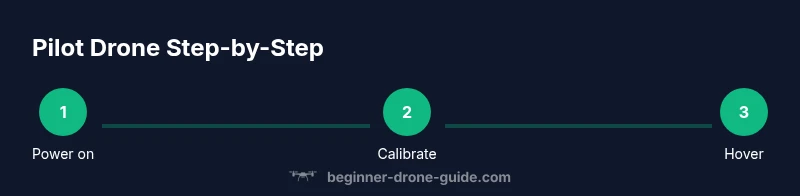
- 1
Power on and connect
Power on the drone and controller, then verify the link is established and stable. Confirm battery levels and sensor status before advancing.
Tip: Keep both devices within line of sight during this initial phase. - 2
Calibrate and check sensors
Run compass and IMU calibration if prompted, especially after a change in location. Confirm GPS lock or a stable indoor stabilization mode.
Tip: Calibrations should be done in a wide-open space away from metal objects. - 3
Check flight readiness
Verify that firmware is current, memory has space for logs, and propellers are secure. Review wind conditions and your planned area.
Tip: If any warning lights appear, pause and reassess before flight. - 4
Choose takeoff location
Move to a clear, open area with ample space and a flat surface. Remove obstacles and ensure no people are nearby.
Tip: Mark a visible landing zone so you can find it quickly. - 5
Lift-off and hover
Apply gentle throttle to lift the drone to a few feet, then stabilize in a hover. Check that altitude and position remain steady.
Tip: Keep small throttle adjustments to avoid sudden climbs. - 6
Practice basic moves
Gently push the stick to move in four directions and perform a 90-degree yaw to understand orientation.
Tip: Hold the drone at eye level and use a fixed reference point. - 7
Return to home test
If available, trigger Return-to-Home from a low altitude to ensure the feature works as expected in your environment.
Tip: Test at a low height before relying on it in emergencies. - 8
Land safely
Lower altitude gradually with smooth throttle control until the drone settles on the landing zone. Power down after touch-down.
Tip: Always have your landing zone clearly marked. - 9
Review and log
Document what went well and what needs practice. Review any camera or sensor data and note improvements for next session.
Tip: Keep a simple practice log for visible progress. - 10
Cool-down and storage
Power off, store batteries safely, and check for signs of wear after flight. Inspect props and frame for damage.
Tip: Cool-down helps prevent battery swelling and material fatigue.
Frequently Asked Questions
What is a pilot drone and how is it different from consumer drones?
A pilot drone is operated by an individual skilled in flying and managing flight controls, often used for practice, teaching, or more complex tasks. Consumer drones are designed for general use and may have simpler modes. The distinction is mainly about the operator's skill and the mission scope.
A pilot drone is operated by someone with focused flying skills, usually for learning or specific tasks, while consumer drones are built for casual use.
Do I need a license or registration to fly a drone in my area?
Regulations vary by country and region. In many places, basic registration or a knowledge test is required for certain operations, while other flights may be allowed under general guidelines. Always check local authorities before flying.
Rules vary by location; check your local aviation authority for the exact requirements before you fly.
What should I check before my first flight?
Before you fly, inspect the drone, controller, and batteries. Verify firmware is up to date, GPS or stabilization is available, and the flight area is safe and clear of people and obstacles. A preflight checklist helps ensure you don’t miss critical steps.
Do a quick check of hardware, software, and the flight area before you fly.
How high can I fly safely with a pilot drone?
Altitude limits depend on local rules and the drone’s capabilities. Start with low airspace and gradually increase as you learn, while always maintaining visual contact with the craft and following authority guidelines.
Keep it low at first and stay within the line of sight, following local rules.
What should I do if communication with the drone is lost?
If you lose connection, many drones hover or return to a home point. Attempt to re-establish the link if safe, and be prepared to perform a controlled landing. Never fly further than you can safely recover.
If you lose signal, rely on the drone's safety features and land safely.
What are common beginner mistakes to avoid?
Avoid flying in crowded areas, skipping preflight checks, and overestimating your abilities. Start with short sessions, practice basic maneuvers, and gradually add complexity as your confidence grows.
New pilots often skip checks or fly in risky areas—start small and safe.
Watch Video
Quick Summary
- Start in a safe, open area with simple maneuvers.
- Follow a consistent, repeatable practice routine.
- Learn and rehearse fail-safes before challenging conditions.
- Practice regularly and prioritize safety, per Beginner Drone Guide.