How to Drone in Breakpoint: A Practical Guide for Beginners
Learn to plan, configure, and fly drone missions with breakpoints or waypoints. This beginner-friendly guide covers tools, steps, safety, and real-world examples to master breakpoint missions.


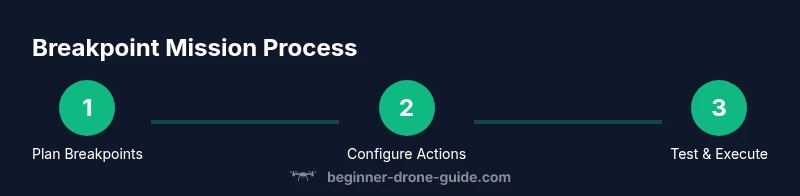
You can successfully execute a drone mission with defined breakpoints by planning each waypoint first, then configuring altitude, speed, and camera actions. Verify airspace, weather, battery, and GPS before launch, and test the breakpoint sequence in a safe area using your flight app. This guide shows you how to drone in breakpoint step by step.
How Breakpoints Shape Drone Missions
Breakpoints in drone missions are the building blocks of a well-executed flight plan. They allow you to segment a route into clearly defined moments where you can adjust altitude, speed, camera, or sensor settings. For beginners, thinking in terms of breakpoints reduces surprises and helps you verify each phase before proceeding. In many drone apps, breakpoints are implemented as waypoints, each with its own set of actions. If you are asking how to drone in breakpoint, start by identifying your mission objective and mapping out the key moments where you want to pause, hover, capture, or adjust. According to Beginner Drone Guide, breaking a mission into discrete milestones makes it easier to assess surface conditions, detect anomalies, and maintain situational awareness during flight. When you understand the role of breakpoints, you can anticipate data collection needs and tailor flight times to safety buffers. The idea is not to automate blindly but to curate a sequence that you can monitor and verify in real time. In practice, breakpoints translate to a simple rule: act deliberately at each stage, then verify you are ready to move on. This approach reduces cognitive load and helps you grow more confident in your flight planning skills.
Planning Breakpoints: The Groundwork
The core of any breakpoint-based mission starts with a solid plan. Begin by defining the overall objective—are you scouting terrain, capturing a sequence of photos, or inspecting infrastructure? Translate that objective into a chain of actionable moments spread across your route. For each breakpoint, specify: the exact GPS coordinates or survey area, the target altitude, the desired speed, and camera or sensor actions. Draft a rough map on paper or in a flight planner, then sanity-check it against local airspace rules. Remember, breakpoints are not set-and-forget; you will refine them as conditions change. According to Beginner Drone Guide’s analysis, a well-structured breakpoint plan reduces in-field guesswork and makes post-mission data easier to interpret. Use a safety margin—extend the altitude or slow down if visibility is reduced, and establish a contingency breakpoint for unexpected wind shifts. If you’re new to breakpoint missions, start with three to five simple breakpoints and gradually increase complexity as you gain confidence. This phased approach aligns with best practices for safe, responsible drone operation and helps you learn how to drone in breakpoint with less risk of surprises.
Defining Breakpoints: Waypoints, Altitude, and Actions
A breakpoint is essentially a waypoint with a tailored set of instructions. Each breakpoint should include the coordinates, a target altitude, a lateral or vertical speed, and one or more actions (photos, video, sensor scans, or data collection). The magic happens when you assign a purpose to each breakpoint—e.g., reach point A at 60 meters, hover for 5 seconds, take a panorama, then glide to point B. You’ll want to define a recovery breakpoint in case the drone drifts off course or loses signal. Keep breakpoints evenly spaced to prevent abrupt throttle changes and to maintain smooth footage. If a breakpoint involves camera work, pre-program the capture sequence to minimize jitter. How to implement this reliably? Test each breakpoint in a controlled environment and validate that your app executes commands in the intended order. The result is a dependable chain of moments that form a safe and effective mission anatomy.
Tools, Apps, and Data You'll Use
To execute breakpoint-based flights, you need reliable hardware and software. A GPS-enabled drone with a stable flight controller is essential. A tablet or smartphone with your flight planning app is typically used to set and edit breakpoints. You’ll also want spare batteries, a power bank for long sessions, and a reliable data storage method for mission logs and imagery. Use official apps from the drone manufacturer or trusted third-party flight planners that support waypoint missions. Maintain an up-to-date map base layer, include no-fly zones, and ensure you have permission to fly in the area. For beginners, record each breakpoint’s parameters in a simple notebook or digital document to avoid misconfigurations. Beginner Drone Guide emphasizes keeping a clean, testable breakpoint library you can reuse across missions and weather conditions.
Pre-Flight Checks and Safety Considerations
Safety is non-negotiable for breakpoint-driven flights. Before takeoff, confirm airspace permissions, weather suitability, and battery health. Ensure GPS lock is strong and test return-to-home behavior. Check propellers, motors, and firmware consistency across the drone and transmitter. Verify the mission plan in your flight app, paying attention to how breakpoints trigger actions and how the drone will react if a breakpoint fails. In many regions, recreational vs. commercial flight rules influence what you can do at each breakpoint, so review licensing requirements and local regulations. The key is to verify that the entire breakpoint sequence can be completed within your available battery margin and that you have a safe fallback plan for misalignment or wind gusts. This is where the practical value of a breakpoint-based plan shines: you know exactly when to land or switch to a safe backup strategy.
Executing the Mission: From Hookoff to Breakpoint Execution
With the plan loaded, perform a controlled takeoff and engage the breakpoint mission. Monitor real-time telemetry, maintain visual line-of-sight if required by your jurisdiction, and watch how the drone responds at each breakpoint. If a breakpoint demands a different altitude or speed due to terrain or lighting, adjust promptly and re-test the upcoming breakpoints. Use a low-pressure test flight to validate the first few breakpoints before proceeding to the full route. If you need to adjust mid-flight, apply discretionary breakpoints at safe points to maintain control and avoid destabilizing the mission. Keep your eyes on the battery gauge and set a conservative end breakpoint that triggers a safe landing if conditions deteriorate. Planning and disciplined execution are the essence of how to drone in breakpoint successfully.
Real-World Scenarios: Breakpoints in Practice
Breakpoints are especially useful in survey work, construction site monitoring, or environmental mapping. For example, you can set breakpoints to pause at critical survey locations for targeted imagery, while other breakpoints trigger faster passes over open ground for broader coverage. In agriculture, breakpoints help you switch from multispectral sensors to high-resolution imagery as you move along a field. Another scenario involves urban drone flights where you must navigate around tall buildings; breakpoints enable you to adjust altitude to maintain line-of-sight and avoid geofencing triggers. The practical benefit is a repeatable workflow: you know where the drone will be, what it will do, and how imagery or data will be captured at each moment. As you gain experience, you can tailor your breakpoint sequence for diverse missions, always prioritizing safety and regulatory compliance.
Troubleshooting Breakpoints: Common Issues and Fixes
Despite careful planning, issues can arise. GPS drift can shift a breakpoint position; if a breakpoint lands off-target, pause, re-lock GPS, and consider minor coordinate adjustments. Scene changes can require new breakpoint actions; update the plan and re-upload before continuing. If the drone fails to execute a breakpoint action, double-check the sequence order and ensure the trigger commands are properly assigned to the breakpoint. Power management problems often stem from underestimating battery use; integrate a buffer at the end breakpoint and avoid long, high-power camera sessions near the mission’s end. In many cases, practicing with a test breakpoint library helps you quickly identify and correct discrepancies. Finally, if you encounter regulatory or airspace warnings, pause the mission and reassess your plan.
Next Steps After Your Breakpoint Mission
After landing, review mission data to understand how each breakpoint performed and where you can improve. Export flight logs, images, and sensor data for post-flight analysis. Note any deviations from planned breakpoints and adjust your next mission accordingly. Share lessons learned with peers or the Beginner Drone Guide community to accelerate your progress. With each breakpoint mission you complete, your confidence and competence grow, and you’ll gain a better sense of how to drone in breakpoint under varying conditions.
Tools & Materials
- GPS-enabled drone(Supports waypoint missions and has reliable GNSS)
- Spare batteries and charger(At least 1 spare; consider 2 for longer sessions)
- Tablet or smartphone with flight planning app(Install official or trusted waypoint-capable apps)
- Data storage (microSD or internal)(For logs and imagery)
- Propeller guards (optional)(Useful for beginner practice)
- Laptop/notebook for breakpoint notes(Record settings and outcomes)
Steps
Estimated time: 60-90 minutes
- 1
Define mission and breakpoints
Identify the objective and segment the route into 3–5 clear breakpoints. For each breakpoint, specify coordinates, altitude, and actions (photos, video, sensor readings).
Tip: Start with a simple 3-breakpoint plan and gradually add more as you gain confidence. - 2
Configure the breakpoint plan in your flight app
Enter coordinates, set altitude and speed, and assign actions at each breakpoint. Enable fail-safes and ensure the sequence will complete within battery limits.
Tip: Test the sequence in a simulator or a safe open area first. - 3
Pre-flight safety and legality checks
Check airspace restrictions, weather, GPS lock, firmware status, and regulatory requirements for your location.
Tip: Have a contingency breakpoint for wind shifts and visibility drop. - 4
Perform a controlled test flight
Take off and run through the first 1–2 breakpoints at low altitude to verify timing and actions.
Tip: Observe how quickly actions execute and adjust as needed. - 5
Execute the full breakpoint mission
Fly through all breakpoints while monitoring telemetry and ensuring safety buffers are respected.
Tip: Be ready to abort and land if conditions degrade. - 6
Post-flight review and data export
Review logs, capture quality, and assess breakpoint performance. Export data for analysis.
Tip: Document lessons learned for future missions. - 7
Refine and replay
Update breakpoint parameters based on results and rehearse the plan in a controlled setting.
Tip: Incrementally increase complexity once comfort level rises.
Frequently Asked Questions
What is a breakpoint in a drone mission?
A breakpoint is a predefined waypoint with specific instructions for altitude, speed, and actions like photos or videos. Breakpoints help organize a mission into controllable segments, improving reliability and data quality.
A breakpoint is a planned waypoint with clear instructions for what the drone should do at that point.
Do I need a license to fly with breakpoints?
Licensing requirements depend on your location. In many regions, recreational and commercial drone rules apply, including Part 107-like rules in the US. Check local regulations before performing breakpoint missions.
Licensing depends on where you fly; always check local rules before breakpoint missions.
Which apps support breakpoint planning?
Most major drone brands provide apps that support waypoint and breakpoint planning. Some third-party planners also offer advanced breakpoint sequencing and data collection features.
Many drone apps support breakpoint planning, either from manufacturers or trusted third parties.
What safety checks should I perform before a breakpoint mission?
Check weather, airspace permissions, GPS lock, firmware status, battery health, and ensure there is a safe return path if a breakpoint fails. Confirm that each breakpoint has a clear action and abort plan.
Do weather and airspace checks, verify GPS, batteries, and a safe abort plan.
How can I recover from GPS loss at a breakpoint?
If GPS is lost, rely on fail-safe mechanisms like return-to-home or land in a safe area if possible. Do not rely on GPS-only guidance; switch to manual control if needed.
If GPS fails, use fail-safes and manual control to land safely.
Can breakpoints be dynamic during a mission?
Some flight planners allow inserting or adjusting breakpoints mid-flight, but this requires strong situational awareness and may increase risk. Use dynamic breakpoints only in controlled conditions.
Yes, but only in controlled setups and with caution.
Watch Video
Quick Summary
- Plan breakpoints before flight to structure the mission.
- Validate airspace, weather, and battery margins for safe execution.
- Test breakpoint actions in a safe environment first.
- Monitor telemetry and be ready to adapt at any breakpoint.
- Review data after flight to improve future breakpoint missions.