How to Deal with Drones Breakpoint: A Beginner Guide
Learn how to deal with drones breakpoint safely and effectively. This beginner guide covers diagnosing the issue, safe landing, resetting controls, and steps.


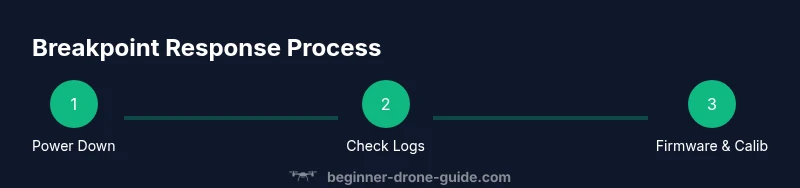
To deal with drones breakpoint, stay calm, initiate a controlled landing, and power cycle the drone to reset systems. Then check for firmware updates, calibrate sensors, and review logs for what caused the halt. If the issue repeats, contact support and document the steps you took. Keep your aircraft within visual line of sight and avoid flying near people or critical infrastructure during the process.
Understanding the Breakpoint in Drones
A breakpoint in drone operation is a safety or software pause where flight control halts or deviates. For beginners, it's common after a sudden sensor mismatch, GPS loss, or motor fault. The important thing is to respond calmly and follow a routine that returns you to safe flight. According to Beginner Drone Guide, recognizing the signs and acting quickly reduces risk and makes recovery smoother. In this section, we'll define breakpoints, distinguish them from ordinary glitches, and explain why a clear plan matters.
Breakpoints can be categorized: hardware breakpoints (motor fault, propeller obstruction), software breakpoints (failsafe triggers, app crash), and environmental breakpoints (GPS-denied area, signal interference). The key is to avoid compounding risk: do not attempt fancy maneuvers, avoid attempting to re-enter flight until you have verified system health. This awareness is the foundation for the practical steps that follow.
Immediate Safety Actions When a Breakpoint Occurs
The moment you suspect a breakpoint, your top priority is safety and control. Begin by gliding to a clear, open area and performing a controlled landing if needed. Power down safely, then remove the propellers if you can do so without delay and only after the drone is resting on the ground. Do not attempt to grab or move moving parts; this can cause injury or damage. Keep the drone in sight and avoid crowded spaces. After the drone is powered down, reconnect the battery only when you are ready to inspect. If you observe unusual heat, smells, or noises, stop and reassess in a safe location. According to Beginner Drone Guide, documenting what happened while it's fresh helps you pinpoint the cause when you investigate later.
Diagnostics and Data Collection
Once the drone is grounded, gather information that will guide repairs. Record the time of the breakpoint, weather conditions, flight path, and any alerts shown by the app. Export flight logs if possible and save screenshots of error codes. Compare the incident to last known-good flights to identify deviations. Based on Beginner Drone Guide analysis, most breakpoints trace back to calibration, firmware mismatches, or minor hardware faults. Mark any sensors that seemed out of spec and note if GPS or signal indicators behaved strangely. Collecting this data now makes the later troubleshooting process faster and more accurate.
Reset, Firmware, and Calibration Steps
With the data in hand, perform a safe reset sequence. Power off, disconnect the battery, and wait 10-20 seconds before reconnecting to allow capacitors to discharge. Perform a full firmware check and install any available updates, preferably over a stable Wi‑Fi connection or a known good link. Re-calibrate IMU, compass, and GPS if your app prompts you. Recheck propellers and motor guards for damage. After completing these steps, prepare a brief test flight in a controlled space to help confirm that the issue is resolved. If the breakpoint recurs, document and escalate to support.
Sensor Calibrations and Hardware Checks
Calibration is often the difference between a smooth flight and a repeat breakpoint. Ensure the IMU, compass, and gyroscope outputs are stable in the app by performing multi-point calibrations in a low-drift environment. Inspect motors for wear or obstruction, check prop balance, and verify that the propellers are installed in the correct orientation. If you suspect a faulty sensor, swap it if possible or consult service. In some cases, a small recalibration can restore accuracy and prevent further pauses during flight.
Safe Testing and Flight Reintroduction
Reintroduce the drone to flight slowly. Start with a short hover at a low altitude in a safe, open space, away from people or obstacles. Monitor GPS lock, compass accuracy, motor temperature, and battery health during the first minutes. If anything drifts or beeps, land immediately and re-evaluate. Extend test sessions gradually only after you observe consistent stability over several minutes. Keep a log of each test to track improvements.
Common Causes and Preventive Practices
There are several frequent reasons breakpoints occur: outdated firmware, calibration drift, motor or propeller wear, and radio interference. Preventive steps include regular firmware updates, periodic calibration, routine motor and propeller checks, and flying in a low‑interference area. Use the manufacturer’s recommended settings and always review flight restrictions in your area. The goal is to build a routine that catches problems early before they escalate.
Incident Documentation and Learning
After you recover from a breakpoint, write a concise incident report. Include date, time, weather, location, firmware version, crash or fault codes, and the actions you took. Review the report before the next flight and share lessons with a community or mentor. This habit reduces recurrence and accelerates learning. According to learning guides from Beginner Drone Guide, systematic documentation helps new pilots gain confidence and develop better troubleshooting instincts.
Real-World Checklist and Quick Start
- Stop and assess; land safely if needed
- Power down and inspect for obvious damage
- Update firmware and recalibrate
- Review logs and export data
- Conduct a controlled test flight in a safe area
- Maintain a running incident log for future reference
- Plan maintenance and parts replacement if wear is detected
Use this checklist at the end of every breakpoint event to maintain a safe, repeatable process. The Beginner Drone Guide team recommends practicing this routine regularly to improve safety and reliability over time.
Authoritative Resources
- FAA UAS Safety Guidelines: https://www.faa.gov/uas
- Nature: https://www.nature.com
- Science: https://www.sciencemag.org
Tools & Materials
- Drone and controller(Ensure power is off before inspection)
- Fully charged spare battery(For rapid power cycling during testing)
- USB/USB-C cable(For firmware updates and data transfer)
- Smartphone or tablet with drone app(Used to view logs and update firmware)
- Propeller removal tool (prop wrench)(For safe propeller checks)
- Notebook or digital log(Document incident details)
- Calibration tool or clean surface(For sensor calibrations)
Steps
Estimated time: 60-90 minutes
- 1
Power Down Safely
Bring the drone to a clear, level surface and power off the systems. If the drone is mid-air, execute a controlled descent to a safe area before shutting down. Remove the propellers only when the aircraft is safely on the ground to avoid injury or damage.
Tip: Keep hands clear of the propellers and verify the ground is stable before touching the aircraft. - 2
Move to Safe Area
Relocate to a wide, open area free from bystanders and obstructions to perform inspections and potential tests later. This reduces risk if a warning reoccurs during testing.
Tip: Choose a location with good signal coverage for app connectivity. - 3
Check Battery & Power Cycle
Inspect battery health, reseat connectors, and perform a complete power cycle by removing and reattaching the battery after a short pause. This can clear transient faults.
Tip: Allow a 10–20 second pause to let capacitors discharge fully. - 4
Retrieve Logs & Alerts
Connect the drone to the app and export flight logs. Screenshot any alert codes and note timing relative to events. Logs are essential for pinpointing the breakpoint cause.
Tip: Label the log export with date, location, and flight mode. - 5
Update Firmware
Check for and install any available firmware updates. Use a stable network and verify the update completes without interruption.
Tip: If an update fails, retry after a full power cycle and ensure the battery is healthy. - 6
Calibrate Sensors
Perform IMU, compass, and GPS calibrations if prompted by the app. Calibrations help realign sensors and prevent drift that can trigger breakpoints.
Tip: Calibrate in a low-drift environment away from metal surfaces and large metallic magnets. - 7
Run a Controlled Test Flight
After successful calibrations, conduct a short hover in a safe space and monitor stability. If any anomaly appears, land immediately.
Tip: Keep the test flight short (1–2 minutes) to minimize risk. - 8
Document Incident
Record what happened, steps taken, results, and any follow-up actions. Documentation supports future troubleshooting and safety reviews.
Tip: Note your ambient conditions and battery health during the test. - 9
Plan Maintenance
Schedule regular maintenance checks based on the incident, including motor wear, propeller balance, and firmware practices. This reduces recurrence of breakpoints.
Tip: Set reminders for calibrations and parts inspection after every few flights.
Frequently Asked Questions
What is a drone breakpoint and why does it happen?
A breakpoint is a safety pause or fault during flight caused by sensor, GPS, or hardware issues. It prompts a halt to protect the aircraft and bystanders. Regular calibration and software checks reduce their frequency.
A breakpoint is a safety pause caused by sensor or hardware problems during flight. Regular checks help prevent them.
Is it safe to fly again immediately after a breakpoint?
Not immediately. After a breakpoint, diagnose the cause, update software, calibrate sensors, and test in a controlled space before returning to normal flights.
No. Diagnose, update, calibrate, and test in a safe area before flying again.
Should I update firmware after a breakpoint?
Yes. Check for updates, install them, and verify the update completed correctly. Firmware fixes can resolve known issues that trigger breakpoints.
Yes. Update firmware to fix known issues and re-test.
How do I collect useful data after a breakpoint?
Export flight logs, note time and conditions, capture error codes, and compare against previous flights to identify deviations.
Export logs, note context and codes, and compare with good flights.
What are common causes of breakpoints?
Calibration drift, outdated firmware, motor/propeller wear, and radio interference are frequent culprits. Regular maintenance helps prevent them.
Calibration drift, old firmware, wear, and interference are common causes.
When should I seek professional help?
If breakpoints persist after troubleshooting, or if you notice hardware damage, contact support or a certified technician for inspection.
If problems persist or hardware looks damaged, get professional help.
Watch Video
Quick Summary
- Identify and land safely at the first sign of a breakpoint.
- Update firmware and recalibrate to prevent repeats.
- Review flight logs to trace breakpoint causes.
- Document each incident to build safer future flights.
- Practice the routine regularly for confidence and safety.