Drone Flying 101: Safe, Smart Tips for New Pilots Today
Beginner-friendly guide to drone flying with practical steps, safety habits, licensing basics, and real-world practice to fly smarter and safer.


With this guide, you will master drone flying safely and confidently by learning essential preflight checks, control basics, and situational awareness. You’ll practice in open, obstacle-free spaces, follow local regulations, and build a routine that reduces crashes and increases flight time. This quick roadmap sets you up for steady, responsible progress.
Introduction to drone flying
Drone flying opens up a world of exploration, creativity, and practical applications—from aerial photography to inspections and learning experiments. This guide is designed for beginners who want a solid foundation in safe, responsible piloting. According to Beginner Drone Guide, drone flying can be approachable for anyone who commits to structured practice and steady learning. The Beginner Drone Guide team found that novices who adopt a repeatable training routine tend to progress faster, build confidence, and reduce risky mistakes. In this section, you’ll learn why a deliberate start matters and how to frame your first practice sessions around safety, curiosity, and legality. We’ll also outline the essential mindset: stay within your skill level, fly in legal spaces, and keep the aircraft—and people around you—safe.
Why safe, gradual progress matters
Starting with small, controlled flights helps you learn the feel of the drone, how it responds to control inputs, and how weather and wind affect performance. A safe, patient approach reduces the chance of crashes and equipment damage, and it builds habit patterns that pay off as you tackle more complex tasks. As you practice, you’ll also develop better situational awareness—seeing potential hazards, judging distances, and planning smooth, predictable moves. Safety isn’t optional; it’s the foundation of every successful flight. In short: the safer your start, the bigger your gains later.
Setting expectations for your first months
Expect a learning curve, with several pleasant milestones: stable hover, gentle forward motion, and controlled turns. Real progress comes from consistent practice, reflection after each flight, and adapting to different environments. The Beginner Drone Guide team recommends keeping a flight log, noting what you tried, what worked, and what to adjust next time. With patience and persistence, you’ll move from hesitant jitters to confident, repeatable flights that you can showcase in videos or photos.
How to approach this guide (structure and mindset)
This article is organized to be practical and actionable. Each section offers concrete tips, checklists, and drills you can apply immediately. We emphasize risk awareness, airspace basics, and the skills that matter most for new pilots: stability, responsiveness, and smooth control. If you want a quick start, skip ahead to the step-by-step practice section and the preflight checklist, then return to the deeper explanations as you gain confidence. The goal is steady, incremental improvement that keeps you safe and excited about drone flying.
Real-world advantages of good fundamentals
Strong fundamentals help you capture better footage, complete small inspections, and enjoy longer, more relaxed flight sessions. Beginners who invest in the basics—proper calibration, consistent checks, and mindful flying—tend to experience fewer surprises and more reliable performance. This foundation also makes it easier to adapt to new drones and features in the future, so you’re set for ongoing growth in your piloting journey.
Tools & Materials
- Drone (entry-level model with stabilized flight modes)(Choose a model with GPS/GLONASS stabilization for easier learning)
- Remote controller(Make sure it pairs reliably with your drone and has a functional display or LEDs)
- Spare propellers(Have at least one complete spare set and a small toolkit)
- Fully charged batteries(Carry at least one extra battery for extended practice sessions)
- Propeller guards (optional but recommended for beginners)(Helps protect props during initial learning in indoor or tight spaces)
- Micro SD card or internal storage(For recording your practice flights and reviewing later)
Steps
Estimated time: 90-120 minutes
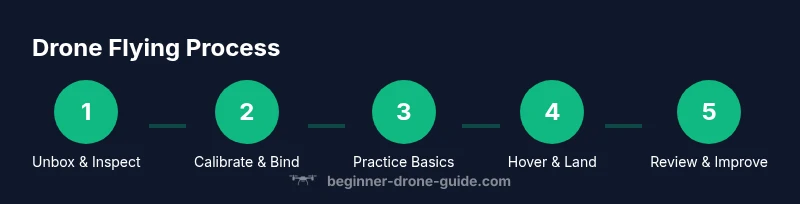
- 1
Unbox and inspect the drone
Carefully remove the drone, controller, and accessories. Check for any loose parts, damaged propellers, or loose screws. Confirm that the battery is compatible and securely seated. Visual inspection helps catch issues before you power up.
Tip: If you see any damage, don’t fly—consult the manual or the manufacturer’s support. - 2
Charge batteries and prepare the controller
Fully charge the drone and controller batteries before your first flight. This ensures consistent performance and avoids mid-flight power loss. Power up the controller and verify link indicators to confirm a solid connection.
Tip: Charge in a safe area away from distractions and allow fans to stay cool during charging. - 3
Attach propellers and bind the controller
Install the propellers correctly and follow the manual’s labeling (usually color-coded). Bind the controller to the drone so inputs are registered. Confirm that all lights indicate a healthy link before flight.
Tip: Double-check propeller orientation; reversed props can cause unstable flight. - 4
Calibrate compass and IMU (if required)
Follow the manufacturer’s calibration steps in a wide-open area away from metal structures. Calibration helps stabilize flight in various orientations and improves GPS performance.
Tip: Perform calibration on a level surface and re-check after any rough handling or a long flight. - 5
Power on and perform a tethered hover
Power the drone and allow it to hover at a low altitude while you verify stability. Use gentle stick inputs to test responsiveness and dampen any drifting.
Tip: If the drone drifts, perform a quick hover test again after ensuring calm air conditions. - 6
Practice basic ascent/descent and gentle turns
Gradually increase altitude with small throttle changes and practice slow, controlled turns. Focus on keeping the drone level and smooth, avoiding aggressive inputs.
Tip: Keep a light touch on the controls; tiny inputs go a long way when starting out. - 7
Introduce forward/backward and lateral movement
Move the drone forward and back, then left and right in short bursts. Monitor drift and make tiny adjustments to maintain position and orientation.
Tip: Use reference points on the ground to gauge distance and stability. - 8
Practice a controlled landing and power-down
Descend gradually to a gentle stop and switch off the motors safely. Post-flight, inspect for any wear and log any anomalies.
Tip: Never land abruptly; a soft landing helps preserve propellers and motor health. - 9
Review flight data and note improvements
Review footage or telemetry to identify areas for improvement. Update your flight log with observations and next-step goals.
Tip: Set small, specific targets for each session to stay focused and motivated. - 10
Plan safer next practice session
Choose a larger open space, check weather and airspace guidelines, and set a realistic practice plan for the next flight.
Tip: Avoid crowded areas and maintain visual line-of-sight at all times.
Frequently Asked Questions
Do I need a license to fly a drone?
Regulations vary by country; many places allow recreational flight without a formal license but require adherence to airspace rules and registration where applicable. For commercial work, more formal compliance is often required. Always check your local aviation authority’s guidance.
Regulations vary by country. For most recreational flights, a formal license isn’t required, but you must follow airspace rules and registration where applicable.
How high can I fly a drone as a beginner?
Altitude limits differ by jurisdiction. Always fly below the maximum allowed for your area and avoid restricted airspace. Start at low heights and gradually increase as you gain experience and confidence.
Altitude limits vary by where you live; keep flights low at first and stay clear of restricted areas.
What is the best beginner drone?
There isn’t a single best model; look for beginner-friendly features like stable GPS, beginner modes, good safety features, and reliable customer support. Choose a drone you can safely upgrade from without replacing core controls.
There isn’t one perfect beginner drone; pick a model with stable GPS and helpful safety features.
What preflight checks should I perform?
Perform a visual inspection, ensure batteries are charged, check propeller guards if used, verify camera and gimbal stability, bind the controller, calibrate sensors if required, and confirm a clear takeoff area.
Do a quick check of batteries, props, and sensors, then verify a clear area for takeoff.
How do I register a drone?
Registration requirements vary by country. In many places, powered aircraft require registration with the relevant aviation authority. Follow official guidance and complete any necessary documentation.
Registration rules differ—check your national aviation authority for current requirements.
What are common beginner mistakes to avoid?
Rushing takeoffs, ignoring wind and weather, flying in restricted areas, failing to perform preflight checks, and pushing the drone beyond your skill level. Build skills gradually and review flights to improve safely.
Avoid rushing, check weather, stay in legal areas, and practice gradually to improve safely.
How can I improve quickly without risking damage?
Use a dedicated practice schedule, fly in calm conditions, and review footage to detect small errors. Start in a large, empty space and gradually introduce complexity as your control becomes steadier.
Practice regularly in calm spaces and watch your footage to catch mistakes early.
What basic maintenance should I perform after flights?
Inspect propellers for chips or warps, clean dust from motors, check battery contacts, and store the drone in a safe, cool place. Document any issues for future reference.
After every flight, inspect props and clean the drone; store it safely and note any issues.
Watch Video
Quick Summary
- Master a calm preflight routine
- Practice in open spaces with clear boundaries
- Learn basic controls before advanced maneuvers
- Follow local rules and fly safely
- Maintain your drone and inspect props after every session