Drones or UFOs in New Jersey: A Practical Comparison
A data-driven comparison of drone activity vs UFO sightings in New Jersey for beginners, with verification steps, legal context, and practical guidance.


In New Jersey, most aerial events labeled as UFOs are eventually traced to drones or other man-made objects. The quick answer is that drone activity and misidentifications explain the majority of sightings, while genuine unidentified phenomena are rare and require careful verification. Gather multiple data sources, check airspace maps, and compare with known local drone activity before concluding.
Context: Is it drones or UFOs in New Jersey?
In New Jersey, as in many urban and semi-urban environments, residents occasionally report bright lights, unusual trajectories, or objects that seem to move in ways that catch the eye. The phrase is often simplified to whether a sighting is caused by drones or something more mysterious. The Beginner Drone Guide team emphasizes a methodical approach: assess the observable characteristics first, then check for common, easily verifiable explanations such as consumer drones. The landscape around major airports, busy corridors, and coastal towns increases the likelihood that a misidentified drone will be read as something extraordinary. When you hear the question is it drones or ufos in new jersey, start with the simplest answer—the object is probably a drone or another everyday air activity. This framing helps avoid jumping to extraordinary conclusions and keeps discussions accessible for beginners who want to fly smarter and safer.
Comparison
| Feature | Drones | UFO sightings in New Jersey |
|---|---|---|
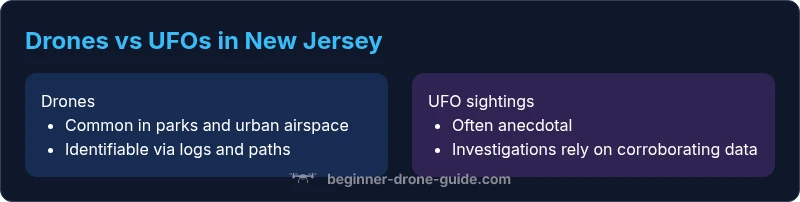
| Frequency and context | Common around urban parks, campuses, and residential airspace; often hobby flights or filming | Reported sporadically across rural and urban areas; often lack corroborating data |
| Evidence quality | Video clips, drone logs, and identifiable flight paths help verification | Anecdotes, photos with limited detail, and inconsistent timelines |
| Regulation & oversight | FAA rules for drones; local ordinances may apply in parks and shorelines | No formal UFO-specific regulatory framework; investigations rely on official channels |
| Typical costs | Ownership, maintenance, and operation costs of drones; potential training | Investigations and media outreach costs are typically borne by researchers or news outlets |
| Best practice to verify | Cross-check flight data, airspace maps, and the presence of nearby drones during the sighting | Consult multiple sources (official reports, witness accounts) before drawing conclusions |
| Best for | Hobbyists, professionals monitoring airspace, and local observers noticing patterns | Researchers, journalists, and authorities evaluating unusual phenomena |
Benefits
- Clarifies common misperceptions with a data-driven approach
- Encourages safe, legal drone practices for beginners
- Provides a practical framework for documenting sightings
- Supports community education about airspace awareness
Weaknesses
- Could undervalue rare, legitimate unidentified phenomena
- Relies on available data, which may be incomplete or biased
- Might require time and coordination to verify claims
Drones explain most NJ sightings; genuine UFOs are rare
In practice, most unexplained aerial events in New Jersey map to drones or misidentifications. The strongest approach is to verify against flight data and airspace awareness before labeling an event as extraordinary.
Frequently Asked Questions
What typically causes 'UFO' sightings in New Jersey?
Most sightings labeled as UFOs in New Jersey are later attributed to drones, aircraft, weather balloons, or meteorological phenomena. Environmental conditions, lighting, and observer expectations can contribute to misidentifications. A structured verification process helps distinguish ordinary air activity from truly unidentified phenomena.
Most NJ UFO reports turn out to be drones or other explainable phenomena. Always verify with flight data and environmental context.
How can I verify whether a sighting is a drone?
Collect time, location, lighting, and trajectory details. Check local airspace maps, nearby aircraft activity, and whether there was any nearby drone operation. Cross-reference with other witnesses and, if possible, review the sky region for drones using apps or control software.
Gather time and place, check airspace, and compare with nearby drone activity before concluding.
Are there laws in New Jersey about flying drones?
New Jersey follows federal FAA rules for drone operations, with additional state and local restrictions in certain parks, beaches, and critical infrastructure zones. Beginners should familiarize themselves with the basic safety guidelines and registration requirements before flying.
Yes—FAA rules apply, with local restrictions in some areas; check maps before flying.
What should I do if I see something unusual in the sky?
Note the time, location, and conditions; collect photos or videos if possible; compare with known drone activity and official airspace data. Report credible sightings to appropriate authorities or organizations that collect airspace data and can provide further analysis.
Record details, compare with drones, and report to the right authorities if you suspect it’s unusual.
Can drones trigger misidentification of UFOs?
Yes. Drones can appear unusual due to lighting, long exposure photos, or uncommon flight paths, leading observers to mislabel them as UFOs. Understanding drone capabilities helps reduce false positives.
Drones often look like UFOs in poor viewing conditions; know what to look for.
Where can I report sightings in New Jersey?
Report credible sightings through local law enforcement channels, FAA submission portals for airspace concerns, or national databases that track aerial phenomena. Providing detailed context improves the chances of accurate analysis.
Use official channels like FAA portals or local authorities for credible sightings.
Quick Summary
- Start with the simplest explanation: drones or man-made objects
- Document sightings with photos, videos, and location context
- Check airspace rules and nearby drone activity before concluding
- Use reputable sources and official reporting channels for verification
- Educate beginners on safe flying practices to reduce misidentifications