Is It Drone or Plane? A Practical Beginner Guide
A practical, beginner-friendly comparison that helps you distinguish drones from planes with real-world cues, safety tips, and regulatory context for 2026.


Is it drone or plane? The quick answer is: in most real-world sightings, small unmanned aircraft (drones) are slower, hover, and have distinctive rotor noise, while airplanes move faster, fly higher, and produce engine sounds. The 2 key cues are altitude and speed, plus rotor configuration versus fixed wings. For observers, recognizing these basics helps you stay within airspace rules and stay safe.
Context and Importance: Why the question matters when you’re new to the skies
According to Beginner Drone Guide, the question is not just academic; it shapes how you respond during busy airspace, how you observe safety cues, and how you stay compliant with local laws. When people ask, "is it drone or plane?", they are really trying to interpret a potentially complex visual signal using limited information. This guide is designed for the absolute beginner, focusing on practical cues you can verify from the ground, the air, and your own observations. By understanding the core differences, you’ll reduce misidentifications that could lead to unsafe maneuvers or regulatory trouble. The keyword is context: combine altitude, speed, profile, and noise to form a quick, reliable assessment rather than guessing based on one feature alone.
Core Differences at a Glance: Drones vs Planes in plain terms
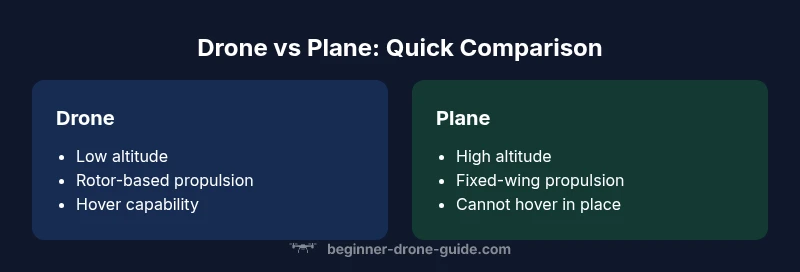
Drones are typically small, have multiple rotors (often 4, 6, or more), and operate at relatively low altitudes. Planes feature fixed wings and tail structures, high speeds, and flight patterns driven by aerodynamics rather than rotor thrust alone. From a distance, a drone’s silhouette often resembles a tiny helicopter or quadcopter with visible propellers, whereas a plane presents wings and a clear fuselage. Understanding these broad silhouettes can prevent premature conclusions. In practice, the most reliable cue is the combination of altitude and speed: drones stay within a few hundred feet of the ground and move more slowly; planes climb higher and accelerate quickly. This section also touches on the regulatory implications you should know before making any live judgments.
Real-Time Cues You Can Use: What to look for in the moment
Identifying whether you’re watching a drone or a plane comes down to a few practical checks. First, observe altitude: if you’re looking at something that is barely above treetop level, it’s more likely a drone. Next, estimate speed: a slow, controlled, hovering flight signals a drone; a rapid crossing or high-speed transit is more typical of a plane. Rotor configuration is another tell: drones typically show rotating propellers in a circular pattern, while planes exhibit wings with smooth, continuous propulsion from jet or prop-driven engines. Finally, consider maneuverability: drones can hover, tilt in place, and perform vertical takeoffs, while planes rely on forward motion for lift. Combine these cues with the sound profile described below to reach a robust assessment.
Visual Signatures: Size, shape, and rotor patterns you can spot
Drones often have a compact frame with visible rotors arranged around a square or circular body. Fixed-wing aircraft display elongated wings and a tapered fuselage, sometimes with a distinct tailplane. If you can see the rotor mechanics, you’re likely looking at a drone; if you see straight-line wings and a fuselage without exposed rotors, it’s more likely a plane. The camera orientation also matters: many consumer drones carry lightweight cameras on gimbals, while planes carry cameras or sensors for commercial ops only in specific contexts. In dim light, be mindful that small drones can appear to glide or hover in place due to rotor RPM changes. These subtle cues, when combined with speed estimates and altitude, dramatically improve identification accuracy.
Sound Signatures: What your ears tell you about the aircraft
Sound is a powerful, often underutilized cue. Drones generate a characteristic whirring from multiple small rotors; the pitch can vary with throttle, but you’ll hear a distinctive buzzing rather than an engine note. Planes produce aerodynamic or jet-like sounds depending on their propulsion system, and you may hear a more continuous, distant roar or a whine during takeoff. In quieter environments, these differences are more pronounced and can be used in tandem with visual cues to form a more reliable verdict.
Regulatory Context and Safe Practices: How rules shape what you should do
From a safety and legal perspective, distinguishing between a drone and a plane matters for airspace rules. In many jurisdictions, drones must be operated within hobbyist or commercial UAS frameworks with altitude and distance restrictions, while planes follow aviation rules and require air traffic coordination in controlled airspace. If you’re unsure, adopt a safety-first approach: maintain a prudent distance, avoid altering your course, and report any suspicious or unregistered activity to local authorities. When teaching beginners, we emphasize observing, not interfering, and using reputable sources to verify anything unusual.
Weather and Environment: How wind, light, and visibility affect identification
Weather can blur your perception. Strong winds can push drones to appear faster or farther than they are, while glare can obscure rotor visibility. Low light may make rotor blades hard to see, or mask the shape of the aircraft. Overcast skies can compress depth cues, making it harder to judge altitude and distance. In bright daylight, you’ll rely more on silhouette and rotor motion. Training yourself to account for environmental factors helps you improve your accuracy over time and reduces risky misidentifications.
Scenarios and Response: Common real-world situations and recommended actions
Consider scenarios like a park near a school or a rural airstrip near homes. If you observe a low, slow-moving object with rotating blades, it could be a drone; if you observe a fast, high-altitude aircraft, it’s likely a plane. In either case, remember to avoid approaching or attempting to intercept, maintain safe distance, and follow local reporting guidelines if something seems out of the ordinary. Practicing with a mentor or simulator can help you recognize patterns without risking safety.
Verification Steps When In Doubt: A practical 5-step checklist
- Note altitude, speed, and distance. 2) Look for rotor blades versus wings. 3) Listen for engine or rotor noise. 4) Compare against local airspace maps and NOTAMs. 5) If uncertainty persists, assume airspace rules apply and report to the appropriate authority or seek confirmation from a trusted source. This method minimizes risk while you build confidence.
Practice Exercises for Beginners: Build skill with safe, repeatable activities
Create simple, repeatable observation drills in a safe area. Time yourself watching a flight, then compare notes with a partner. Use a checklist to record altitude, speed, silhouette, and sound, and review after each session. Over time, you’ll develop a mental model that helps you classify aircraft quickly. The goal is not to police the skies, but to understand your environment and stay within legal and safety boundaries.
Authority and Further Reading: Where to learn more (and why it matters)
For authoritative guidance, consult regulatory bodies and peer-reviewed sources. FAA and equivalent aviation authorities publish user-friendly materials on aircraft identification and airspace rules. Universities and research institutions also offer practical safety courses for beginners that emphasize sensory cues, data-driven observations, and legal compliance. Our recommendations draw on a combination of official sources and practical, field-tested guidance from the Beginner Drone Guide team.
Comparison
| Feature | Consumer Drone (typical quadcopter) | Fixed-Wing Aircraft (plane) |
|---|---|---|
| Altitude Range | Typically up to a few hundred feet AGL, depending on local rules | Often several thousand feet AGL; capable of long-range flight |
| Speed | Moderate to slow, often under 60 mph depending on model | High speed, commonly 100+ mph depending on aircraft type |
| Visual Profile | Compact body with visible rotors; camera on a gimbal is common | Wings with a fuselage and tail; engines may be jet or prop-driven |
| Noise Signature | Rotor whirr; multi-rotor sound, varies with throttle | Engine or jet-like hum; continuous airframe noise |
| Regulatory Category | Typically under UAS/drone regulations; altitude limits apply | Subject to aviation regulations; requires airspace coordination in many zones |
| Typical Missions | Aerial photography, hobby flying, education, and training | Passenger and cargo transport, commercial flights, research |
| Detection Cues | Rotor visibility, shadow, hover capability, tail configuration | Wing shape, tailplane, and aerodynamic cues |
Benefits
- Improved safety awareness through rapid cues and observation
- Supports beginners in making informed, lawful judgments
- Promotes responsible behavior around airspace and crowds
- Builds foundational knowledge for future drone navigation
Weaknesses
- No single cue guarantees correct identification
- Environmental factors can obscure key signals
- Misidentification risks persist in busy airspace
Prioritize safety by identifying cues and following airspace rules
Differentiating drones from planes is a practical skill for beginners. Focus on altitude, speed, rotor vs wing signatures, and sound. When in doubt, assume airspace responsibility and seek official confirmation.
Frequently Asked Questions
How can I tell a drone from a plane in real time?
Use a combination of altitude, speed, and silhouette. Drones hover or move slowly with visible rotors, while planes fly higher and faster with fixed wings. Practice with a simple checklist to improve consistency.
In real time, look for altitude, rotor visibility, and speed to tell a drone from a plane, and always prioritize safety.
What are the legal obligations if I misidentify one?
Legal obligations vary by jurisdiction, but most places require you to avoid interfering with aircraft and to follow airspace rules. If unsure, report unusual activity to local authorities or aviation authorities.
If you’re unsure, follow airspace rules and report any suspicious activity to the proper authorities.
Are there sounds that differentiate drones and planes?
Yes. Drones usually produce a whirring rotor sound; planes produce jet or engine noises depending on propulsion. Sound is a helpful cue when combined with visuals.
Drones buzz from rotors; planes have engine sounds. Use both sound and sight to judge.
What should I do if I see an unidentified aircraft near me?
Maintain distance, do not attempt to intercept, and report to air traffic authorities or local law enforcement if it appears unsafe or suspicious.
Keep your distance and report to the relevant authorities if it seems unsafe.
Do hobby drones have to follow the same airspace rules as planes?
Not exactly the same; drones operate under UAS or drone-specific regulations, with altitude and distance limits. Planes follow broader aviation rules, especially in controlled airspace.
Drones follow UAS rules; planes follow aviation rules, especially near controlled airspace.
Can weather affect my ability to identify drones vs planes?
Yes. Wind, glare, and visibility can obscure rotor or wing signatures, making quick judgments harder. In poor conditions, rely more on standard procedures and safety margins.
Weather can blur cues; stay safe and follow standard procedures when visibility is poor.
What training helps beginners improve aircraft identification?
Structured courses on airspace rules, sensory observation, and safety practices help beginners improve identification accuracy. Look for official resources and practical exercises.
Enroll in beginner airspace and safety courses to sharpen your identification skills.
Where can I find authoritative guidance on drone identification?
Consult aviation authorities (like the FAA in the United States) and university safety programs for up-to-date, practical guidance. They publish checklists and recommended procedures.
See official aviation resources for reliable identification guidance.
Quick Summary
- Identify drones by rotor-based silhouettes and hovering behavior
- Planes show fixed wings and higher speeds; observe altitude first
- Use a simple 5-step verification checklist when unsure
- Always follow local airspace rules and safety protocols
- Practice with supervision and official training resources