How to Put Drone Mobile in Service Mode: A Beginner Guide
Learn how to safely put a drone into service mode for maintenance, calibration, and diagnostics. This beginner-friendly guide covers prerequisites, steps, safety checks, and safe exit.


By the end, you will know how to safely put a drone into service mode, why it’s needed for maintenance, and how to exit back to normal flight. This quick answer covers prerequisites, basic safety checks, firmware considerations, common prompts on popular models, and best practices to minimize risk while calibrating sensors, testing motors, and validating system health before return to operation.
What service mode is and when to use it
Service mode is a controlled state that temporarily suspends normal flight safeguards to allow maintenance tasks without the risk of accidental motor start or unstable sensor readings. For hobbyists and new pilots, this mode is essential when calibrating sensors, updating firmware, inspecting internal components, or testing a repair. Not every drone model uses the same entry method, so always consult the manufacturer’s guide for your specific model. According to Beginner Drone Guide, placing the drone in service mode enables safe maintenance and calibration without stray motors or sensors interfering with normal flight. By understanding when to use service mode and how it interacts with the drone’s safety systems, you reduce the risk of damage and keep your equipment reliable for future flights. This is not a substitute for proper training, but a careful, methodical approach to maintenance that helps you learn safely.
Why service mode matters for beginners
For beginners, service mode removes the automatic guardrails that usually prevent catastrophic failures during maintenance. It gives you direct access to sensors and actuators, allowing precise calibration and verification of component health. When used correctly, service mode helps you detect drift, misalignment, or degraded hardware before a flight, saving time and preventing accidental crashes. Beginner Drone Guide emphasizes that taking your time to understand model-specific procedures reduces risk and builds confidence. Always pair service-mode work with grounded expectations, a clean workspace, and a willingness to recheck every result.
Firmware and hardware prerequisites you should check
Before entering service mode, confirm your drone’s firmware version supports maintenance operations without triggering anti-tamper alerts. Ensure you have the correct USB or maintenance app, the right cables, and any required licensing or permissions from the manufacturer. Compatibility matters: a mismatch between firmware, app, and hardware can cause misreported sensors or failed diagnostics. The Beginner Drone Guide team recommends reading the model’s release notes and verifying that a recent calibration baseline exists before you begin. Having a backup of configuration data is also wise in case you need to revert changes quickly.
Legal and regulatory considerations to keep in mind
Maintenance work may be subject to local rules about modifying drone software or bypassing safety features. Always respect applicable laws and manufacturer terms of service. If you’re in a jurisdiction with mandatory licensing or registration, make sure you remain compliant before performing advanced diagnostics. The Beginner Drone Guide analysis shows that staying within allowed procedures reduces legal risk and helps you maintain a reputable practice as a beginner pilot. When in doubt, contact the manufacturer or a certified technician for guidance.
Model-specific notes and prompts you should expect
Every model has a unique path to enter service mode, and prompts may vary from a simple toggle to a multi-step sequence. Before you begin, locate the exact entry method in your user manual and note any required codes or button combinations. Some models require a power-cycle, others need a software prompt approval. If you encounter unfamiliar prompts, pause and consult the manufacturer’s documentation. From the perspectives of new pilots, documenting model-specifc prompts helps you build a reliable routine and reduces the chance of accidental exits during critical checks.
High-level overview of the steps to enter service mode
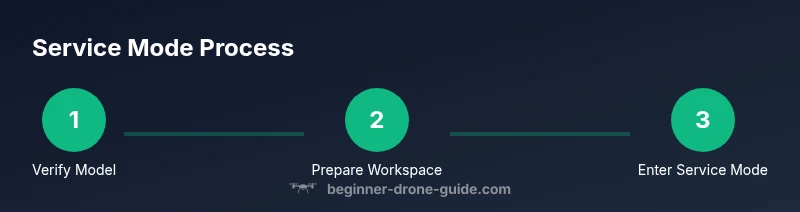
The following is a concept-level outline to orient you before you start the detailed steps in the dedicated STEP-BY-STEP component. First, verify the drone is powered off and on a stable surface. Next, establish a safe connection with the maintenance tool or app. Then, execute the model-specific sequence to place the drone into service mode. Finally, confirm you can access diagnostic menus and calibration options. The exact steps will vary by model, so always follow the manufacturer’s guidance alongside these general principles.
Calibrations you should perform while in service mode
Calibrations performed in service mode typically include IMU/gyroscope alignment, compass calibration away from metal interference, and sensor health checks for accelerometers and magnetometers. Some drones also offer calibration for the visual sensors and obstacle avoidance subsystem. Document each calibration outcome and note any drift in readings. Remember, calibration is not a one-size-fits-all task; adapt tests to your drone’s geometry, payload, and operating environment.
Diagnostics and sensor health checks to run
Within service mode, run a battery of diagnostics to verify sensor integrity and actuator response. Check motor windings, propeller balance, and ESC health. Confirm that readings from the IMU, barometer, GPS, and compass align with expected baselines. If any sensor reports unusual values or communication errors, pause maintenance and investigate hardware integrity. Keep your logs tidy; they’ll help you track improvements over time and simplify troubleshooting.
How to test motors and propellers safely
To test motors, secure the drone on a stable, inert surface and perform a controlled, low-power test to verify each motor spins in the correct direction and reaches the expected speed. Watch for abnormal vibrations, heat buildup, or unusual noises. Use the propeller guards if available and recheck the throttle response across the full range. After testing, ensure the power system is stable and there are no loose components before returning to service mode exit.
Exiting service mode and validating normal operation
Exit service mode only after you have completed all required calibrations and diagnostics and confirmed all systems operate normally in a standard flight profile. Reconnect any cables, reattach propellers per the manufacturer, and perform a cautious tethered test or a short, low-altitude hover. Validate GPS lock, stability, and sensor readings in flight-like conditions. The Beginner Drone Guide team recommends reviewing logs and confirming all safety features are enabled after you exit.
Common pitfalls and troubleshooting tips
A few frequent pitfalls include attempting maintenance without model-specific instructions, skipping ferrite or static precautions, or failing to re-check calibration after reassembly. If a diagnostic flag appears, consult the manual and verify wiring connections before proceeding. Keep a clear log of changes and avoid rushing. If you detect persistent issues, revert to a known-good baseline and retry the maintenance steps with fresh documentation.
Resources and aftercare for ongoing maintenance
Maintain a habit of periodic checks using service mode during scheduled maintenance windows. Create a checklist that includes firmware validation, calibration baselines, sensor health, and motor testing. Store logs securely and back them up. The Beginner Drone Guide team recommends building a personal library of model-specific maintenance notes so you can perform future work confidently and safely.
Tools & Materials
- Drone model manual(Exact model instructions for service mode.)
- Official service cable or approved maintenance app(Use manufacturer-supported tools if available.)
- Fully charged battery on a safe bench(Keep battery away from flammable materials.)
- Propeller removal tool or protective gloves(Optional if you plan to remove props.)
- Non-conductive mat or work surface(Prevents static discharge.)
- Small screwdriver set and tweezers(For minor disassembly.)
Steps
Estimated time: 40-75 minutes
- 1
Verify model supports service mode
Consult the official manual to confirm that service mode exists for your drone model and note any model-specific prerequisites. This ensures you don’t attempt a path that could bypass safety protections or cause damage.
Tip: If the manual lists alternate entry methods by firmware version, write down the exact sequence for your version. - 2
Power down and secure the drone
Place the drone on a flat, non-slip surface in a clean, well-lit area. Power down completely and disconnect the battery if permissible. Remove loose hardware that could shift during maintenance.
Tip: Use a magnetic mat to keep tiny screws from rolling away. - 3
Disconnect peripherals and remove props if advised
Detach any peripherals and remove the propellers if the manual recommends it. This minimizes the risk of accidental motor startup during maintenance.
Tip: Store screws in labeled containers to avoid misplacement. - 4
Connect to the maintenance tool or app
Set up the official maintenance connection according to the model (USB, Bluetooth, or app-based interface). Ensure your computer or tablet is trusted by the drone’s software.
Tip: Close other apps to reduce interference during data transfer. - 5
Enter service mode using the model-specific sequence
Follow the exact button sequence or menu path described in the manual to enter service mode. Do not skip steps or improvise; minor errors can leave the drone in an unusable state.
Tip: Pause and double-check each step before confirming the entry. - 6
Run initial health checks and calibrations
Access the diagnostic and calibration menus and perform IMU, compass, and sensor calibrations as appropriate for your model. Document the baseline readings for future reference.
Tip: Record before-and-after readings to gauge calibration quality. - 7
Document changes and preserve logs
Keep a clear log of all changes, calibrations, and firmware notes. This helps with troubleshooting and future maintenance.
Tip: Use a dedicated maintenance notebook or a digital log with timestamped entries. - 8
Exit service mode and validate normal operation
Exit the service mode sequence exactly as the manual prescribes. Reassemble components, reconnect power, and perform a cautious test hover to confirm stable behavior.
Tip: If anything feels off, revert to the baseline configuration and re-run diagnostics.
Frequently Asked Questions
What is service mode on a drone and why would I use it?
Service mode is a controlled state that allows maintenance tasks without triggering normal flight safeguards. Use it for calibration, diagnostics, and component inspection to ensure your drone remains safe and reliable.
Service mode is a safe maintenance state that lets you calibrate and diagnose your drone without it trying to fly.
Is service mode the same as a factory reset?
No. Service mode allows maintenance tasks while keeping user data and configurations intact. A factory reset restores default settings and erases custom configurations, which is a separate operation.
No, service mode is for maintenance; a factory reset restores defaults and clears custom settings.
Can I enter service mode on any drone?
Entry methods vary by model and firmware. Always consult the manufacturer’s documentation for your specific drone to avoid damaging hardware or voiding warranties.
Entry methods are model-specific, so check your manual before starting.
What should I do if service mode won’t enter?
Verify you followed the exact model-specific sequence, confirm firmware compatibility, and check for any required permissions. If problems persist, contact the manufacturer’s support.
If service mode won’t enter, double-check the steps and firmware compatibility, then contact support if needed.
How often should I use service mode during maintenance?
Use service mode as needed for maintenance tasks, not as a routine during normal flights. Regular calibrations can reduce drift and improve reliability.
Use it as needed for maintenance, not regularly during every flight.
Is service mode safe for beginners?
When done with care, model-specific instructions, and proper safety precautions, service mode is safe. Take time to learn the exact steps and never skip warnings.
Yes, with careful following of instructions and safety checks.
Watch Video
Quick Summary
- Understand service mode purpose and limitations.
- Follow model-specific entry steps exactly.
- Calibrate sensors and run diagnostics in a controlled environment.
- Document results and preserve safety settings post-maintenance.
- Exit service mode only after confirming normal operation.