Drone Fly Guide for Beginners: Safe, Practical Flight
Learn how to safely fly a drone as a beginner with practical preflight checks, licensing basics, flight modes, weather tips, and real-world flight guidance.


Learn how to safely perform a drone fly as a beginner by following practical preflight checks, basic controls, and essential safety rules. You’ll need a compliant drone, a charged battery, and access to open, obstacle-free space. This Beginner Drone Guide overview helps you fly smarter, safer, and with confidence.
What does 'drone fly' mean for beginners
For many newcomers, drone fly means more than taking selfies from the sky; it’s a process of learning to control a small aircraft safely and responsibly. In beginner terms, drone fly is the act of piloting a drone with steady hands, basic maneuvers, and awareness of your surroundings. There’s a big difference between simply powering on and flying with intention. A well-executed drone fly emphasizes safety, legal compliance, and comfortable handling of the aircraft in real-world environments.
According to Beginner Drone Guide, the core goal is to build confidence gradually through structured practice, starting with simple hover and slow moves in calm conditions. The term encompasses setting up your gear, understanding flight modes, and performing risk assessments before each session. For beginners, the most important outcomes are: stable takeoffs, controlled hover, precise turns, and safe landings. Always remember that your first flights shape your safety habits for years to come. The drone you fly is a learning tool; the skills you gain translate to better flights, fewer crashes, and more enjoyable aerial experiences. In this article, we’ll walk through practical steps, common pitfalls, and drills that pace progress while keeping safety front and center.
Before you power up, know the rules in your area: airspace restrictions, no-fly zones, and registration requirements. A thoughtful approach reduces risk to people, property, and bystanders and helps you build good flying habits from day one.
Tools & Materials
- Drone with stable GPS(Ensure it is beginner-friendly with prop guards.)
- Charged spare batteries(Carry at least 2 fully charged batteries.)
- Charger and cables(Use official charger or safe third-party.)
- Extra propellers (set of 2-4)(In case of wear or damage.)
- Controller/Remote(Pair with drone prior to flight.)
- MicroSD card (optional)(For video recording.)
- Sun shade or ND filter (optional)(For bright days.)
- User manual (region-specific)(Review basics and safety notes.)
- Safety gear (eye protection)(Helpful, not required.)
- Markers/cones for practice area(Defines a safe drill space.)
Steps
Estimated time: 60-90 minutes
- 1
Unbox and Inspect
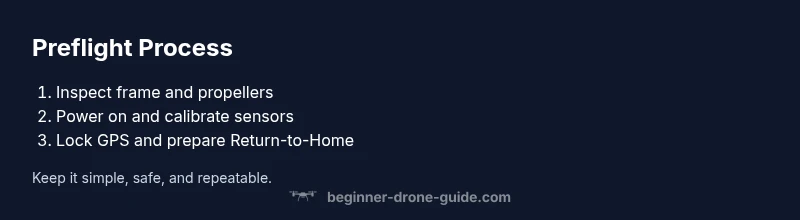
Unbox the drone, inspect the frame, blades, and battery for damage. Check for loose screws, cracks, or deformed propellers. Replace any damaged parts before powering on to prevent in-flight failures.
Tip: If you see any damage, don’t fly—swap parts and recheck before flight. - 2
Power On and Calibrate
Power on the transmitter and drone, then complete any required sensor calibrations in a calm, magnet-free area. Calibrate compass and IMU to reduce drift during hover and maneuvers.
Tip: Calibrate away from metal surfaces and electronics to avoid erroneous readings. - 3
Check GPS and Home Point
Ensure GPS satellites are locked and the aircraft has a stable home point if available. Enable Return-to-Home (RTH) settings only after confirming the feature is properly configured.
Tip: If GPS is flaky, stay in a wide open area and avoid complex paths. - 4
Hover and Gentle Hover Drills
Lift to a safe hover height (1.5–2.5 meters) and practice tiny roll/pitch corrections to keep the aircraft steady. Focus on smooth, deliberate movements rather than speed.
Tip: Use slow, small inputs to build muscle memory. - 5
Practice Basic Maneuvers
Perform forward, backward, and side-to-side movements at a slow pace. Maintain horizon reference and avoid chasing the aircraft with your eyes—watch the drone and the horizon together.
Tip: Look for drift and correct with small sticks rather than large inputs. - 6
Ascend, Descend, Land
Practice controlled climbs and descents, then execute a calm landing with gradual throttle reduction. Confirm area is clear of people or obstacles before landing.
Tip: Always land into a clear, safe zone to prevent runaway landings. - 7
Review and Reset
After the flight, inspect propellers and battery connectors for wear. Review video or notes to identify areas for improvement before your next session.
Tip: Keep a simple flight log to track progress and recurring issues.
Frequently Asked Questions
What is the best drone for a beginner?
A beginner-friendly drone with stable flight, beginner modes, protective guards, and easy takeoff/landing is ideal. Look for auto-hover and GPS stabilization to reduce complexity.
Choose a drone with stability features and simple modes to build confidence quickly.
Can I fly indoors?
Indoor flight is possible in large, empty spaces, but beginners should start outdoors to minimize collision risk and benefit from open air. Use prop guards if indoor use is necessary.
Yes, in big indoor spaces, but outdoor practice first builds confidence.
Do I need a license to fly a drone?
Regulations vary by country. Check your local aviation authority for recreational and commercial rules, including any registration requirements.
Regulations differ by country, so verify what applies where you fly.
How long does it take to learn to fly a drone?
Most beginners improve with regular practice over several weeks. Start with basic hover and small maneuvers, then gradually add complexity.
Progress comes with consistent practice; don’t rush into advanced maneuvers.
What should I do if a flight goes wrong?
If something feels off, land calmly, disconnect power if needed, and recheck controls, battery, and compass before the next flight.
Stay calm, land safely, then troubleshoot before trying again.
Is it safe to fly in windy conditions?
Wind can destabilize a drone. Avoid gusty conditions and fly at lower speeds when wind is present.
Strong winds make control harder—delay flights in gusty weather.
Watch Video
Quick Summary
- Learn preflight checks before every flight
- Maintain line of sight and safe distance
- Master basic controls and hover first
- Practice gradually with structured drills
- Inspect gear after each flight to prevent repeats of issues