Drone Flight Course: A Practical Guide for Beginners
A practical, beginner-friendly guide to selecting and succeeding in a drone flight course. Learn safety, rules, planning, and hands-on skills to fly with confidence.


A drone flight course is a structured program that teaches beginners the fundamentals of piloting, safety, and regulations. It blends theory with hands-on practice to help you fly confidently and legally. If you’re new to drones and want to minimize risk while maximizing learning, a formal course is the fastest path to competence. In this guide we’ll explore what to expect, how to choose a course, and how to apply what you learn to real-world flying. According to Beginner Drone Guide, the best starting point is a beginner-friendly course that emphasizes core skills, safety habits, and practical flight scenarios.
What is a drone flight course and who should take one
A drone flight course is a structured program designed to teach beginners the fundamentals of piloting, safety, and regulations. It blends theory with hands-on practice to help you fly confidently and legally. If you’re new to drones and want to minimize risk while maximizing learning, a formal course is the fastest path to competence. In this section we describe what makes a course valuable and who benefits most. According to Beginner Drone Guide, a solid starting point is a beginner-friendly course that emphasizes practical progression over generic theory. This ensures you gain real-world skills quickly and build a strong safety habit from day one. The course content is designed to be approachable for novices while still challenging enough to prevent bad habits from taking root.
How to choose a course: format, credentials, and outcomes
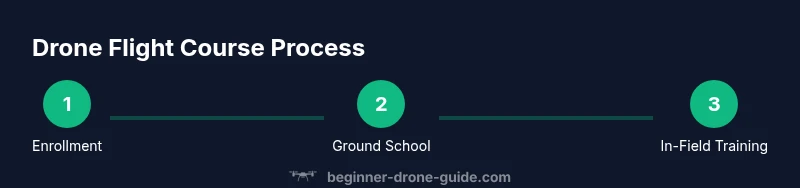
When selecting a drone flight course, look for a clear curriculum, recognized credentials, and measurable outcomes. Prefer courses that offer a mix of ground school, simulators, and real-world flights. Check whether the course aligns with licensing requirements in your region and whether a certificate or credential is awarded upon completion. Reading reviews and comparing tuition is smart, but ensure the content covers airspace rules, weather, maintenance, and emergency procedures. Beginner Drone Guide recommends prioritizing hands-on flight time and a structured progression rather than a single weekend of theory. Also consider whether the course is online, in-person, or hybrid, and ensure access to supportive instructors who respond promptly. This approach ensures you clearly see how the course will improve your practical skills and safety mindset.
Core topics covered in a beginner-friendly drone flight course
A solid beginner course should cover a core set of topics that build a stable foundation for safe flight. Key areas include: basic drone anatomy and controls; flight planning and risk assessment; weather considerations; airspace classes and legal requirements; flight restrictions and no-fly zones; maintenance checks; emergency procedures; sensor usage and obstacle avoidance; basic photography/videography if the drone has a camera; post-flight logging and analysis. Throughout these topics, practical exercises help you translate theory into action. As you progress, you’ll gain competency in stable hover, precise movements, and basic navigation, all while developing a safety mindset. This is where the drone flight course becomes central to your learning path. Beginner Drone Guide analysis shows that students who practice deliberately tend to retain skills longer and perform better under pressure.
Hands-on training vs. theory: balancing practice and classroom time
A well-rounded drone flight course balances instructional theory with ample hands-on flight time. Theory provides the rules, planning frameworks, and safety checklists, while practice translates those rules into muscle memory. Expect simulator sessions to build basic muscle memory before touching the real drone, followed by supervised outdoor flights in controlled environments. The most effective courses progressively increase flight complexity—from hover and basic maneuvers to more dynamic paths and simple QA-style challenges. The involvement of competent instructors helps you receive immediate feedback, accelerating learning and reducing the chance of developing unsafe habits. Practically, you should spend roughly half of your time in the air and half in guided discussion or sim labs.
Safety, legal considerations, and risk management
Drone flight safety is non-negotiable. Courses cover flight envelopes, obstacle avoidance, emergency procedures, and how to conduct risk assessments before every flight. You’ll learn about airspace restrictions, local regulations, and how to check NOTAMs or temporary flight restrictions as applicable in your area. A critical skill is pre-flight planning: reading weather signs, estimating wind effects, and deciding whether a mission is within your current capabilities. By mastering risk management, you reduce the likelihood of crashes or regulatory violations and protect people and property around your flights. This topic is essential for anyone pursuing professional or hobbyist drone work.
Equipment prerequisites and choosing your first drone
Starting with the right gear makes a big difference. Most beginners benefit from a cost-effective, reliable drone with stable flight and good safety features like prop guards, GPS stabilization, and return-to-home. You’ll also need a compatible controller, enough batteries, and a microSD card for flight recording. As you gain confidence, you can upgrade to a more capable model, but avoid overspending at the outset. Courses often require that you bring your own drone or provide one for shared practice; confirm with your provider what equipment is expected. Keeping a log of your flights helps track progress and plan future practice sessions.
Study strategies for practical tests and licensing prerequisites
Preparation for practical tests involves a steady rhythm of review, simulator practice, and real-world flights. Create a weekly practice plan that includes a warm-up, a structured flight sequence, and a debrief. Simulators can help you practice stall recovery, orientation, and complex maneuvers without risking damage to your drone. Licensing prerequisites vary by country, but most programs emphasize knowledge of airspace categories, weather, maintenance, and flight safety fundamentals. Use official syllabi, practice exams, and instructor feedback to identify gaps and target them with focused micro-skills sessions. Consistency trumps intensity when building long-term competence.
Practice planning: flight drills and progression ladders
Effective practice requires a plan. Start with a basic ladder: hover stability, then gentle forward/backward motion, then left/right strafing, followed by yaw turning and gentle altitude changes. Each drill should have a defined success criterion and a debrief step. Build complexity gradually by combining tasks, increasing wind tolerance, and introducing obstacles in a controlled setting. Track your times and accuracy to measure progress over weeks or months. A clear progression ladder helps you stay motivated and prevents stagnation.
Real-world applications after completing a course
Once you’ve completed a drone flight course, you can apply your skills to a wide range of real-world tasks. Hobbyists often pursue aerial photography, real estate shots, or event coverage, while aspiring professionals may seek freelance video work, surveying, inspection, or agricultural monitoring. Having a course-backed foundation makes it easier to pass licensing exams, comply with regulations, and communicate with clients about flight plans, safety measures, and delivery outcomes. Your next steps include building a portfolio, continuing practice, and exploring local opportunities for supervised flights or internships. The key is to keep flying legally and safely while expanding your practical capabilities.
Common mistakes and how to avoid them
New pilots frequently misjudge wind, misread airspace, or skip pre-flight checks. Others rely too much on automation and fail to maintain visual contact or situational awareness. To avoid these traps, establish a personal pre-flight checklist, practice hover accuracy in light wind, and always perform a second safety check before every mission. Never fly above your comfort zone, and always have a safe landing zone identified. Regular debriefs with an instructor or mentor can help identify repeating errors and turn them into actionable improvements.
Readiness to fly unsupervised: a self-check guide
Before flying solo, ensure you can execute a controlled takeoff, stable hover, straight-line flight, and precise landings in calm conditions. Confirm you know how to respond to unexpected behavior, such as motor vibration or GPS loss, and practice safe recovery procedures. Your self-check should include a weather review, airspace review, equipment inspection, and a defined mission plan. If any element feels uncertain, seek supervision or postpone the flight until you’ve reinforced the necessary skills.
Authority sources and recommended readings
For further reading and to verify information about drone safety and regulations, consider these sources. Official regulatory guidance can be found at the following links to government and academic outlets. These resources help you stay current on licensing, airspace rules, and best practices as you pursue more advanced drone work.
Tools & Materials
- Drone with basic safety features (GPS, stable flight, prop guards optional)(Choose a beginner-friendly model with beginner modes and safe landing options)
- Remote controller(Ensure compatibility with your drone and spare batteries)
- Spare propellers(Two pairs minimum; check for compatibility with your drone model)
- Memory card / storage(At least 32GB microSD card with reader for flight footage)
- Flight log notebook or digital log(Record date, weather, location, flight duration, and issues)
- Starter checklist and user manual (PDF)(Keep a copy for quick reference during practice)
- Prop guards (optional)(Helpful for indoor or beginner ground practice)
Steps
Estimated time: 2-3 hours
- 1
Power on and inspect
Power on the drone and controller, then perform a quick visual check of motors, props, and battery level. Confirm the firmware is up to date if possible and ensure no obvious signs of wear. This initial check prevents avoidable issues mid-flight.
Tip: Always start with a visual pre-flight inspection to catch loose parts before takeoff. - 2
Calibrate compass and IMU
Calibrate essential sensors according to the manufacturer’s instructions. A magnetometer/compass calibration helps with accurate navigation, while IMU calibration improves stability and reduces drift.
Tip: Perform calibration in an open area away from metal objects and large magnets. - 3
Power up and establish GPS lock
Turn on GPS mode and wait for a solid satellite lock. A stable GPS lock improves position hold and return-to-home reliability, especially in outdoor environments.
Tip: Be patient; rushed power-ups can lead to weak GPS signals and unstable hover. - 4
Run a pre-flight safety checklist
Check propellers for damage, verify battery levels, and confirm calibration results. Ensure your flight area is clear of people and obstacles and identify a safe takeoff/landing zone.
Tip: Use a standard, repeatable checklist to minimize misses. - 5
Arm motors and perform a gentle takeoff
With hands clear of the propellers, arm the motors and lift to a stable hover at a low altitude. Maintain a calm, steady stick input and avoid aggressive motions.
Tip: Keep flight at low altitude during early practice to minimize risk. - 6
Practice basic controls
Gently practice pitch, roll, and yaw to develop spatial awareness. Move in small increments and monitor how the drone responds to controller input.
Tip: Use slow, deliberate inputs to build muscle memory and precision. - 7
Introduce altitude changes
Gradually introduce climbs and descents, staying within visible range. Practice maintaining altitude and smooth vertical control.
Tip: Set a target hover height before shifting altitude to stay under control. - 8
Perform simple paths
Fly a simple square or triangle path to practice coordinated turns and consistent speed. Focus on keeping the drone level and predictable.
Tip: Plan your path on paper or a simulator before attempting it outdoors. - 9
Return-to-home and landing
Test automatic return-to-home (RTH) if available, but remain prepared to manually land if WiFi/GPS is compromised. Confirm landing alignment with the chosen zone.
Tip: Always designate a safe landing zone during practice. - 10
Record and review flights
Save flight footage and log your observations. Review footage to identify areas for improvement such as smoother transitions or tighter hover.
Tip: Keep a brief debrief after each session outlining 2-3 action items. - 11
Plan your next practice session
Set goals based on your last results and adjust the difficulty of drills. Schedule regular practice to maintain progress and prevent skill decay.
Tip: Progress slowly; consistency beats intensity over time. - 12
Prepare for formal coursework or certification
If you’re aiming for licensing or a formal credential, align your practice with the course syllabus and instructor feedback. Schedule the next course date or exam window and gather required documents.
Tip: Keep a copy of your completion records to simplify future certification.
Frequently Asked Questions
What is the difference between a drone flight course and a basic introductory workshop?
A drone flight course typically offers a structured curriculum with assessments and a credential upon completion, while a workshop is shorter, focuses on specific skills, and may not provide certification. Courses emphasize progression, safety, and practical application.
Courses provide structured learning with outcomes and potential certification; workshops are shorter and skill-focused.
Do I need a license to fly commercially after completing a course?
Licensing requirements vary by country. Many places require passing a knowledge exam or obtaining a certificate to operate commercially. Always verify local regulations and ensure your course aligns with licensing expectations.
Licensing depends on your location; check local rules and ensure your course aligns with them.
What equipment should I bring to a drone flight course?
Bring your own drone (or confirm provided equipment), spare batteries, a controller, memory card, and a flight log. A basic safety checklist and the course syllabus are also essential.
Bring your drone setup, batteries, memory card, and a logbook.
How long does a typical drone flight course take?
Most beginner courses span several weeks with a mix of in-class and practical sessions. Check the syllabus for weekly hours and total duration.
Most start with a few weeks of classes plus hands-on practice.
Are online courses as effective as in-person training?
Online courses can cover theory well, but hands-on flight time is crucial. Look for blended formats that combine virtual learning with supervised practice.
Online can teach theory; you still need practical flight time for real-world skill.
What is the best way to practice after finishing a course?
Continue with guided practice, maintain a flight log, and seek advanced modules or certifications. Regular, deliberate practice sustains skills learned in the course.
Keep practicing, log flights, and pursue advanced modules to stay sharp.
Watch Video
Quick Summary
- Define a clear learning path with a drone flight course as the foundation.
- Balance theory with hands-on practice for durable skill development.
- Prioritize safety, regulations, and pre-flight planning in every session.
- Use a progression ladder to steadily increase complexity.
- Document practice and reflect to accelerate improvement.