Can Drones Help Recover Deer in Illinois? A Beginner's Guide
Discover whether drones can help in deer recovery in Illinois, including regulatory requirements, safety considerations, and practical steps for beginners.


Using a drone to recover a deer in Illinois is not a one-size-fits-all task. It requires complying with FAA rules, state wildlife laws, and appropriate permits. This guide explains when drones can assist, the limitations, and how to work safely with wildlife authorities to help responders. Always contact IDNR and local authorities before attempting any drone-assisted wildlife recovery.
Wildlife and Search Tasks: What drones can (and can't) do
can you use drones to recover deer in illinois? This question underscores the need to understand both capabilities and limits. Drones can help locate deer over large areas using visual RGB cameras and thermal imaging, map terrain and movement patterns, and transmit real-time coordinates to ground responders. They are tools to improve situational awareness, not a substitute for trained wildlife handlers or veterinary care. Deer are sensitive to loud noises and sudden movements, so flight paths should be planned to minimize disturbance. In Illinois, successful drone-assisted deer recovery hinges on lawful use, careful planning, and strict adherence to animal welfare guidelines. Drones can extend search reach, cover inaccessible terrain, and document habitat conditions that influence recovery operations. Yet weather, daylight, cover density, and battery life limit effectiveness. Keep flights within permitted altitudes, avoid private property without permission, and coordinate with the local wildlife and law enforcement teams before starting.
Illinois Regulations at a Glance: Permits, restrictions, and wildlife protection laws
Navigating the legal landscape is essential before any drone-assisted wildlife work in Illinois. Operators should be fluent in FAA rules for commercial operations (Part 107 or relevant waivers) and in state wildlife regulations enforced by the Illinois Department of Natural Resources (IDNR). In practice this means obtaining the necessary permissions, avoiding disturbance to protected species, and coordinating with wildlife authorities when a deer is injured or distressed. Flying over roads, populated areas, or crowds may require additional approvals and risk assessments. Always verify whether a permit is required to conduct aerial searches on public or private land, and document the authorization status in your flight plan. The Beginner Drone Guide team emphasizes that legal compliance protects wildlife, the operator, and the public, and supports effective rescue outcomes by preventing delays caused by regulatory questions.
Technical capabilities: what drones can detect and how
Modern drones paired with appropriate sensors can detect heat signatures from deer at night or in shaded areas, thanks to thermal cameras. High-resolution RGB cameras support visual tracking during daylight, while mapping software helps create up-to-date field maps that show likely travel routes and habitat features. Sensor fusion, flight stability, and precise GPS positioning increase search efficiency, especially in rugged terrain. Realistic expectations: thermal contrast may be reduced by wind, moisture, or dense canopy, and small deer or copious undergrowth may be missed. Operators can use target-search patterns (grid, spiral, or orbit) to maximize coverage while preserving battery life. Always test sensors in a safe environment before field use, and ensure your flight plan includes contingency routes and a return-to-home threshold to protect the deer and the drone.
Before you try: risk assessment and safety concerns
This work involves live wildlife and potential property risks. Risks include startling deer, propeller hazards near people, property damage, and battery failures leading to uncontrolled landings. Weather, wind speed, and gusts influence stability and flight time, so postpone flights during poor conditions. Airspace conflicts and privacy concerns are also important factors. A thorough risk assessment should identify who is on the ground, who is in charge of communications, and how data will be shared with authorities. The Beginner Drone Guide team notes that the best outcomes come from working under the supervision of wildlife professionals and adhering to a documented emergency plan.
Best practices for search-and-recovery scenarios
Begin with a clear objective: locate the deer, assess distress, and communicate precise location data to responders. Use a pre-flight checklist, a safe takeoff area, and a visible ground spotter. Fly at conservative altitudes to minimize disturbance, maintain line of sight, and monitor battery levels closely. Use thermal imaging in low light to identify warm cues; switch to visual mode in bright daylight for confirmation. Record all data—capture coordinates, altitude, and time stamps—to share with responders. After flight, debrief with the team to refine procedures and update the flight plan.
Tools and gear that help a deer recovery operation
A field-ready kit includes a drone with a reliable thermal camera option, spare batteries, a portable charger, and a ground crew with two-way radios. Carry a weather-appropriate case, a first-aid kit, maps or GPS-enabled devices, and a basic camera for documentation. Insurance and a copy of any required permits should be readily accessible. A simple data logging setup helps preserve flight logs and evidence for authorities.
Ethical considerations and coordination with authorities
Wildlife-positive outcomes rely on ethical decision-making and strict adherence to regulations. Before every flight, confirm authorization with the IDNR and any landowners or land managers. Document how data will be handled, who has access, and how long recordings will be stored. Consider non-lethal, non-invasive methods first, and avoid actions that could cause additional stress or injury to the animal. When in doubt, pause operations and consult with wildlife professionals.
Real-world scenarios and hypothetical outcomes
In a typical field scenario, a drone can quickly cover rough terrain where ground teams would struggle, identifying potential escape routes or distressed deer locations. The data gathered—coordinates, visual cues, and thermal signatures—can accelerate a ground response and help responders position teams efficiently. However, even the best drones cannot substitute for trained wildlife rehabilitation staff or veterinarians, and their use should always be integrated with on-site expertise and regulatory compliance.
Tools & Materials
- Drone with thermal camera option(Ensure the camera supports enabled thermal sensing and calibration checks before field use.)
- Remote controller(Verify firmware, return-to-home settings, and obstacle avoidance are active.)
- Extra batteries and a charger(Have enough capacity for the planned search plus a conservative safety margin.)
- Ground spotter with two-way radio(Important for safety, coordination, and immediate ground feedback.)
- Maps or GPS-enabled device(Pre-load search area maps and coordinates, with offline backup.)
- First-aid kit and PPE(Essential for operator safety and wildlife handling precautions.)
- Permits/ID paperwork(Carry FAA license if required and IDNR wildlife-permit documents.)
- Protective case and rain cover(Optional but recommended for rugged field conditions.)
Steps
Estimated time: 60-120 minutes
- 1
Verify permissions and plan
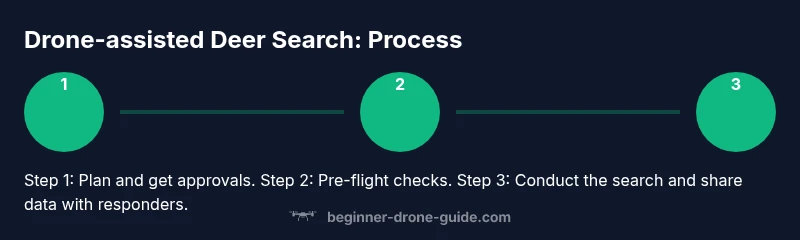
Before any flight, confirm FAA requirements and IDNR permits for the specific county and landowner. Identify the search area, set objectives, and outline a safe flight path, including retreat and return routes. Ensure ground teams are briefed and on standby for rapid handoff of information.
Tip: Have a designated ground liaison who communicates directly with responders and landowners. - 2
Perform a pre-flight check
Inspect the drone, sensors, gimbal, and batteries. Calibrate the compass, verify GPS lock, and confirm return-to-home is enabled. Check weather conditions and test hover in a safe area before approaching the target site.
Tip: Run a quick test hover to confirm stability and wind tolerance. - 3
Set up communication and safety measures
Establish a communication plan with your ground spotter and responders. Define roles, signals, and emergency procedures. Ensure you are always within line-of-sight and keep a safe distance from private property and roads.
Tip: Use a dedicated channel for wildlife-related updates. - 4
Execute the search with efficient patterns
Choose a search pattern (grid, spiral, or sweeping orbit) tailored to the terrain. Start with lower altitudes to maximize detail and gradually expand coverage as battery allows. Prioritize areas with thermal hotspots or visible movement.
Tip: Monitor battery level continuously and have a conservative abort point. - 5
Annotate findings and coordinate with responders
Capture precise coordinates, altitude, and time stamps for any deer signs. Share live updates with the ground team and mark areas of interest on the map. Use still images or short video clips to document conditions.
Tip: Keep data organized with consistent naming conventions. - 6
Assess deer condition remotely
Observe behavior from a safe distance and avoid approaching or attempting to move the deer. If injury or distress is evident, report immediately to wildlife authorities and follow their guidance.
Tip: Do not attempt physical contact or lifting via drone. - 7
Post-flight wrap-up
Download and back up flight data, review sensor performance, and log any wildlife disturbances. Debrief with the team to adjust procedures for future flights and update the flight plan if needed.
Tip: Document lessons learned for continual improvement.
Frequently Asked Questions
Is it legal to use a drone to locate deer in Illinois?
Legal use depends on FAA rules and IDNR permits. You must have the proper authorizations and conduct operations in a way that minimizes wildlife disturbance. Always coordinate with wildlife authorities before attempting any drone-assisted search.
In Illinois, you need the right FAA authorization and wildlife permits, and you should coordinate with authorities before using a drone for locating deer.
Can a drone physically rescue a deer in distress?
No. Drones are tools for locating and assessing the scene; they should not be used to lift or carry deer. Rescuing distressed wildlife should be performed by trained professionals.
Drones can't safely lift or transport deer; leave rescue to trained wildlife responders.
What training is needed to use drones for wildlife work?
Basic drone piloting knowledge, understanding of wildlife regulations, and safety procedures are essential. Additional coordination with wildlife authorities and on-site professionals is recommended.
You should have proper drone piloting training and coordinate with wildlife authorities.
What conditions maximize success for drone searches?
Clear weather, good visibility, and open terrain improve coverage. Use thermal imaging and plan for battery life; ensure you have a contingency plan.
Good weather and clear visibility help, and make sure you have enough battery life and a plan if things take longer than expected.
Who should you contact first in an emergency deer encounter?
Contact local wildlife authorities or IDNR, and follow their guidance. Do not delay contacting responders while you attempt to search.
Call wildlife authorities first and follow their instructions in an emergency.
Watch Video
Quick Summary
- Verify permissions before flight and plan thoroughly
- Use drones to locate, not capture, wildlife
- Coordinate with IDNR and FAA; comply with regulations
- Prioritize animal welfare and safety for all team members
- Document data for responders and authorities