Can You Track a DJI Drone If Stolen? A Practical Guide
Learn whether stolen DJI drones can be tracked, what steps to take, and how to maximize recoverability with beginner-friendly guidance and practical actions.


According to Beginner Drone Guide, can you track a stolen DJI drone? It depends on whether the drone is linked to your DJI account and has location services enabled. If active, you may see last-known coordinates in the app and alert authorities; however tracking is not guaranteed and depends on connectivity, power status, and applicable laws.
Understanding Tracking Possibilities for DJI Drones
Dji drones and many other consumer models can offer location-based assistance when they are tied to your account and have location services enabled. For a beginner, the core idea is simple: if the device is online, strapped to its charger, and periodically reporting telemetry to the cloud, you can potentially see where it was last active. If the drone is offline, powered off, or the battery has been removed, live tracking becomes impossible and you may only have flight logs or the last known location as clues. The Beginner Drone Guide team emphasizes that proactive setup before a theft dramatically improves your chances. By linking the drone to your account, enabling location reporting where available, and keeping your account protected with strong credentials and two-factor authentication, you create an affordance for recovery should misfortune strike. Remember that laws, privacy considerations, and the thief’s actions all influence what you can do after the fact. In many cases, law enforcement and insurance providers are involved, and cooperation with authorities is essential for a successful outcome.
What tracking features exist and how they work
Tracking features are typically tied to the manufacturer’s ecosystem and your account. If a drone supports location reporting, you’ll often see the drone’s last reported position on a map within the official app. Some ecosystems store recent flight logs, device health, and battery status, which can help establish ownership and a theft timeline. The usefulness hinges on three conditions: the drone remains online, it continues to communicate with the cloud, and you have access to the account holding ownership proof. As a result, you should not rely on tracking as a foolproof solution, but as a data point to corroborate your claim when working with authorities or insurers. The Beginner Drone Guide team notes that real-time tracking is rarely guaranteed once connectivity is broken, so prepare for a multi-channel recovery approach that includes police reports and insurance.
Preventive measures you should have in place
Preparation is your best defense. Before you fly, register your drone with the manufacturer and your local authorities if required. Enable any available location-sharing features and ensure your DJI (or other) account is secured with a strong password and two-factor authentication. Record key details such as the drone’s serial number, purchase receipt, and photos of the device. Maintain flight logs and backup data in a secure cloud or offline storage. If your drone is registered to your account and linked to a recovery service, you’ll have a better chance of locating it after a theft. This block also covers practical steps like setting up a notification system for unexpected device loss and keeping emergency contacts handy for reporting quickly.
Immediate actions after theft
If theft occurs, act quickly. First, confirm the loss and secure access to your account to prevent tampering. Immediately report the theft to local law enforcement with the drone’s serial number, last known location, flight logs, and any available footage. Notify your insurance provider if you have coverage and provide a copy of the police report. Check whether the manufacturer’s tracking features were enabled and whether the device connected to the cloud recently; if so, share any new location data with authorities. Document all actions you take and preserve evidence for later claims or investigations. Speed matters because the longer a thief operates the drone, the less likely it is to be recovered.
Recovery possibilities and realistic expectations
Recovery depends on several factors: whether the drone was online before the theft, how quickly authorities are notified, and the thief’s ability to stay disconnected. In many cases, recovery is contingent on prompt reporting, cooperation with the manufacturer and law enforcement, and the availability of accurate location data. Even when a drone is reported, real-time tracking is rarely guaranteed, and some cases end with recovery at a later date or even the drone not being recovered at all. The takeaway is to leverage every available channel—manufacturer account data, police support, insurance claims, and community awareness—to maximize the chance of recovery. The process can be lengthy, so prepare to endure a careful, documented effort rather than expecting an immediate resolution.
Authority sources and how to report
To strengthen your approach, consult official guidelines and best practices. The FAA’s UAS regulations and guidance establish the framework for drone operations and accountability; consumer privacy considerations are explored by federal agencies; and academic resources highlight the security implications of connected devices. For a starting point, you should review the following: 1) Official drone regulations and safety guidelines (FAA: https://www.faa.gov/uas); 2) Consumer privacy and data security considerations (FTC: https://www.ftc.gov); 3) Security and standardization research relevant to connected devices (NIST: https://www.nist.gov). These sources help clarify what you can and cannot do, and how to collaborate with authorities when a drone is stolen. Beyond official guidelines, track your drone’s history, keep comprehensive records, and document every action you take to bolster your case.
Additional considerations: privacy, data protection, and legal notes
When discussing tracking and reporting a stolen drone, respect privacy laws and ensure you are handling data lawfully. Do not share sensitive personal information beyond what is necessary for a police report or insurance claim. As you pursue recovery, maintain a careful balance between proactive tracking attempts and respecting the law. If you are unsure about the legality of certain actions (for example, remotely triggering a geofence or disabling a device mid-theft), seek guidance from authorities or the manufacturer to avoid liability. This final section reinforces that responsible, law-abiding behavior improves your chances of recovery while protecting your own rights and the rights of others.
Tools & Materials
- Drone serial number(Find on the drone body, in the original packaging, or in the maintenance records)
- DJI account credentials(Username, password, and access to two-factor authentication)
- Smartphone or tablet with internet(For accessing the app and locating the drone online)
- Proof of ownership(Purchase receipt, photos, or ownership documents)
- Police report forms(Prepare a theft report with serial, last seen location, and times)
- Insurance details(Policy number and coverage specifics for the drone)
- Flight logs / recent activity(Keep access to last flights and telemetry if available)
Steps
Estimated time: 1-2 days
- 1
Secure your accounts
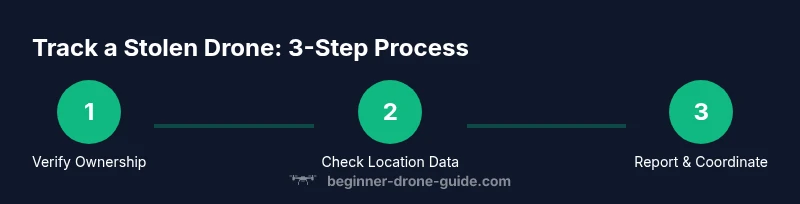
Immediately log into your DJI account and change passwords. Enable or verify two-factor authentication and remove access for any unknown devices. This helps prevent tampering and ensures you have integrity in any follow-up actions.
Tip: Do not reuse passwords across services; a compromised account could compromise other devices as well. - 2
Check for location data
Open the account app to look for last reported location or flight logs. Note the timestamp and coordinates, and capture screenshots for your police report. Do not attempt to retrieve the drone yourself in a risky situation.
Tip: Document every screen you view; this creates a solid trail for investigations. - 3
Contact authorities
File a police report with the serial number, last known location, and any pertinent flight logs. Provide the evidence you gathered so investigators can act quickly and accurately.
Tip: Ask for a case number and keep a copy of the report for your records. - 4
Notify your insurer
If you have drone insurance, file a claim and attach the police report and ownership documents. Insurance claims often require documentation of the theft and steps taken to recover the drone.
Tip: Include a timeline of events and the location data you collected. - 5
Coordinate with the manufacturer
If location services or loss prevention features were enabled, check whether the manufacturer can assist or view any location data (within privacy and policy constraints). Follow their guidance for next steps.
Tip: Do not rely on the manufacturer’s data alone; combine it with police and insurance procedures. - 6
Stay engaged with the recovery process
Monitor any updates from authorities or the manufacturer, and be prepared to provide additional documentation or interviews. Recovery can take time and may require multiple channels of communication.
Tip: Keep your records organized; you’ll need them if the drone is recovered or if you file a claim.
Frequently Asked Questions
Can a stolen DJI drone be tracked if it is powered off?
If the drone is powered off or the battery is removed, real-time tracking is unlikely. You may still rely on last-known location data and flight logs to support a report.
If the drone is powered off, real-time tracking is unlikely. Use last-known data and logs to work with authorities.
What information should I provide to the police?
Provide the drone’s serial number, purchase receipt, last known location, timestamps from flight logs, and any footage you have. Include your DJI account details and a copy of the police report.
Give the serial number, purchase proof, last location, and flight logs to the police with your report.
Do third-party tracking services help recover a stolen drone?
Third-party trackers may offer situational data, but recovery depends on manufacturer features and law enforcement. Rely on official channels and insurance as the primary path.
Third-party trackers can help only as a supplement; rely on manufacturer features and police for recovery.
Will tracking a stolen drone violate privacy laws?
Tracking within the manufacturer’s official tools and reporting to authorities typically stays within privacy laws. Avoid improper access to others' data and follow legal procedures.
Using official tools and reporting to authorities usually stays within privacy rules.
Should I contact DJI support after theft?
Yes. Contact DJI support to report the theft, verify any available locator data, and obtain guidance on next steps consistent with their policies.
Contact DJI support to report the theft and get guidance on next steps.
What practical steps maximize recovery chances?
Immediately report to authorities, secure your account, gather evidence, and inform your insurer. Use any manufacturer-provided location data and flight logs to triangulate the incident.
Report quickly, secure accounts, gather evidence, and use available location data to support recovery.
Watch Video
Quick Summary
- Take immediate action: report theft and secure your accounts
- Enable location and record-keeping features ahead of time
- Coordinate with authorities, insurer, and the manufacturer for recovery
- Understand that tracking is not guaranteed; prepare a multi-channel plan
- The Beginner Drone Guide team recommends proactive setup and prompt reporting