Who is Make Drone? A Beginner's Guide
Explore who makes drones, how makers differ across markets, and what to look for when choosing a drone maker. A practical, beginner-friendly overview that helps new pilots understand manufacturers, startups, and DIY contributors, with safety and regulatory context.


Who makes drones? In practical terms, drone makers are the designers and manufacturers who create the hardware, software, and integration that power each craft. The phrase 'who is make drone' often asks which firms or individuals build the devices used by hobbyists and professionals. According to Beginner Drone Guide, the landscape ranges from large multinational manufacturers to agile startups and DIY builders.
Who Makes Drones: A Practical Overview
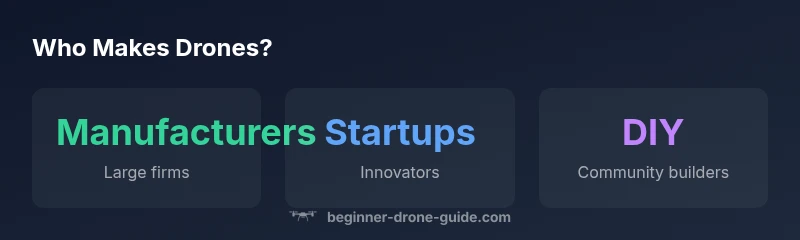
Drones aren’t built by a single person in isolation. The phrase "who is make drone" points to a spectrum of contributors who together bring a product from idea to flight. In this landscape, you’ll encounter three broad categories of makers: large multinational manufacturers that deliver scale and reliability; mid-size innovators that push niche capabilities; and DIY or community-based builders who remix hardware and software. According to Beginner Drone Guide, understanding these layers helps beginners assess quality, support, and warranty when selecting a drone. The most successful, beginner-friendly models usually come from teams that prioritize safety, easy setup, and clear documentation. For newcomers, it’s not just about the price but about how the maker supports you through the learning curve and beyond release.
The Roles: Designers, Manufacturers, and Integrators
A drone is not a single invention but a product of multiple disciplines working in concert. Designers map flight behavior, control logic, and user interfaces. Engineers source components—motors, sensors, batteries—and test assemblies for reliability. Manufacturers handle assembly lines, quality assurance, and cost control. Integrators tie everything together, ensuring software communicates with hardware, flight modes are intuitive, and safety protocols are enforced. The key takeaway for beginners is to look for makers who publish clear documentation, provide reliable software updates, and offer responsive customer support. When you read about who makes drones, remember that many devices are the result of cross-functional teams that span continents and years of development.
How Makers differ by Market Segment
Not all drones are made equal, and maker types align with market segments. Consumer drones aim for simplicity, portability, and short learning curves. Prosumer models balance performance with usability, often featuring higher-quality cameras and better flight times. Commercial and industrial drones are designed for specialized tasks such as surveying, inspection, or mapping, and they prioritize longevity, ruggedness, and service networks. Each segment tends to prefer different maker archetypes: big brands for reliability, nimble startups for innovation, and DIY communities for customization. For beginners, recognizing these segments helps set expectations about warranties, spare parts, and future upgrades. As you learn, you’ll notice that the best makers cultivate ecosystems—apps, plugins, and accessory lines—that help new pilots grow.
Core Technologies That Makers Use
Modern drone makers rely on a core set of technologies: flight controllers, GPS systems, obstacle-avoidance sensors, propulsion hardware, and robust batteries. The software stack typically includes flight control firmware, a ground control app, and mission-planning options. Communication protocols ensure safe control at range, while safety features like geofencing and emergency landing routines improve reliability. Makers also invest in packaging, manuals, and tutorials that help beginners understand calibration, updates, and maintenance. When evaluating a maker, prioritize those with transparent tech specs and demonstrable reliability rather than marketing gloss. Beginner Drone Guide notes that a solid maker will provide practical setup guides, quick-start tutorials, and a clear roadmap for future upgrades.
The Supply Chain: From Chips to Frame
Drones are assembled from a network of components sourced globally. Semiconductors, sensors, motors, frames, and batteries come from specialized suppliers. Successful makers manage this supply chain with redundancy, quality control, and traceability. The result is a product that performs consistently across different environments. For beginners, this means selecting a maker with readily available spare parts and a responsive service channel. The supply chain is also a reminder that the drone you buy today could be built from components sourced across multiple regions, underscoring the importance of robust after-sales support.
How to Assess a Maker's Credibility
Credibility comes from transparency, track record, and user feedback. Look for a maker with clear documentation: published safety guidelines, calibration procedures, and firmware release notes. Check for professional certifications in components or safety practices, and review independent test results when available. Warranty terms and return policies reveal confidence in the product. Community reputation matters too—read user experiences in forums, review sites, and official social channels. Remember to verify licensing and insurance requirements if you plan commercial use. The most credible makers emphasize safety, ongoing education, and user empowerment for beginners.
Common Pitfalls When Evaluating Drone Makers
Avoid marketing hype that promises extraordinary capabilities with minimal effort. Watch for vague specifications, unverified external links, and limited after-sales support. Beware makers who restrict access to firmware or force cloud-only features that require constant online connectivity. If a product seems too good to be true, it probably is. Always cross-check with independent sources and seek real-world demo videos or test flights. For beginners, the safest approach is to choose makers with robust educational resources, generous return policies, and a clearly defined upgrade path.
Real-world Examples of Maker Types
Consider three archetypes to understand the landscape: multinational manufacturers that provide broad product lines and global service networks; mid-size innovators that offer specialized capabilities like advanced mapping or long-range flight; and DIY communities that share open-source designs and customization options. Each type contributes differently to the ecosystem: large brands push safety standards and user-friendly software; startups drive niche innovations; DIY builders foster experimentation and learning. As a beginner, balance the advantages of dependable service with the opportunity to grow through customization and experimentation.
Licensing, Safety, and Compliance Considerations
Regardless of maker type, all pilots must respect local regulations governing flight, privacy, and airspace. In many regions, licensing or certification may be required for certain operations or payloads. Safety features—geo-fencing, failsafe modes, and controller redundancy—are fundamental from reputable makers. Ensure that you understand registration requirements, permitted flight zones, and mandatory maintenance. A responsible maker will help you navigate these rules, explain how to perform pre-flight checks, and provide access to up-to-date safety guidelines. As you learn, keep safety at the forefront and stay informed about evolving rules.
Overview of drone maker landscape
| Aspect | Notes | Examples (Generic) |
|---|---|---|
| Who makes drones | Designers, manufacturers, integrators | Large brands, startups, DIY groups |
| Market focus | Segment-based needs | Consumer, Prosumers, Commercial, Industrial |
| Key selection factors | Safety, support, & warranties | Clear docs, parts availability, easy calibration |
Frequently Asked Questions
Who are the main types of drone makers?
Drones are produced by large manufacturers, mid-size innovators, and DIY/community builders. Each group brings different strengths, from reliability and scale to customization and rapid experimentation.
Drones are mainly from big brands, startups, or DIY groups. Each type brings its own strengths.
Do large manufacturers dominate the market?
Large manufacturers do hold significant market share in consumer and commercial drones, but startups and DIY builders influence innovation and accessibility. The landscape varies by region and application.
Large brands are influential, but startups and DIY builders drive innovation.
What should a beginner look for in a drone maker?
Prioritize clear documentation, reliable firmware updates, strong customer support, and a transparent safety track record. A maker that offers onboarding resources and community support can ease the learning curve.
Look for good docs, updates, and support to help you learn safely.
Are DIY drones legal to fly?
DIY drones can be legal to fly, depending on local rules. Ensure you comply with registration, pilot responsibility, and privacy laws. Check geofencing and safety features offered by the maker.
DIY drones can be legal if you follow local rules and stay within safety guidelines.
How can I verify a maker's credibility?
Check official safety documentation, firmware release notes, and warranty terms. Read independent user reviews and look for educational resources that show ongoing support.
Read docs, reviews, and warranties to judge credibility.
What role do regulations play in maker choice?
Regulations shape what features are necessary, such as geofencing or licensing. A reputable maker helps you stay compliant through updated software and guidance.
Regulations influence features and compliance; choose a maker that keeps you compliant.
“Drones succeed when makers and users collaborate across scales—big brands, nimble startups, and community builders all push the tech forward.”
Quick Summary
- Identify your mission before picking a maker.
- Different market segments demand different maker types.
- Prioritize safety, support, and firmware updates.
- DIY options offer customization but require technical skills.
- Regulatory awareness matters for all makers.