History of Drones in India: Invention and Evolution
Explore the origins of unmanned aerial vehicles in India, when drone technology emerged, the milestones that shaped its progress, and practical guidance for beginner pilots navigating licensing, safety, and real-world use.


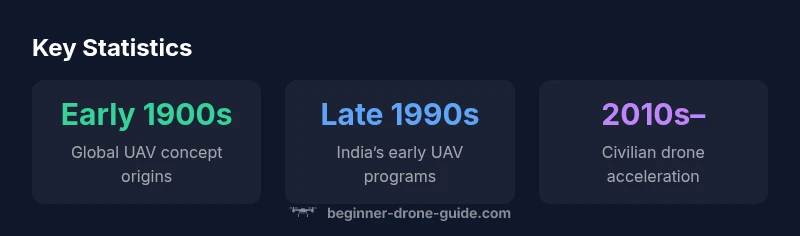
There isn’t a single invention date for drones in India. Unmanned aerial vehicles emerged globally in the early 20th century, with initial demonstrations abroad. India began serious drone development and adoption in the late 1990s and expanded through the 2000s and beyond, driven by defense, research institutions, and growing civilian use.
Historical arc: global origins and India’s entry
Drones, or unmanned aerial vehicles (UAVs), trace their conceptual roots to early aviation experiments and remotely piloted systems conducted in the first half of the 20th century. The widespread adoption of practical UAVs surged through the mid-20th century and into the 1980s and 1990s, with advances in sensors, autonomy, and telecommunication links. For India, there isn’t a singular moment of invention; instead, a progression of aerospace research, defense experimentation, and academic curiosity culminated in a more formalized drone ecosystem in the late 1990s. This period marks the shift from experimental showcases to structured programs that would enable broader civilian and commercial applications. The question often asked, when drone was invented in india, is better answered by looking at the stepwise development across institutions rather than a single inventor’s claim. The Beginner Drone Guide team emphasizes this nuanced history to help new pilots understand how India’s drone narrative fits into the global timeline.
Early experiments and academic interest
Across Indian universities and research institutes, early UAV projects focused on autonomous stabilization, lightweight airframes, and integrating sensors for mapping and surveillance. These projects often paired engineering curricula with real-world testing, using small-scale platforms to validate flight control software and telemetry. Students and faculty learned through iterative design cycles, sharing results in conferences and journals. This era laid the groundwork for more ambitious programs that would later attract government and industry partnerships. The emphasis was on safety, reliability, and the ability to operate in diverse Indian environments, from urban rooftops to rural corridors.
Military and defense integration
Defense research in India played a pivotal role in validating UAV technologies under demanding conditions. Early programs explored endurance, payload capacity, and robust navigation in challenging terrains. The transition from lab benches to field trials highlighted the need for stronger airframes, better propulsion, and secure data links. These milestones helped forge standards that would later influence civilian experiments and commercial pilots entering the market. The interlocking relationship between defense and academia accelerated the transfer of technological know-how, setting the stage for broader adoption in non-military contexts.
Civilian adoption and the rise of startups
Government initiatives to open civil airspace for non-military drones created a pathway for startups and research entities to experiment with delivery, agriculture, infrastructure inspection, and disaster response. Indian companies began tailoring platforms for local needs, emphasizing portability, cost-effectiveness, and user-friendly software. This era also spurred training programs and community networks for aspiring drone pilots, helping a broader audience access practical, hands-on learning. The result has been a more vibrant, diverse drone ecosystem that complements state-led programs.
Regulatory milestones shaping practice
Regulatory evolution has been central to India’s drone journey. Early advisories gradually evolved into formal licensing, registration, and operational frameworks designed to balance safety with innovation. Evolving policies addressed airspace permissions, flight restrictions, and company compliance, guiding hobbyists and commercial operators alike. For beginners, understanding the regulatory timeline helps in planning flights, obtaining necessary permissions, and staying compliant while exploring airspace responsibly. The regulatory landscape remains dynamic, reflecting technological advances and shifting risk assessments.
Case studies: institutions and initiatives driving progress
Several Indian institutions have run notable UAV programs that bridge theory and practice. Academic partnerships with industry consortia and government agencies have produced research-grade platforms and affordable kits for hands-on learning. Startups focusing on agriculture, site surveying, and cinematography have demonstrated how local needs can drive global competitiveness. These case studies illustrate the trajectory from classroom experiments to real-world deployments, underscoring the importance of mentorship, accessible tooling, and ethics in responsible drone usage.
Practical guidance for beginners: learning from history
For new pilots, history provides context for why certain rules exist and how to approach learning safely. Start with foundational topics such as basic flight dynamics, pre-flight checks, and local airspace rules. Practice with small, beginner-friendly platforms before progressing to more capable systems. Build a habit of documenting flights, understanding weather implications, and staying current with regulatory updates. Embracing the historical perspective helps novices fly smarter, safer, and with greater confidence.
Selected milestones in the global and Indian drone history
| Milestone | Approx Year | Notes |
|---|---|---|
| Global UAV concept origins | Early 1900s | Initial experiments abroad |
| India: academic UAV projects | Late 1990s | University-led development |
| Civilian airspace access | 2010s | Policy-driven usage growth |
| Domestic drone startups | 2010s–2020s | Applications expand across sectors |
Frequently Asked Questions
When did India start recognizing drones legally?
India began moving from advisories to formal licensing and registration in the 2010s, with ongoing updates to airspace rules. This progression created opportunities for hobbyists and commercial operators while emphasizing safety and accountability.
India began formal drone licensing and registration in the 2010s, with ongoing updates to airspace rules to balance safety and innovation.
Are there Indian-made drones and platforms?
Yes, Indian developers and startups have produced domestically designed drones for agriculture, surveying, and defense-adjacent applications. These efforts emphasize cost-efficiency, local supply chains, and compatibility with Indian regulatory workflows.
There are Indian-made drones for various civilian uses, focusing on affordability and local regulatory compatibility.
What is the current regulatory status for flying in India?
The regulatory framework centers on the DGCA, with requirements for registration, pilot licensing, and mission approval. Operators must follow safety protocols, maintain aircraft records, and obtain permissions for specific airspace and operations.
Regulations are overseen by the DGCA, requiring registration, licensing, and airspace permissions for many flights.
Why study the history of drones in India as a beginner?
Understanding the historical context helps you navigate current rules, avoid common safety gaps, and learn from real-world deployments. It provides a framework for responsible experimentation and informed decision-making.
History helps you fly safely and follow the rules with confidence.
How has India contributed to global drone technology?
India has contributed through academic research, defense-related development, and expanding civilian use cases, reflecting a growing ecosystem that collaborates with global suppliers and standards bodies.
India contributes through research, defense projects, and expanding civilian drone use.
Where can a beginner learn about licensing in India?
Begin with the DGCA’s guidelines and Digital Sky portals for licensing, registration, and airspace rules. Local UAV training programs and accredited courses can provide hands-on preparation.
Check the DGCA guidelines and Digital Sky portal for licensing and registration.
“Drones evolved as a global technology, and India’s contribution came through structured programs, education, and industry partnerships that turned curiosity into practice.”
Quick Summary
- Understand history through milestones, not a single invention date
- India’s drone ecosystem grew from academia to industry
- Regulatory evolution shapes safe, legal operations
- Begin with foundational skills before scaling to advanced platforms
- Learn from regional case studies to apply best practices